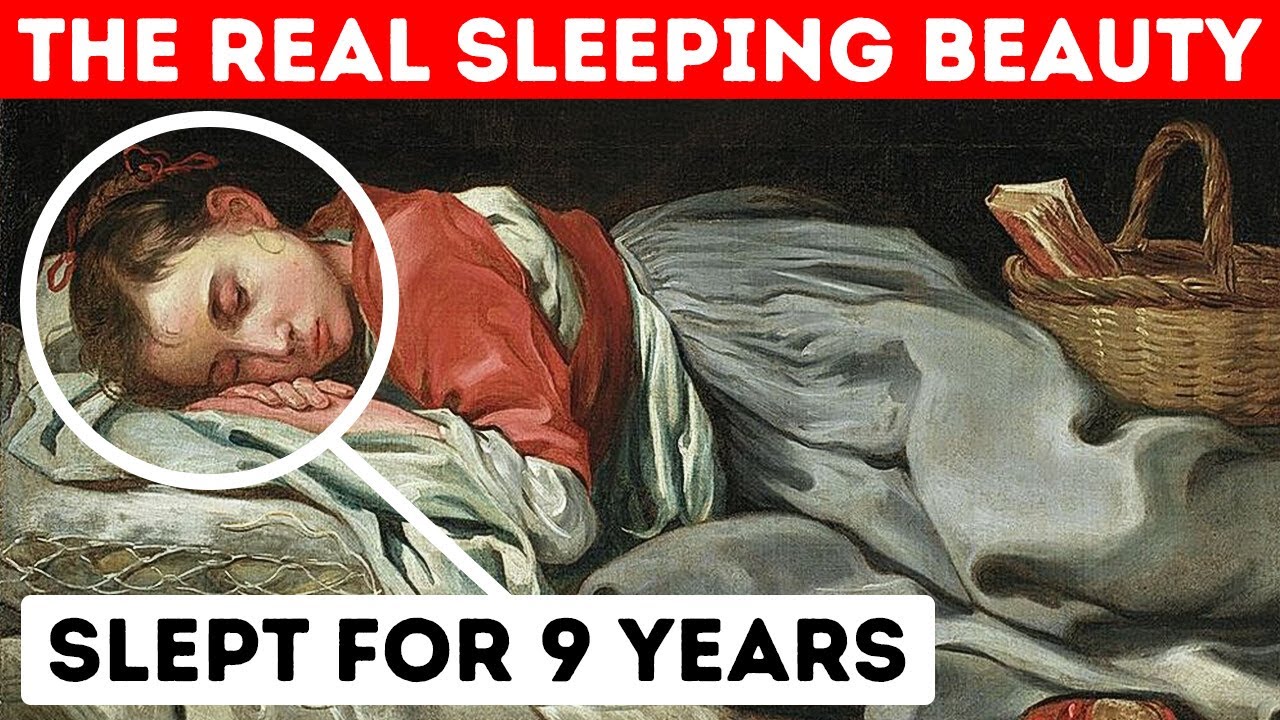
For more than a century, a story from the Buckinghamshire village of Turville has sounded like a fairy tale with a medical record hidden inside it. In 1871, an eleven-year-old girl named Ellen Sadler reportedly fell unconscious after a series of seizures and did not properly wake for more than nine years. Newspapers called her the “Sleeping Girl of Turville.” Visitors came to see her. Doctors argued over what they were seeing. And when Ellen finally regained consciousness, the central question remained: what had actually happened in that cottage?
The surname is sometimes written as “Sandler,” but the surviving local records identify her as Ellen Sadler. That correction matters because the case is already surrounded by retellings that blur dates, names and observations. The more carefully we follow the record, the stranger the story becomes—not because it proves a supernatural sleep, but because it preserves a genuine conflict between testimony, medical opinion and family control.
How did Ellen Sadler become the “Sleeping Girl”?
Ellen was born in Turville in 1859 into a large rural labouring family. When she was about eleven, she was sent to nearby Marlow to work as a nursemaid. There, according to later accounts, she began suffering bouts of extreme drowsiness and illness. A local doctor, Henry Hayman of Stokenchurch, recorded concerns about an abscess or glandular swelling at the back of her head and symptoms that suggested a serious neurological or spinal condition.
Keep exploring
Continue with Curiosmos
The family had little money, so the parish vicar helped arrange Ellen’s admission to a hospital in Reading. A family-history account based on local records says she spent roughly seven weeks there and returned home on 27 March 1871. Two days later, she suffered violent convulsions. Hayman arrived after the attacks and found her, in the family’s telling, unconscious and lying on her side.
From that point, the claim was extraordinary: Ellen did not move of her own accord or regain awareness for the next nine years, while her mother, Ann Frewen, cared for her at home. Even the dates vary in later retellings. Some reports place the beginning of the episode on 17 March, while other accounts follow Hayman’s later statement that the seizures came two days after Ellen’s return from hospital. That disagreement is a small warning about how much of the story depends on recollection and newspaper reports rather than a continuous clinical record.
What did visitors actually see?
Turville did not remain isolated from the story. Journalists, medical men and curious visitors travelled to the cottage. A Bucks Free Press reporter described Ellen lying on her left side, with regular breathing, warm skin and a rapid pulse. Her hands were thin and flexible, her body emaciated, and her feet and legs extremely cold. The description sounds like an observation, but it does not tell us whether Ellen was asleep, paralysed, intermittently conscious or being presented under carefully controlled conditions.
Feeding created another mystery. The family said Ann gave Ellen port wine, tea and milk three times a day. After Ellen’s jaw reportedly locked, liquid was poured through the gap left by a broken tooth using a small teapot. Those details were repeated by doctors and newspapers, yet no modern examination can test how much nourishment Ellen received, how often she was moved, or what happened when no visitor was present.
That is the point at which the case becomes more than an old curiosity. It is a record of what people claimed to witness—and of what nobody was allowed to observe continuously.
Why did people suspect a hoax?
Some visitors were convinced that Ellen was genuinely ill. Hayman later said that he had made unannounced visits and never found her in a different position. The vicar of Turville also made surprise visits, although he believed Ellen was conscious. Other observers were far less certain.
Ann Frewen controlled access to the room and sometimes told visitors that Ellen was not ready to be seen. She permitted what were described as “fair tests,” but refused to let doctors or nurses remain with Ellen for an extended period. She also rejected proposals to move the girl to a London hospital. Neighbours claimed they had seen Ellen sitting at the window at night. Meanwhile, visitors’ donations and the sale of locks of hair gave the family a financial reason to keep the mystery alive.
None of this proves that the illness was fabricated. It does show why the evidence never settled the matter. Hayman believed Ellen was paralysed and unconscious. The vicar thought she was conscious. The family supplied the daily-care story, while outsiders were allowed only brief glimpses. Every side of the argument rested on incomplete access.
What changed after Ellen’s mother died?
Ann Frewen died in May 1880. Her death forced the local authorities to confront a practical question that the legend usually skips: who was caring for Ellen, and how was she being kept alive?
At the inquest, Ellen’s stepfather, Thomas Frewen, gave evasive answers when the coroner asked about feeding. The coroner was especially interested in the amount of port wine Ellen received. Doctor Hayman repeated his belief that her condition was genuine, while the vicar offered his own doubts without a clear explanation. The coroner ultimately placed Ellen in the care of her married sisters, Elizabeth Stacey and Grace Blackall, who could provide constant attention.
In October 1880, Ellen regained consciousness. By November, local reports said she had recovered remarkably well. She remembered her childhood but reportedly had no memory of the years spent in bed. Her only lasting physical problems were described as slight shortness of stature and a weak eye. In 1886 she married Mark Blackall, and census records later place the couple in Berkshire and Oxfordshire. They had at least five children.
Could someone really sleep for nine years?
No diagnosis can be made from the surviving accounts. A modern doctor might consider disorders of consciousness, catatonia, severe neurological disease, drugging or a pattern of intermittent awareness. But those possibilities cannot be retrofitted into a Victorian case without examinations, records and independent observation.
The phrase “slept for nine years” may therefore hide several different realities. Ellen may have spent long periods unresponsive. She may have been conscious at times but unable to communicate. The family may have misunderstood, embellished or deliberately staged parts of the story. Or an illness unknown to the doctors of the period may have produced a state that later generations could only describe as sleep.
What if the most important discovery is not a solution but the shape of the uncertainty? The case gives us a village, a doctor, an inquest, newspaper witnesses and later census records. It also gives us missing hours, conflicting testimony and no reliable account of what happened behind the closed door. That is why Ellen Sadler’s story still belongs in the Curiosmos archive of unsolved mysteries: the unanswered question is not simply how long she slept, but how much of the story anyone was ever able to see.
Sources and further reading
- Rebecca J. Gurney, “The Sleeping Girl of Turville,” Origins, Buckinghamshire Family History Society, June 2007: local records, newspaper references and census research.
- Henry Hayman, “Annotations: The Sleeping Girl of Turville,” The Lancet 114 (1880), pp. 923: archival journal record.
- “Medical Annotations: The Turville Trance Case,” The Lancet 101 (1873), pp. 352–353: archival journal record.
- Explore more reported mysteries in the Curiosmos Unsolved Mysteries archive.