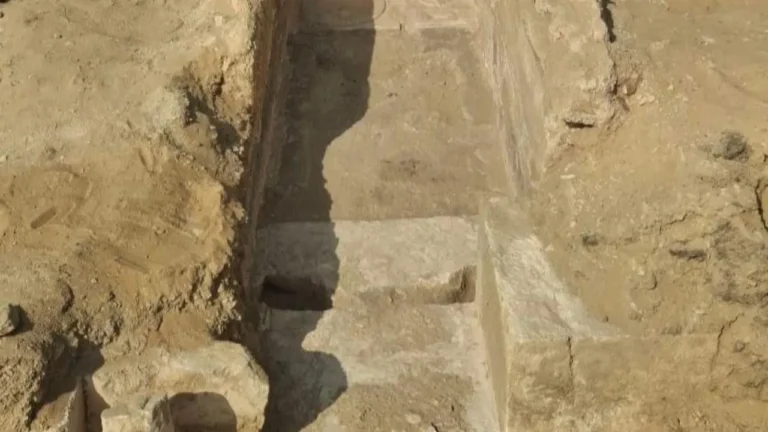
In the sweltering heat of 1850, renowned French Egyptologist Auguste Mariette embarked on a monumental expedition, driven by a desire to enrich the collections of the Louvre Museum in Paris. His journey took an unexpected turn when he stumbled upon a peculiar protrusion in the sands of Saqqara, not far from where the first pyramid of Egypt was built. This curiosity led Mariette to unearth what would soon be recognized as one of Egypt’s most enigmatic discoveries: the entrance to the underground Serapeum. The use of explosives revealed a vast tomb complex, hidden beneath the desert for millennia, sparking intrigue and mystery in the academic world.
The Enigmatic Sarcophagi
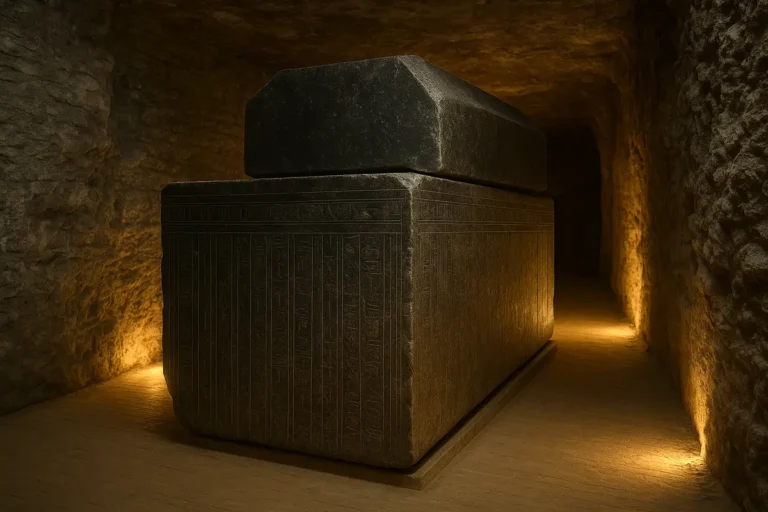
Buried under the vast desert were not just corridors, but a 790-foot-long subterranean passage, a hidden world carved into the limestone bedrock. Lining this passage were alcoves, each housing a colossal stone sarcophagus. These weren’t ordinary burial containers; each one was an engineering marvel, approximately 13 feet long, 7.5 feet wide, and towering over 10 feet tall. Weighing an astonishing 70 to 100 tons, with their lids alone weighing about 25 tons, these granite behemoths presented a puzzle: how were these massive structures transported and maneuvered into place by the ancient Egyptians? This question remains one of the most perplexing unsolved mysteries of ancient engineering.
The Apis Bull and Mystical Theories

While mainstream Egyptologists predominantly endorse the theory that these sarcophagi were designed for the sacred Apis bulls, an animal embodiment of the god Osiris, this explanation is not without its detractors. The discovery of just one tomb with animal remains casts a shadow of doubt over this theory. The Apis bull was not merely an animal but a divine symbol, believed to be a terrestrial messenger of the gods. Myths recount the divine birth of the first Apis, born from a cow touched by a heavenly beam of light. This celestial connection fuels speculation about the sarcophagi’s purpose, perhaps as a bridge between the earthly realm and the stars.
What Egypt’s antiquities ministry records
Egypt’s Ministry of Tourism and Antiquities describes the Serapeum as two long corridors and dates its use as a burial place for Apis bulls from the reign of Amenhotep III in the New Kingdom through the Ptolemaic Period. The bulls were linked to Ptah, the god of nearby Memphis; only one Apis lived at a time, and its death was followed by an honoured burial and the search for a successor. The ministry also records offerings there by Ramesses II’s sons Khaemwaset and Merenptah, high priests of Ptah. Saqqara itself was a royal cemetery from Egypt’s earliest dynasties, and Djoser’s Third Dynasty Step Pyramid stands nearby.
The Debate over the Age of the Serapeum
The enigma deepens when delving into the age of the Serapeum. Ancient chroniclers like Herodotus, Strabo, and Eusebius spoke of Egypt’s Golden Age, a time shrouded in myth and legend, possibly dating back as far as 10,500 BC. This era, supposedly a time when deities and mortals coexisted, tantalizes researchers with the possibility that the Serapeum could be a remnant from this mystical epoch. However, the scientific community remains skeptical, often refuting such ancient timelines. This ongoing debate highlights the chasm between traditional archaeological interpretations and more speculative historical theories.
Beyond Mainstream Beliefs
The discovery of mostly empty sarcophagi in the Serapeum has given rise to a myriad of alternative theories. These hypotheses, often sidelined by mainstream academia, suggest that the sarcophagi served a purpose far more complex than mere animal burial. Some theorists propose that their colossal size and intricate construction point to a function beyond our current understanding, possibly relating to ancient astronomical practices or even lost technological knowledge. The refusal of mainstream science to entertain these possibilities only adds to the Serapeum’s aura of mystery, making it a source of endless fascination and speculation.
Have something to add? Visit Curiosmos on Facebook. Join the discussion in our mobile Telegram group