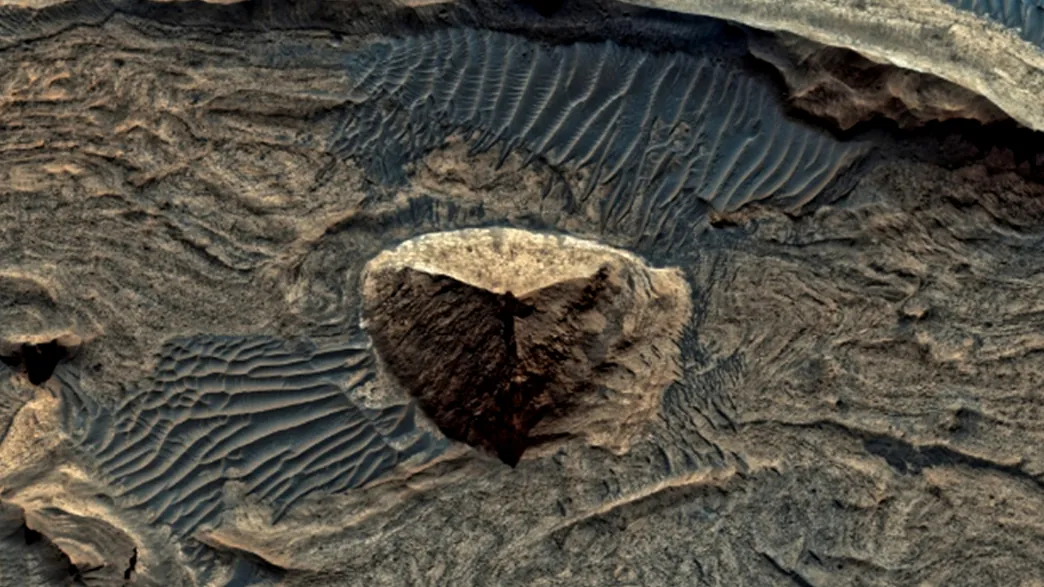
A three-sided, pyramid-like mound in the Martian canyon region known as Candor Chasma has circulated online as supposed evidence of extraterrestrial architecture. The feature appears in orbital images as a sharply defined triangle, with shadows that make its faces look unusually clean and planar.
The formation sits within Valles Marineris, the vast canyon system that cuts across Mars’ equatorial region. The setting is geologically dramatic and visually deceptive, and that combination has long made it a magnet for claims that natural landforms are something more.
Carl Sagan, writing in his 1980 book Cosmos, urged both caution and curiosity about pyramid-like shapes seen in early Mars imagery: “The largest Mars Pyramids have a base width of 3 km and a height of 1 km, so they are much larger than the Pyramids of Sumer, Egypt, and Mexico. With the ancient eroded shape, they could be small hills, sandblasted for centuries, but they warrant, I think, a closer look.”
Where the “pyramid” comes from
The modern wave of attention traces to high-resolution orbital photography assembled and shared online as large mosaics, including “gigapan” images built from spacecraft data. The best-known recent images of Candor Chasma come from HiRISE, the High Resolution Imaging Science Experiment camera on NASA’s Mars Reconnaissance Orbiter. HiRISE can resolve surface details down to about a meter in many observing modes, fine enough to pick out boulders, rover tracks, and steeply layered slopes.
In 2018, the triangular mound was pushed into the broader internet spotlight through tabloid-friendly UFO coverage and reposts, including summaries such as an IFLScience explainer that traced how the claim spread from “alien hunter” commentary to viral reposting. The argument was not that NASA had announced anything, but that the shape itself looked too tidy to be accidental.
The shape is real in the basic sense that a mound with a roughly triangular outline exists in that location. What is contested is the leap from “triangular” to “built.”
The argument for design, and the limits of the evidence
Some advocates of an artificial origin point to the apparent smoothness of one face and the way the mound’s edges line up in certain views. Others cite a paper hosted by the journal site TSI Journals, with a PDF version that presents a detailed visual analysis of the feature using NASA spacecraft images and geometric comparisons. The paper’s authors are associated with the Cydonia Institute, a group known for promoting interpretations of Mars imagery as evidence of ruins.
Their conclusion is explicit: “We contend that the structural form of this three-sided pyramid observed within the western region of Candor Chasma is real,” the authors wrote, claiming a “high probability of artificial origins.”

That claim does not turn on a single photograph. It turns on an interpretation of shadows, slopes, and symmetry from orbit, without on-the-ground measurements and without a chain of evidence showing construction materials, tool marks, or surrounding infrastructure. In planetary science, “looks engineered” is not a strong category by itself, because erosional landscapes routinely produce straight-ish edges, triangular facets, and apparent corners when wind, gravity, and layering interact.
What Mars does to mountains
Candor Chasma is not a blank canvas. It is part of a canyon network shaped by tectonic stretching, collapse, landslides, and long-term erosion. NASA has repeatedly highlighted the area’s layered deposits and steep wallrock as a record of changing conditions over time, including erosional patterns visible in Mars Odyssey images and higher-resolution views from HiRISE.
Scientific work on Candor Chasma’s interior layered deposits has focused on natural origins tied to sedimentation, chemistry, and later reshaping. For example, a widely cited study in Journal of Geophysical Research: Planets examined evidence for the origin and evolution of the layered deposits in Candor Chasma and discussed scenarios involving sedimentary accumulation and alteration over time (AGU paper). None of that research requires artificial construction to explain sharp-edged landforms, because layered materials can erode into facets and ridges that look geometric from a distance.
Mars is also an extreme planet for visual illusions. The atmosphere is thin, so distant features can appear unusually crisp. Dust and sand are constantly moved by wind, and steep slopes are prone to collapses and downslope movement. In imagery taken from a single angle and under a single sun position, shadows can exaggerate straight boundaries, while subtle variations in slope can be flattened into the illusion of a clean “face.”
The result is that a triangular mound can look like a three-sided monument in one lighting geometry and like an ordinary eroded hill in another.
Pattern-seeking is the point, not the punchline
The psychological term for seeing meaningful images in ambiguous stimuli is pareidolia. It is not a pathology. It is a normal feature of human perception, especially when the brain is presented with partial information and high-contrast patterns like light and shadow.
Mars has supplied a long catalog of pareidolia-driven headlines, none more enduring than the “Face on Mars,” first seen in a 1976 Viking 1 image and later re-imaged at higher resolution, revealing an ordinary landform shaped by topography and illumination (NASA resource). The episode became a template: a suggestive low-information image produces confident narratives, and better data steadily shrinks the room for fantasy.
The Candor Chasma “pyramid” fits the same pattern, with a modern twist. Today’s images are sharper, bigger, and easier to share at scale, but they are still images, still limited by geometry, and still vulnerable to the brain’s preference for tidy explanations.
Mars is worth looking at closely, as Sagan argued, precisely because it is a real world with a complicated history written into its rocks. The closest look, in science, is not the most imaginative one. It is the one that survives better lighting, better angles, better instruments, and eventually, direct measurement