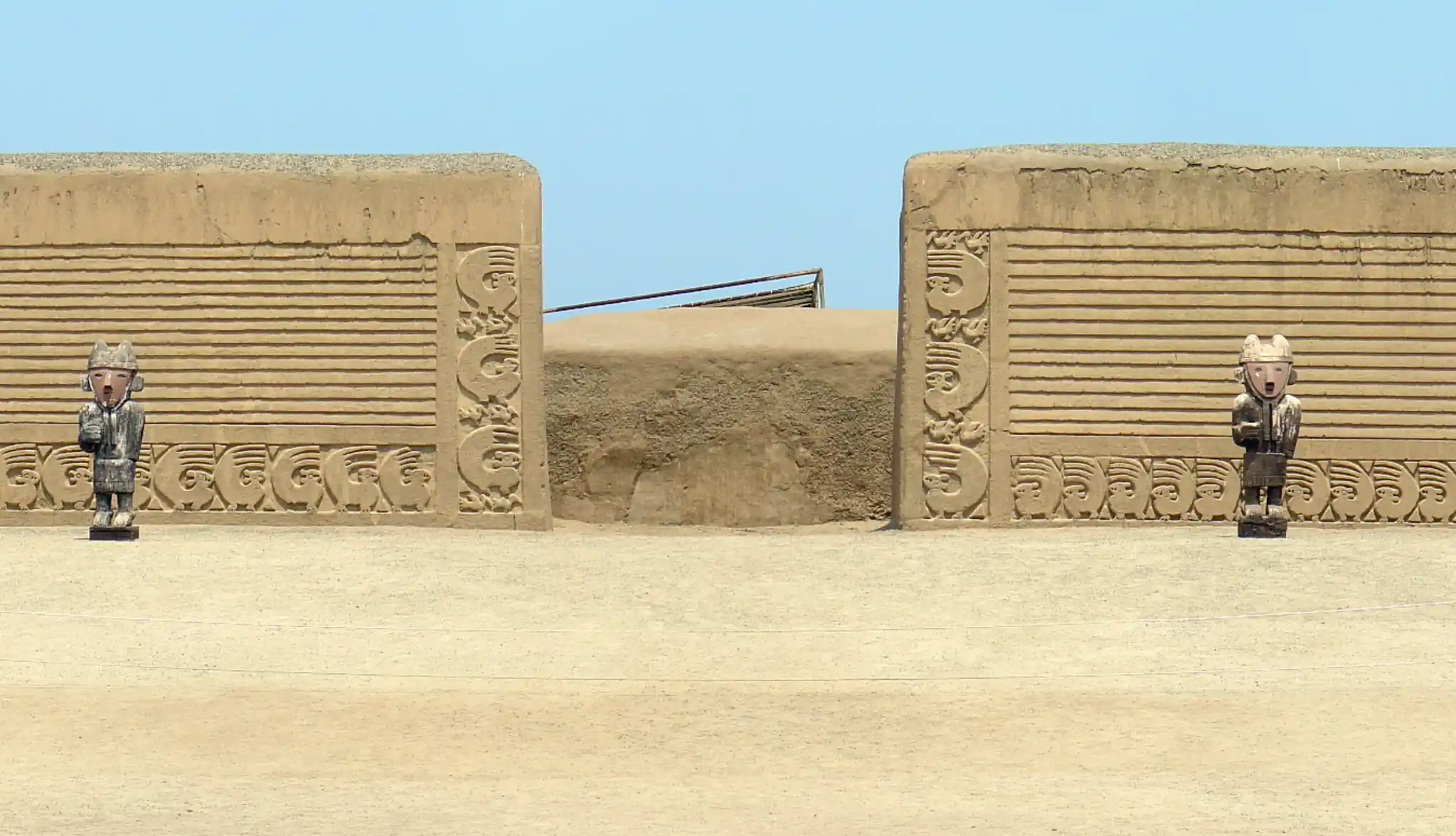

Built from adobe beside the Pacific, the Chimú capital became the largest earthen city in pre-Columbian America and now survives in a race against erosion.
Before Machu Picchu became Peru’s shorthand for ancient grandeur, another city had already risen and ruled on the coast. Chan Chan was older, vastly larger in area, and built not from mountain stone but from adobe, becoming the largest earthen city in pre-Columbian America and the political heart of the Chimú kingdom.
That difference matters because Chan Chan tells a different Peruvian story. Machu Picchu climbs into cloud and granite. Chan Chan spread low across a desert plain near the Pacific, a city of sun-dried brick, salt air, controlled water, and walls that once enclosed power on a monumental scale. What remains today is still immense, but it is also fragile in a way stone ruins are not.
The capital before the postcard
The Chimú kingdom emerged on Peru’s north coast after the decline of the Moche, drawing on earlier coastal traditions while building a state of its own. Chan Chan took shape in the late first millennium and early second millennium, with construction beginning around 950 A.D. and continuing as successive rulers expanded the city into a dense royal and administrative center near the Moche Valley.
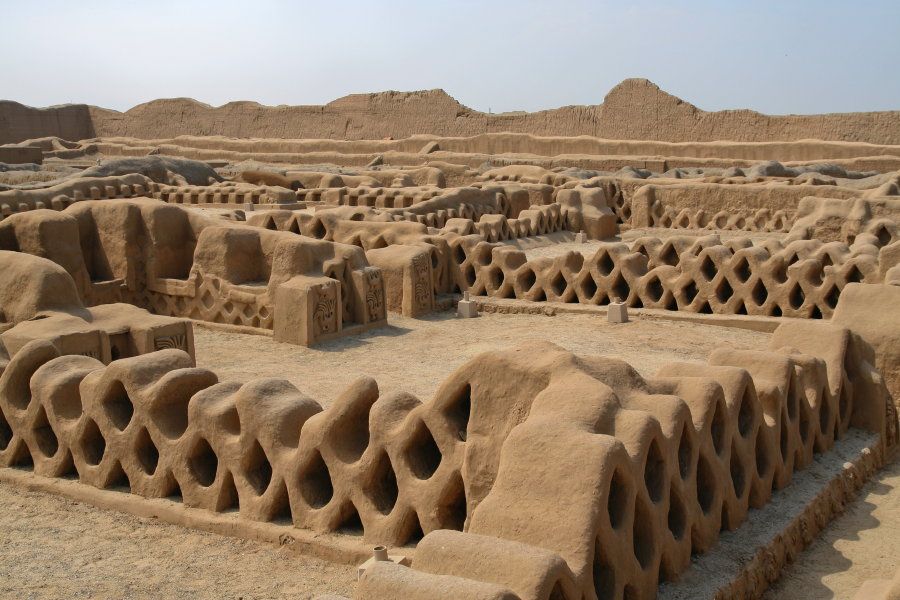
This was not a settlement that grew by accident. Chan Chan was planned. UNESCO’s description of the site still captures its scale best: a city that once covered about 20 square kilometers, with a monumental core of around six square kilometers at its center. Inside that core stood nine great rectangular royal compounds, often called ciudadelas or palaces, enclosed by high earthen walls and arranged as controlled worlds of plazas, storage rooms, wells, reservoirs, ceremonial spaces, and funerary platforms.
The material itself shaped the city’s character. Chan Chan was made from adobe, mud mixed and molded into bricks, then dried under the coastal sun. The walls could rise to roughly nine meters, and within them the city narrowed and opened in deliberate sequence. Long corridors forced movement. Single entrances limited access. Reliefs of birds, fish, and other marine forms ran across some surfaces, tying the city visually to the ocean that fed it and the political order that controlled it.
A plan written in adobe
Chan Chan’s greatest argument against the desert was water. The north coast of Peru is arid, and the ground around the city receives very little rain. Yet the Chimú sustained a large urban population and the fields that fed it through an irrigation system so ambitious that UNESCO identifies an approximately 80-kilometer canal linking the city’s world to river water moving down from the Andes.
That hydraulic work did more than keep crops alive. It created the conditions for rule. Fields of cotton, maize, squash, beans, and other crops turned an exposed coastal zone into a productive landscape tied to Chan Chan’s needs. Water management, agriculture, labor, and storage all converged in the capital. The city’s rulers did not merely occupy the desert. They reorganized it.
The architecture reflects that same logic. Chan Chan did not chase vertical drama. It expanded outward in layered enclosures, broad compounds, and regulated routes. Even the air was part of the plan. The coast brought wind, fog, and salt, and the city’s spaces were laid out to work within that environment rather than deny it. For the Chimú, power was expressed through controlled movement, controlled access, and controlled resources, above all water.
The kingdom of the coast
By the mid-fifteenth century, the Chimú realm stretched for hundreds of miles along the Pacific coast, with influence extending across valleys and desert corridors from near present-day Lima far to the north. Chan Chan sat at the center of that system, drawing tribute, labor, craft production, and prestige goods into one urban machine. Modern archaeological work has pushed the image of the city beyond a simple royal compound. It was a functioning capital with neighborhoods, workshops, storage sectors, and a population that likely reached into the tens of thousands.
The Chimú were also outstanding craftspeople. They worked gold and silver, wove complex textiles, shaped elegant blackware ceramics, and handled luxury materials that moved across long distances, including feathers and Spondylus shell from farther north. Much of that wealth was bound to the authority of the ruling elite. Chan Chan was where the kingdom’s power became visible in architecture, ceremony, and the stockpiling of goods.
That is part of why Chan Chan still feels so large even in ruin. It was never a remote ceremonial outpost. It was a capital in the full sense of the word, the place where hierarchy hardened into walls, corridors, and plazas, and where an empire on the coast gave itself a center. Long before Europeans arrived, and before Machu Picchu would later become the image most travelers carried home from Peru, the north coast had already built an urban civilization on a continental scale.
When the Inca arrived
Chan Chan’s political life broke in the late fifteenth century. Around 1470, the Inca conquered the Chimú capital, sacked royal tombs and storerooms, and drew skilled metalsmiths and other specialists toward Cuzco. Later accounts identify the defeated Chimú ruler as Minchancaman, taken south as Inca power absorbed the coast. Whatever the exact sequence on the ground, the result is clear. Chan Chan lost the autonomy that had made it the center of its own world.
The city did not vanish in a single moment, but its structure of rule was broken. Royal compounds were looted. Administrative systems were altered. The court that had animated the ciudadelas was gone. By the time the Spanish entered the region in the sixteenth century, Chan Chan was already a diminished place, vulnerable to plunder and then to the slower violence of abandonment. Earthen architecture can survive for centuries, but only when people keep maintaining it.
What the desert is taking now
Chan Chan is now both a World Heritage site in danger and a warning about how difficult earthen cities are to preserve. Wind abrades exposed surfaces. Salt works through the walls. Heavy El Niño events hit the north coast with destructive rain that adobe was never meant to absorb in volume. UNESCO’s climate case study is blunt about the problem. Once structures are exposed, erosion can move quickly, and the loss is not only physical but also archaeological, because damaged surfaces take information with them.
Even so, Chan Chan has not fallen silent. Excavation and conservation continue, especially in places such as the Nik An complex and nearby sectors of the old city. Recent work has refined the picture of who lived there and how the neighborhoods functioned, showing a more socially complex and diverse urban population than older models allowed. The city is still yielding evidence, which means preservation is not simply about saving scenery. It is about keeping open a major archive of how coastal Andean power worked before the Inca took the north.
Protection now involves roofs, drainage, maintenance, public education, buffer-zone controls, and the harder legal and political work of defending the site from development pressure and illegal occupation. UNESCO’s latest state-of-conservation reporting notes ongoing maintenance, risk management, improved visitor services, outreach programs, and continued concern over encroachment around the property. Chan Chan survives because people are still working against the conditions that erase it.
Visitors arriving today will not find polished stone walls or a ruin that flatters the camera from every angle. They will find weathered adobe, long enclosures, marine friezes, and a city that asks to be read at ground level. That is precisely why Chan Chan stays with people who walk it carefully. It preserves a different answer to the question of how ancient American states built power. The clearest fact is also the hardest one. Peru’s northern coast once held a capital of extraordinary scale, and enough of it still remains to redraw the map of the ancient Andes, provided the earth it was built from can be kept in place