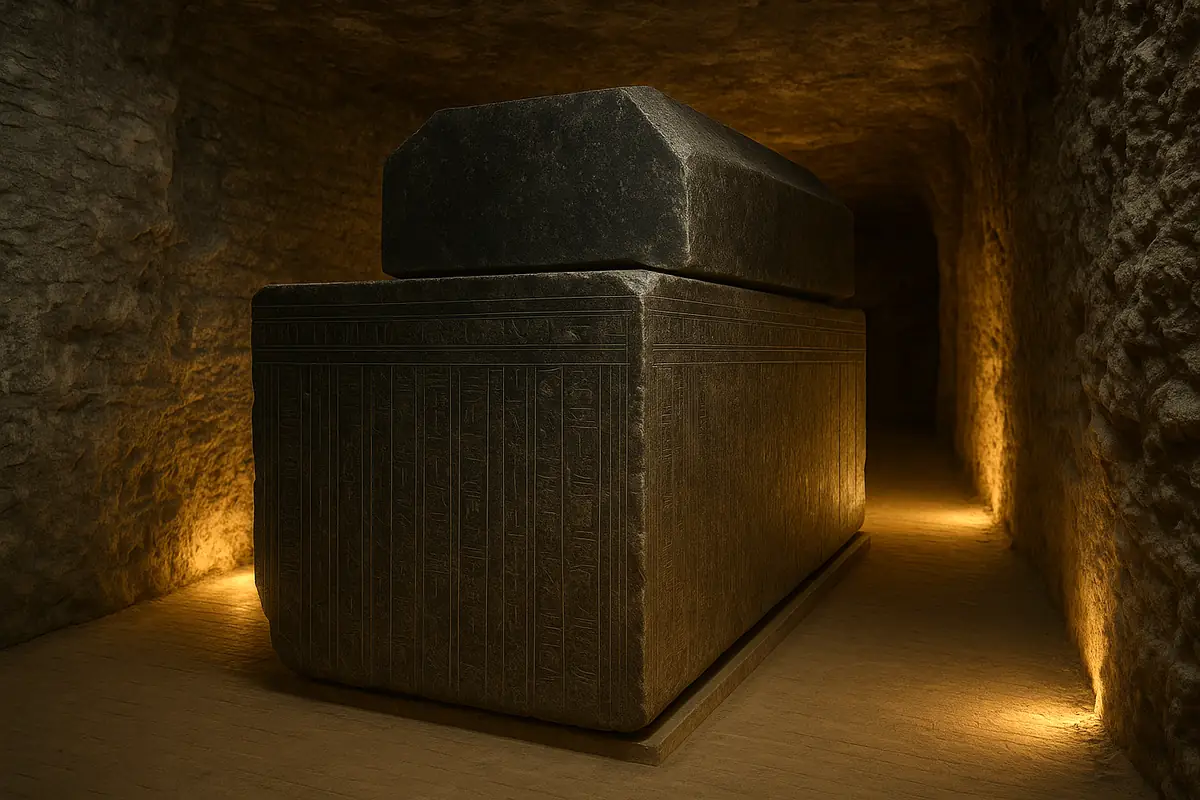

Beneath Saqqara, the Serapeum holds colossal sarcophagi so large, so precise, and so strangely quiet that even its accepted purpose leaves part of the story unresolved.
Most people meet ancient Egypt through the pyramids. They rise out of the desert with such force that everything around them can feel secondary. But one of the most unsettling monuments in Egypt is not a pyramid at all. It lies underground at Saqqara, in the vast necropolis of Memphis and its Necropolis, where a long stone passage leads into a sequence of chambers holding immense sarcophagi of granite and basalt, each one carved at a scale that still stops visitors cold.
This is the Serapeum of Saqqara, a monument usually described as the burial place of the sacred Apis bulls. That explanation is real, documented, and central to the site. Yet the deeper one looks into the great underground gallery, the less complete the neat version feels. The largest stone coffins are massive, polished, and almost entirely anonymous. Many were found empty. Some carried only fragments. And the silence around them is part of what keeps the Serapeum alive in the modern imagination.
Where the desert opens downward
The Serapeum stands not far from the Step Pyramid of Djoser, in a landscape already crowded with mastabas, shafts, temples, animal catacombs, and royal experiments in stone. Saqqara is not a single monument but a long cemetery of dynasties layered across centuries. The Serapeum belongs to that world, though it feels different from almost everything around it. It does not declare itself with height or spectacle. It draws you below the surface.
The monument was excavated in 1850 by Auguste Mariette, who was following ancient references connected to the cult of the Apis bull. What he uncovered was extraordinary even by Egyptian standards: a subterranean complex with long corridors and side chambers, and within them a series of colossal stone sarcophagi unlike anything most people associate with animal burials.
The broad religious setting is not in serious dispute. The Egyptian Ministry of Tourism and Antiquities identifies the Serapeum as the tomb of the sacred Apis bulls associated with Ptah, whose cult center was at Memphis. The site remained in use from the New Kingdom into the Ptolemaic era. The Apis bull itself was no ordinary sacred animal. In Memphis, it was treated as a living manifestation tied to one of Egypt’s most important gods, and after death it received burial honors on a royal scale.
That context explains a great deal. It explains the prestige of the monument, the ritual importance of the burials, and the deep connection between Saqqara and the cult life of Memphis. It does not explain everything in the main gallery.
The boxes that changed the mood of the site
The Serapeum’s most famous sarcophagi are not simply large. They are unnervingly large. Made from hard stone such as granite and basalt, they fill their chambers with the kind of mass that changes how a place feels. Many estimates place the boxes themselves in the range of 60 to 80 tons, with lids weighing many tons more. Some of the granite is widely believed to have come from the quarries around Aswan, hundreds of kilometers to the south, where ancient Egypt drew some of its finest stone.
That matters because the question is not only how these boxes were carved, but how they were moved. Hard stone had to be quarried, shaped, transported north, hauled across land, and then maneuvered into underground chambers where the clearances are tight and mistakes would have been costly. The Serapeum turns ancient engineering into something physical and immediate. You do not need a theory to feel the problem. The stone itself does the work.
The surfaces add another layer to the puzzle. The interiors were hollowed out with care. The lines are sharp. In places the polish is so fine that people often reach for modern comparisons. That can lead to exaggeration, but the workmanship does not need embellishment. It is impressive on its own terms. Ancient Egyptian builders worked with copper tools, pounders, and abrasives such as quartz-rich sand. They were capable of astonishing precision when time, labor, and status were all on their side.
That point matters because the Serapeum has drawn more than its share of inflated claims. The site does not require lost machines or vanished civilizations to be remarkable. Egyptian stoneworkers had already shown what they could do in obelisks, statues, temples, and royal tomb architecture. Still, the Serapeum presses the issue harder than most places do because everything happens underground, in confined space, and at immense weight.
How could they get them underground
The practical answer is not mysterious, but it is formidable. The accepted view is that the stone was moved on sledges, probably along prepared routes, with water or mud used to reduce friction where needed. Egypt’s own visual record shows workers hauling heavy objects this way. Once the blocks reached the site, ramps, levers, ropes, and carefully staged descent would have done the rest. One long-standing idea is that sand inside the chambers helped control the final lowering of the sarcophagi, with material removed gradually to settle each box into place.
That method makes sense. It also implies planning on a very high level. These were not casual installations. The corridors are narrow. The margins for error are small. A broken lid, a slipped box, or a badly judged descent could have ruined months of work or blocked the chamber entirely. The Serapeum may not need miraculous explanations, but it absolutely demands respect for ancient logistical skill.
The carving presents its own challenge. Granite is hard. Hollowing out the interior of a giant stone box with hand-powered tools and abrasives would have taken immense time and discipline. Yet that is exactly the sort of long, controlled labor Egyptian craftsmen could produce when elite religion or royal power required it. The sarcophagi at the Serapeum look severe, controlled, and deliberate. Nothing about them suggests haste.
The part that still does not sit easily
If the engineering can be explained in broad terms, the monument’s silence is harder to settle. Egyptian tomb culture was usually explicit. Names mattered. Text mattered. Identity mattered. Even modest burials often preserved who the dead person was, what offerings were needed, and how the deceased should move safely into the afterlife.
The great sarcophagi of the Serapeum do not follow that familiar pattern. Only a few carry inscriptions. Most are bare. Several were found empty, or nearly so. Some appear to have held only fragmentary remains that do not restore the whole story. That is unusual enough to keep the site under discussion.
The usual explanation remains that these were burial containers for Apis bulls, and there is no good reason to discard that framework. The Serapeum belongs to the Apis cult. The wider site supports that reading. Britannica’s overview of the Serapeum ties it directly to the sacred bulls of Ptah, and objects linked to Apis worship survive in museum collections, including examples in the British Museum. The religious tradition is real.
What remains uncertain is narrower, but still important. Why are the largest boxes so stripped of identifying detail. Why were some empty. Why was so much effort invested in containers that say so little on their surfaces. In ancient Egypt, that restraint is harder to ignore than the scale.
Where interpretation begins
Once those questions are raised, the Serapeum opens into competing readings. Some argue that the emptiness of certain sarcophagi does not weaken the Apis explanation at all. Tombs are disturbed. Remains decay. Robbery, later intrusion, and ancient reuse complicate the record everywhere in Egypt. Others think at least some of the boxes may have had a symbolic function alongside a funerary one, closer to sacred containers or cenotaphs than straightforward animal coffins.
A more controversial line of thought pushes further and suggests that the great gallery may preserve something older, or at least something reused in a way that later tradition did not fully explain. That idea remains outside the mainstream, and it stays there for good reason. The Serapeum does not provide clear evidence for a lost forgotten builder race or impossible technology. What it does provide is an unusual concentration of unanswered detail inside an otherwise documented religious setting.
That distinction matters. A site can be historically grounded and still unresolved in part. The Serapeum is not a blank mystery. It has context, chronology, and cultic meaning. It also has giant anonymous sarcophagi that do not fit comfortably into the usual Egyptian habit of speaking clearly through stone.
The strongest conclusion is also the simplest one. The Serapeum was part of the sacred burial system of the Apis bulls at Saqqara. But in its great underground gallery, the largest coffins leave behind a harder question than their size alone. They show what the ancient Egyptians could do with planning, manpower, and stone. They do not fully tell us why they chose to do it here in this form, with such weight, such polish, and so little written explanation