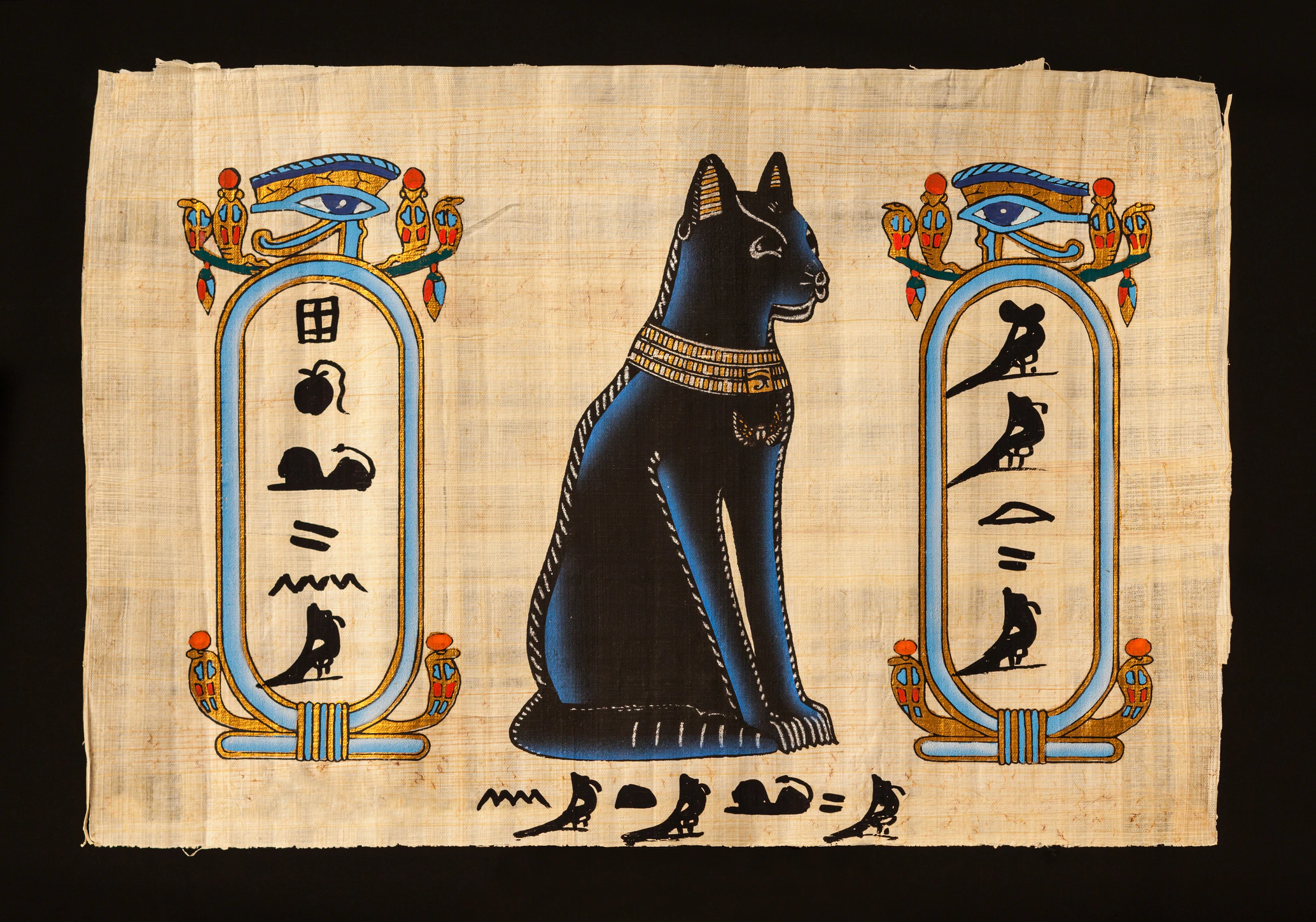

In ancient Egypt, cats were far more than household animals: they moved through religion, art, ritual, and daily life as protectors, companions, and living symbols of divine force.
When people picture ancient Egypt, they usually see pyramids, pharaohs, and stone colossi rising from the desert. Yet few animals were woven more deeply into Egyptian life than the cat, a creature trusted in the home, honored in temples, and tied to one of the most beloved divine powers in the Egyptian world.
More than a household pet
The ancient Egyptian attachment to cats did not grow from sentiment alone. Cats were useful, elegant, and watchful. In farming communities built around grain storage, they helped control mice, rats, and snakes. That practical value mattered in a civilization where food security could shape survival itself. But utility alone does not explain the place cats came to hold.
Egyptians saw character in animals, and cats carried a particular charge. They were poised yet unpredictable, affectionate on their own terms, and startlingly effective when they struck. In them, Egyptians found a creature that could seem calm one moment and fierce the next. That dual nature made cats unusually suited to the symbolic language of Egyptian religion.
Over time, the cat became linked to protection, fertility, domestic peace, and female power. Those ideas gathered around the goddess Bastet, who could appear as a cat-headed woman or in purely feline form. In some older traditions she retained leonine force, closer to the dangerous power associated with lioness goddesses. In later periods, the domestic cat became her clearest image. She was protective, life-giving, and deeply tied to the household, but never soft in any empty sense. Egyptian religion rarely stripped strength from its nurturing deities, and Bastet was no exception.
That helps explain why cats never sat at the edge of Egyptian culture as a charming footnote. They belonged close to the center.
The goddess in the cat
Bastet’s presence gave cats a sacred charge that reached from temple precincts to ordinary homes. Bronze cat figures, amulets, and statues show how consistently the animal was used as a vessel for divine meaning. In the Egyptian imagination, the cat’s alert posture was not decorative. It signaled vigilance. A seated cat with ears forward and tail wrapped close looked like a creature keeping watch, and Egyptian artists leaned into that image again and again in statuary and ritual objects.
That sacred connection shaped everyday feeling. A cat in the home was not simply tolerated for its usefulness. It could be seen as a bearer of blessing, a presence linked to safety, warmth, and order. For people living in a world crowded with visible and invisible threats, the idea of protection was not abstract. It mattered in childbirth, in illness, in travel, in the fate of children, and in the stability of the household itself. Bastet’s appeal rested there. She was not a distant cosmic figure. She was a power people could bring close.
The city of Bubastis, in the Nile Delta, became the great center of her cult. Pilgrims traveled there, offerings accumulated there, and the goddess’s name carried beyond the city that housed her main temple. Archaeology and surviving objects show just how broad her appeal became, especially in later periods when cat imagery appears in extraordinary volume. Cats were not holy in some vague symbolic sense. They were folded into an active religious system of offerings, devotion, amulets, and public celebration.
Companions in the house, guardians in the palace
The Egyptian love of cats was not confined to temples. They lived in homes, moved through elite and ordinary spaces alike, and appear in tomb paintings and small objects that suggest familiarity rather than distance. This is where the Egyptian relationship with cats becomes especially vivid. The same animal could be sacred, useful, and deeply personal.
Cats brought a kind of order to domestic life. They killed pests. They guarded stored food. They curled into the spaces where families lived and slept. Their presence likely felt both ordinary and charged, as many things in Egyptian life did. The boundary between sacred and domestic was never rigid. Household objects could carry ritual meaning. Protective images could belong in private rooms. A beloved animal could also stand under the shadow of a goddess.
That overlap extended upward into royal and temple life. Later writers and modern retellings often describe cats as guardians of pharaohs and palaces. The deeper truth is less theatrical and more interesting. Egyptians saw feline qualities as protective, and temple art, amulets, and statues repeated that theme constantly. A cat in a palace or temple would have been valued for the same reasons it was valued in a home, though with greater prestige attached. It watched, hunted, and symbolized a divine force that could repel danger.
Egyptian art understood the cat’s visual power with remarkable precision. Sculptors did not need dramatic poses. A still cat was enough. In bronze figures and carved images, the animal appears self-contained, balanced, and hard to surprise. That was exactly the point. Egyptian artists were not capturing a pet being cute. They were fixing into form an animal that could stand for controlled power.
The dead were not left behind
The strongest material proof of Egypt’s devotion to cats survives in its cemeteries. Large numbers of cat mummies have been found across Egypt, and they remain among the most striking reminders of how seriously the animal was taken in religious life. Museums still hold wrapped feline remains, cat coffins, and containers made for the burial of sacred animals, including examples in the British Museum’s collection.
These burials tell more than one story. Some cats were mummified as beloved animals. Others were offered in ritual contexts as votive gifts to a deity. Animal mummification in Egypt was vast and complex, involving ibises, crocodiles, bulls, falcons, and many other creatures, but cats occupied a special place because of their direct link to Bastet and the emotional closeness they had to human households. The broader religious system behind animal mummies in ancient Egypt shows how sacred animals could operate as offerings, embodiments, or intermediaries within temple practice.
This is also where the modern image of universal feline pampering needs a little sharpening. Cat burials reveal devotion, but they also reveal scale. By the first millennium BCE, animal cults had become highly organized, and some mummified animals appear to have been bred or selected for ritual demand. The evidence does not erase Egyptian reverence for cats. It makes that reverence more concrete, and more institutional. Religion in ancient Egypt lived not only in affection but in systems, offerings, priests, workshops, cemeteries, and pilgrimage.
Even so, the emotional force remains clear. Egyptians thought cats deserved care in death, whether as sacred offerings or as cherished creatures tied to divine protection. A civilization does not mummify animals in such numbers unless those animals have entered its deepest symbolic language.
A face that filled Egyptian art
Cats appear across Egyptian visual culture with unusual consistency. They show up in sculpture, jewelry, amulets, painted scenes, coffins, and bronze votive figures. Some are purely naturalistic. Others carry divine signs or images of Bastet herself, as in cat figures made to embody the goddess’s protective role. A cat could be rendered with spare realism and still hold enormous religious weight, which is one reason Egyptian feline imagery remains so compelling today.
The best examples preserve a sense of formal restraint. The cat sits upright. The body is compact. The face is alert but unreadable. The animal has dignity without strain. In pieces like this cat with an image of Bastet on its breast, the line between representation and devotion nearly disappears. The cat is both animal and sign.
That visual tradition mattered because Egyptian art was never only decorative. Images worked. They protected, invoked, and stabilized. An amulet shaped like Bastet or a cat did not merely depict safety. It participated in it. The same logic shaped wall scenes, household objects, and funerary equipment. Cats became part of the protective machinery of Egyptian life and death.
Their image also carried social meaning. Cats embodied grace, composure, self-command, and danger held in reserve. Egyptians admired those qualities in gods, rulers, and ideal forms of order. The cat’s body, with its softness masking speed and force, fit that vision perfectly.
Where the fascination still rests
Modern readers are often drawn to ancient Egyptian cats because the connection feels strangely familiar. The affection is easy to recognize. The reverence is not. That gap between intimacy and divinity is where the subject keeps its grip. Egyptians did not separate the useful, the beautiful, and the sacred as sharply as modern life often does, and the cat moved across all three realms with ease.
It is also why the subject survives so strongly in popular memory. The Egyptian cat was not a minor curiosity left behind in tomb art. It belonged to religion, domestic life, festival culture, burial practice, and artistic production on a major scale. Exhibitions devoted to the cats of ancient Egypt continue to draw attention because the material is rich and the underlying idea is still potent. People can understand loving a cat. Understanding a cat as a sacred protector asks for a different kind of historical imagination.
The clearest view is also the strongest one. Cats in ancient Egypt were neither worshiped as simple idols nor kept as ordinary pets who happened to be nearby when religion was happening. They occupied a middle ground that Egyptian culture treated as entirely real: useful hunters, intimate companions, protectors of the household, and living creatures closely tied to Bastet’s divine force. That is why they endured in bronze, linen, stone, and memory long after the houses that sheltered them were gone.