
Built in 762 under the Abbasids, the circular “City of Peace” was a purpose-made seat of power whose physical traces were later absorbed by a growing metropolis.
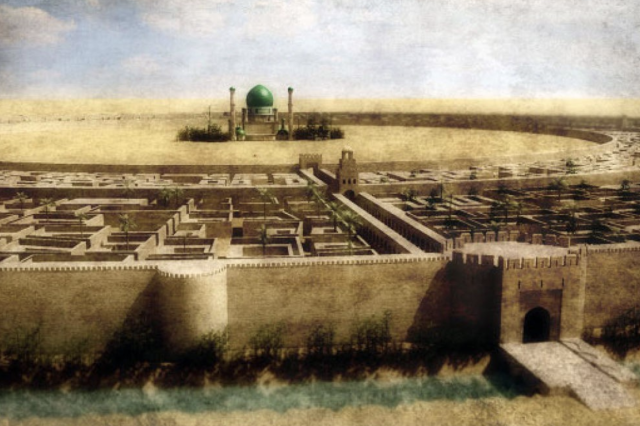
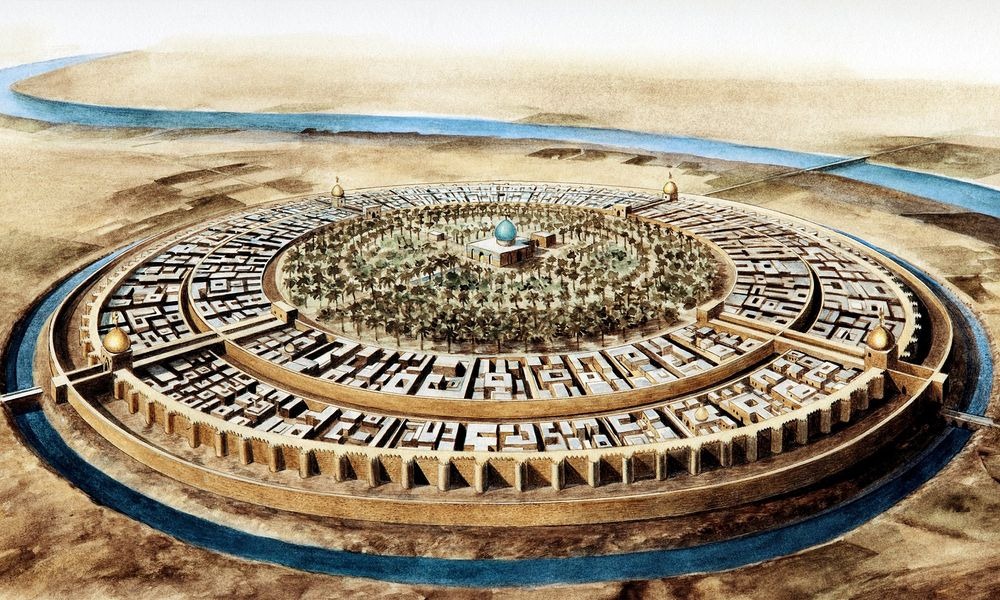
Baghdad began as a design, not an accident of settlement. In 762, the Abbasid caliph al-Mansur chose a site on the Tigris River and ordered a new capital built behind circular walls. The plan was meant to concentrate authority and display order, with the caliph’s palace and the main mosque planted at the geometric center of the city.
The result, known to contemporaries as Madīnat al-Salām, the “City of Peace”, is remembered today as the Round City of Baghdad. Almost nothing of it survives above ground. But the idea of it, and the basic outline of how it worked, still shapes how historians understand Baghdad’s rise as a political and intellectual powerhouse.
A capital drawn as a circle
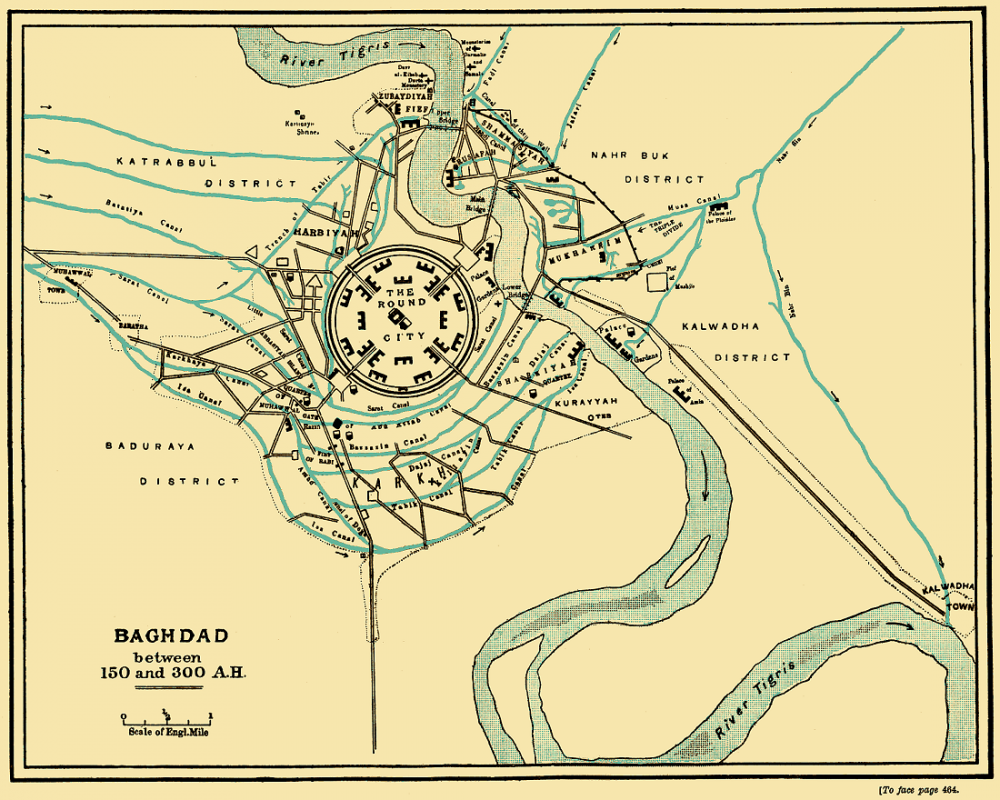
Al-Mansur’s Baghdad was conceived first as a governing complex and a fortified seat for the Abbasid court, not as a conventional residential city. Encyclopaedia Britannica describes the Round City as about 2,700 metres (3,000 yards) in diameter, enclosed by three concentric walls, with the palace and great mosque at the center and major roads radiating outward.
The layout was also legible as an imperial map. Four principal gates faced outward toward the Abbasid world: Bab al-Kufa, Bab al-Basra, Bab al-Sham, and Bab al-Khorasan, each aligned with routes and regions that mattered to the caliphate’s military and commercial reach. Roads from those gates converged on the center, where power and public ritual were staged side by side.
Medieval Arabic historians preserved unusually detailed memories of the project, including who worked on it and how it was organized. A widely repeated estimate credited to the ninth-century geographer al-Ya‘qubi puts the workforce at about 100,000. Whatever the true total, the scale was large enough to make the Round City a reference point for later writers describing planned capitals and the Abbasids’ confidence in administration, engineering, and logistics.
The timing of the build was treated as part of the program. Accounts of the city’s foundation emphasize that the start date was selected for auspiciousness, and later scholarship preserves the names of court astrologers associated with the founding horoscope. One modern synthesis of the tradition notes that July 30, 762 was remembered as the chosen moment to break ground.
The caliph’s pride in the undertaking comes through in a line often attributed to him in the later narrative tradition: “This is indeed the city that I am to found, where I am to live, and where my descendants will reign afterward,” a quotation commonly repeated in summaries of the Round City’s story, including the entry on the Round City of Baghdad.
Order, symbolism, and Persian precedents
The circle carried practical advantages. Concentric defenses and controlled entry points simplified security. A central palace complex reduced the distance between court, bureaucracy, and garrison. But the geometry was also meant to communicate something about rule: a capital that looked deliberate, measured, and centered.
Historians have long noted that Baghdad’s plan had parallels in pre-Islamic Persian urban models. Encyclopaedia Iranica points to earlier Sasanian round cities with four gates, and to Persian influence in architectural forms and court culture that the Abbasids adopted as they built a new imperial identity.
Later writers also linked the city’s geometry to the prestige of Greek learning, describing the circle as a tribute to classical teachings on proportion and planning. A detailed journalistic account of Baghdad’s founding, drawing on medieval sources, presents the Round City as a statement of mathematical clarity and imperial control, with the plan traced and approved under the caliph’s supervision before construction began.
The House of Wisdom and the culture of translation
The Round City is often paired in popular memory with the House of Wisdom, the Abbasid-era library and scholarly enterprise tied to Baghdad’s reputation for learning. Even here, the record is less neat than the legend.
Some traditions place the institution’s origins in collections assembled under early Abbasid rulers, then expanded under later caliphs. A UNESCO history of Arab culture describes the House of Wisdom as founded in Baghdad sometime during the reign of al-Mansur or that of his successors. A modern reference work for the institution, Bayt al-Hikmah, emphasizes its role as an arm of the caliphal bureaucracy and traces its enrichment under Harun al-Rashid and its broader intellectual profile under al-Ma’mun. In a related biography, Britannica’s entry on al-Ma’mun links his patronage of translations and scholarship to the House of Wisdom as an academy.
That last point matters for understanding what Baghdad represented in the ninth century. The translation movement associated with Abbasid patronage drew on Greek, Syriac, Persian, and other scholarly traditions, and it helped make Arabic a major language of scientific and philosophical work. The House of Wisdom became a symbol for that era even when historians debate how formal, centralized, or unique the institution really was. Modern scholarship has contested the older, tidy picture of a single grand “academy,” a debate reflected in studies such as Dimitri Gutas’s Greek Thought, Arabic Culture and more recent collections like The Abbasid House of Wisdom: Between Myth and Reality.
The broader point remains intact: Baghdad became a magnet for scholars, administrators, artisans, and merchants, and the city’s institutions supported a dense intellectual economy that outlived any single building or library.
Praise, expansion, and disappearance in plain sight
Baghdad quickly spilled beyond its first circular walls. Britannica notes that the Round City’s limited size encouraged rapid growth outside the fortifications as markets and housing spread, forming districts that became part of the larger urban fabric within decades.
Contemporary and near-contemporary observers described the place with admiration that focused on its defenses, its gates, and the clarity of its design. One oft-cited passage, attributed in later retellings to the ninth-century writer al-Jahiz, reads:
“I have seen the great cities… but I have never seen a city of greater height, more perfect circularity, more endowed with superior merits, or possessing more spacious gates or more perfect defenses than Al Zawra, that is to say, the city of Abu Jafar al-Mansur.”
The quotation survives in modern compilations and narrative histories of Baghdad’s founding, including a widely circulated account of the Round City’s early reception in The Guardian.
Yet the Round City did not vanish in a single catastrophe. Its “loss” was gradual, the kind that happens when a city keeps living. Walls were dismantled or repurposed. Neighborhoods expanded across earlier boundaries. Administrative centers shifted. By the time later shocks arrived, including the devastating Mongol conquest of 1258, the Round City was already only one layer in a much larger capital.
What remains, then, is less a ruin than a blueprint that historians can still read through texts: a capital designed to embody order, to centralize rule, and to project legitimacy across an empire. The Round City’s physical form faded into the street plan of later Baghdad. Its concept, however, helped define what a purpose-built imperial city could be: a place engineered not only for defense and bureaucracy, but for a culture that treated learning as a tool of statecraft.