
It remains a profound mystery as to how ancient people managed to transport and position stones that weigh between 90 and 125 tons.
Perched above Cusco, Sacsayhuaman remains one of the clearest displays of what Inca builders could do with raw stone, steep terrain, and immense human labor. Its giant zigzag walls are concrete, measurable, and still standing, yet the full story of how this high citadel was planned, quarried, shaped, and assembled continues to leave room for argument, admiration, and hard questions.
The great hilltop complex above the old Inca capital combines ceremony, power, and engineering on a scale that still feels startling when you stand in front of the masonry itself.
The city above the city
Sacsayhuaman rises on the northern heights above Cusco, part of the monumental landscape of the old imperial capital now protected within the City of Cuzco. The name is often rendered as “place where the hawk is fed.” What survives today is only part of the original complex, but even in its reduced state it has the force of something much larger than a ruin. The terraces cut across the hill in three sweeping zigzags. The stones lock together without mortar. The setting gives a commanding view over the valley below.
For the Inca state, this was no marginal outpost. Sacsayhuaman stood close to the political and sacred core of Cusco, a city that under Pachacuti became the center of a vast Andean empire. Older accounts and modern summaries alike place the major imperial phase of construction in the 15th century, during the great building campaigns associated with Pachacuti and his successors. Britannica’s overview of Sacsayhuamán still reflects the broad consensus on that point, even as archaeology has made the deeper history of the Cusco region more complex.
The source tradition around the site has never been tidy. Spanish observers treated it as a fortress because of its walls, height, and role in war. Other interpretations place more weight on ceremony, royal display, and ritual space. That tension is not a modern invention. It is built into the place itself. Sacsayhuaman looks defensive from a distance and ceremonial once you begin to understand how closely it belonged to the sacred and political life of imperial Cusco.
Walls built from moving mountains
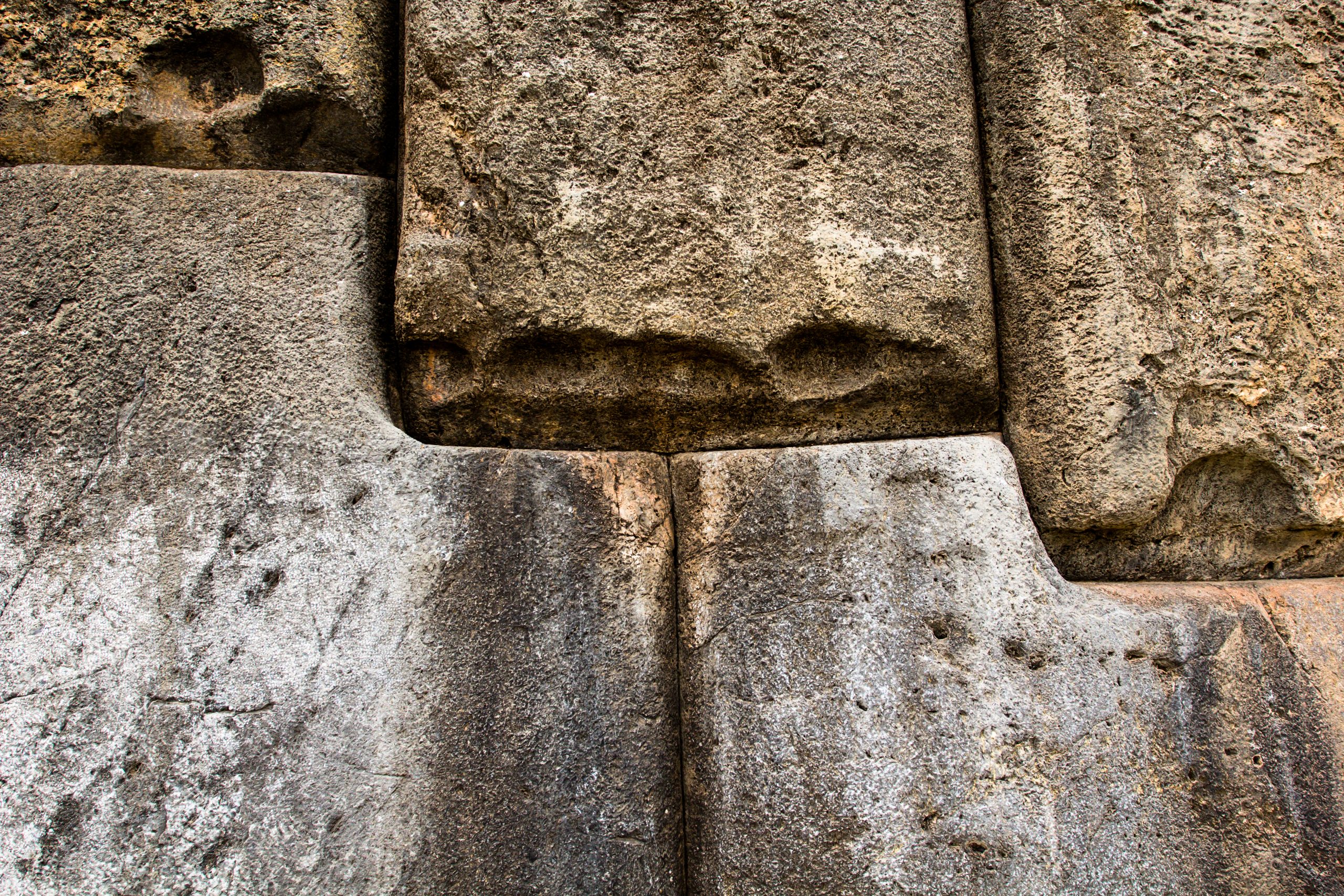
The first shock of Sacsayhuaman is physical. The terrace walls are made from enormous limestone blocks, many weighing tens of tons, with some estimates for the largest reaching well over 100 tons. These are not neat rectangles stacked in courses. They are irregular, many-sided masses cut to interlock with a precision that still draws people into long arguments about method.
That precision matters because the walls are not crude despite their scale. Their faces meet tightly. Their lines rise and fold with the slope. The masonry has the puzzle-like complexity associated with the finest Inca stonework, but here it has been pushed into a heavier, more muscular register. In the wider architectural landscape of the Andes, Sacsayhuaman belongs to the tradition of polygonal stone construction that made imperial Cusco famous. The city’s surviving walls, celebrated in places such as the Twelve-Angled Stone, show the same command of fit, weight, and seismic stability, though at a smaller scale.
This is why the site has long been described as cyclopean. The word is old and imperfect, but it captures the first human reaction to the masonry. These blocks do not look as if they should have been moved at all, much less fitted into a coherent, durable retaining system on a high ridge above a capital city.
Mainstream explanations do not remove the wonder. They relocate it. Archaeologists and historians do not need lost machines to explain Sacsayhuaman. They point instead to quarrying, levering, hauling, earthen ramps, ropes, rollers in some circumstances, and above all labor organized at state level. The Inca world was capable of mobilizing immense workforces through systems of tribute labor and logistical planning described in studies of Inca political economy. That framework makes the walls more intelligible, but it does not make them ordinary.
Labor measured in generations
One of the striking claims long attached to Sacsayhuaman is that around 20,000 people took part in the building effort and that construction stretched across decades. Figures vary from source to source, but the larger point remains solid. This was not a short campaign. It was a state project of exceptional importance, likely unfolding over the reigns of more than one ruler and drawing on labor far beyond a single local community.
That kind of timescale changes the way the site should be imagined. Sacsayhuaman was not built by a few inspired master masons working in isolation. It was the product of a highly organized society able to feed workers, move stone, coordinate specialized skills, and keep a monumental vision intact over years. At that scale, construction becomes more than engineering. It becomes governance made visible.
The source text is right to sense family generations in the work. Even if the exact numbers cannot be fixed with complete confidence, the monument plainly belongs to a long process rather than a single moment. Men cut stone. Others hauled it. Others shaped joints. Others prepared the terraces and supporting earthworks. Priests, planners, and rulers gave the project meaning. The result was a complex tied to the imperial city not as decoration, but as one of its defining heights.
Temple, fortress, and sacred ground
Sacsayhuaman is often reduced to a single function, and the site resists that simplification. The source text points to the temple of Hanan Qosqo and to worship linked with Inti, Quilla, stars, lightning, and other divinities. That religious dimension fits what is known of imperial Cusco as a landscape where governance and worship were inseparable. Ceremonial use at Sacsayhuaman is not a fringe theory. It is one of the strongest ways of understanding the complex.
At the same time, the Spanish were not inventing the military aspect when they described it as a fortification. The hill became a decisive position during the struggle for Cusco in the 1530s. Height, walls, access, and visibility gave it strategic value whether or not defense was its only or even primary original purpose. A place can be sacred and militarily useful at once, especially in an imperial capital.
This is where the article becomes more interesting if it stays calm. Sacsayhuaman does not need to be trapped inside a false choice between temple and fortress. Its scale, layout, and position suggest a royal-ceremonial complex with defensive power built into it. That mixed reading also better matches what the Inca state often did elsewhere, where architecture expressed control, ritual order, and practical command all at once.
Older ground beneath imperial stone
The source text also touches on a point that deserves careful handling: the hilltop was likely important before the imperial Inca phase reached its final monumental form. That is plausible and, in broad terms, supported by regional archaeology. Cusco did not spring into existence in the 15th century. The city and its surrounding basin preserve a much deeper sequence of occupation, one that UNESCO describes as extending across more than 3,000 years of pre-Inca development in the region.
Scholars working on Inka origins and early Cusco archaeology have argued that late pre-Inca groups, including the Killke, occupied and shaped parts of the basin before imperial expansion transformed it. That does not mean the massive zigzag terraces of Sacsayhuaman belong to some vanished civilization unrelated to the Inca. It means the hill almost certainly had a longer local history before the imperial state reworked it on a monumental scale.
That distinction matters. It keeps the door open where the evidence leaves room, but it also keeps the strongest ground underfoot. Sacsayhuaman can be both older in occupation history and unmistakably Inca in its famous surviving stonework.
What the Spanish could not carry away
The site visible today is also the product of destruction. After the conquest of the Inca, Spanish builders dismantled large parts of Sacsayhuaman and reused many of its smaller, finely worked stones in colonial Cusco. The pattern fits the larger colonial transformation described by UNESCO’s account of Cuzco, where churches, houses, and palaces rose over the old Inca urban fabric. Sacsayhuaman was quarried a second time, this time not to build the imperial city but to help overwrite it.
That spoliation left behind a brutal kind of evidence. The smaller and more manageable stones went downhill into the colonial city. The heaviest blocks remained because they were too difficult to move. In that sense, the giant masonry that now astonishes visitors is partly what the conquerors failed to erase.
This is also why the transport problem still feels so vivid. The Spanish reused much of the site, yet even they did not attempt to relocate the largest stones. That does not prove the Inca possessed unknown machinery absent from history. It does show that the original builders were operating with a level of labor organization, terrain knowledge, and stone-handling skill that later occupiers did not match in practice.
Sacsayhuaman remains mysterious in the right way. Its builders were real. Its masonry is real. Its political and sacred importance to Cusco is real. The exact sequence of construction, the full range of its functions, and the practical details of hauling and setting its biggest stones are not fully recoverable. That is enough to keep the monument alive as a serious historical problem without turning it into fantasy