Curiosmos
  • Home
  • Unsolved Mysteries
  • Ancient Civilizations
  • Cosmic Phenomena
  • Alien Theories
  • Curious Lists
No Result
View All Result
Like us on Facebook
Curiosmos
  • Home
  • Unsolved Mysteries
  • Ancient Civilizations
  • Cosmic Phenomena
  • Alien Theories
  • Curious Lists
No Result
View All Result
Curiosmos
No Result
View All Result

10 Things You Need to Know About the “Immortal” Welwitschia Plant

Vladislav TchakarovbyVladislav Tchakarov
August 21, 2021 - Updated on January 14, 2025
in Editor's Picks
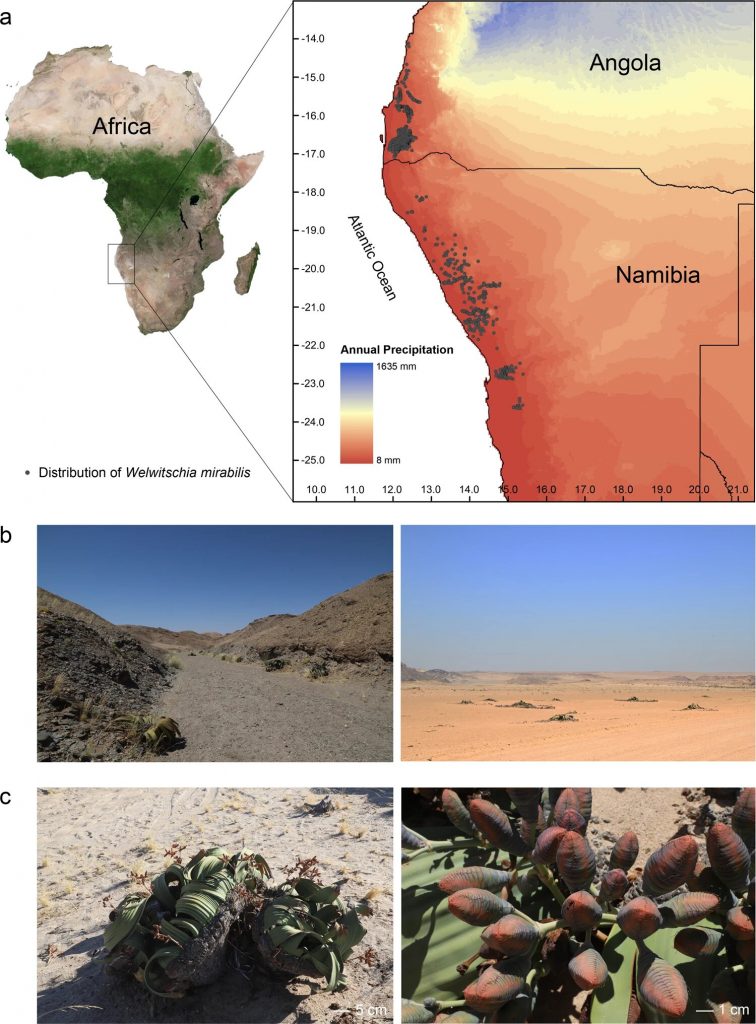
Geographical location and typical habitat of the Welwitschia plant. Credit: Tao Wan

Geographical location and typical habitat of the Welwitschia plant. Credit: Tao Wan

Share on FacebookShare on Twitter

An international team of scientists discovered that the African Welwitschia plant can live for more than a thousand years thanks to the disposal of genetic debris and a special way of growing leaves.  They hope that the genetic secrets of Welwitschia will be useful in agriculture – in a changing climate, it is important to create plants that can survive in an arid and nutrient-poor environment.


Everything you need to know about the Welwitschia plant

Welwitschia is a fascinating plant that has not only adapted to survive in one of the harshest places on planet Earth – the Namib Desert but can also survive for thousands of years.

Continuous development and adaptation

The difference between the Welwitschia plant and most other plants is its ability to continue developing and adapting. While most species stop developing once fully grown, Welwitschia is the opposite. Curiously, it actually dies once it stops growing.

More than 2,000 years old

In previous studies, scientists found that a single specimen of Welwitschia is more than 2,000 years old. Some botanists believe that some specimens might also be more than 3,000 years old. For this incredible period, the plants do not change a single leaf; they have only two massive leaves during their entire lifetime.

Related Posts

A sonar image. Image Credit: MAYOBS - CNRS/IPGP/IFREMER/BRGM.

Our Planet Rang Like a Bell For 20 Minutes, and Scientists Now Know Why

May 24, 2019 - Updated on May 2, 2023
This is Yonaguni, the underwater structure off the coast of Japan. Credit: Wikimedia Commons.

The underwater structure off the coast of Japan — natural or engineered?

May 22, 2025

Two leaves

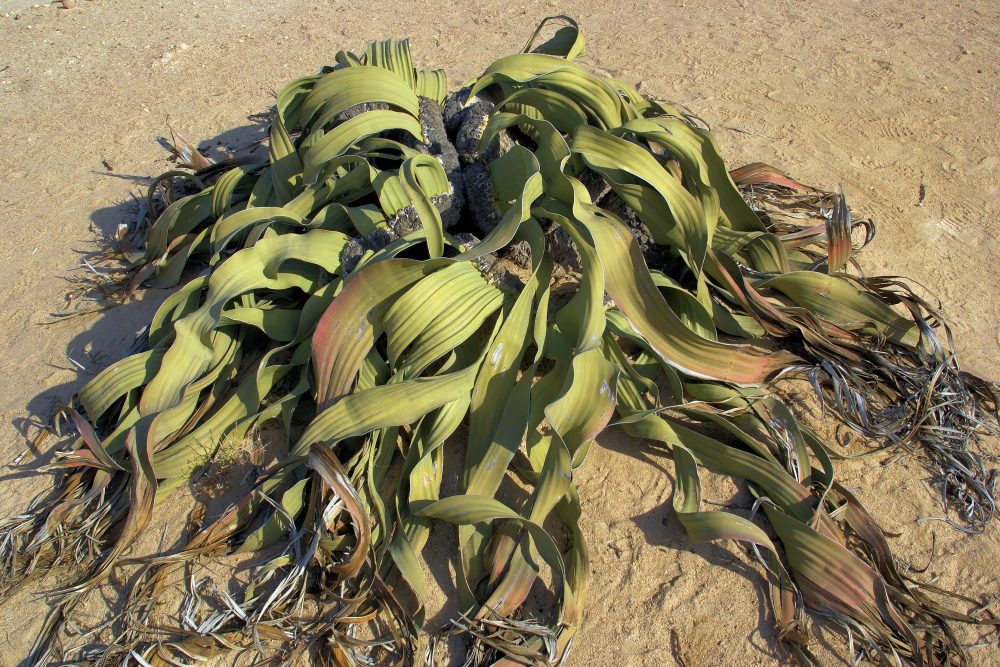
Yes, the winds and sandstorms normally cut the two plants longitudinally, in many stripes, which causes the impression of many leaves. However, botanists’ studies have proven that each plant has only two leaves.

Geographical location and typical habitat of the Welwitschia plant. Credit: Tao Wan

Endemic plant

Welwitschia is an endemic plant – it can be found only in the Namib Desert. As most books say, Friedrich Welwitsch found it here, not in the Kalahari. Namib is a strange desert. Precipitation is low – about 25 – 50 mm per year, but the humidity is high, as thick fog invades from the ocean.

New discoveries

The journal Nature Communications published a study where scientists talked about some of the secrets of genetics that determine the unique form of Velvichia, its longevity, and its resistance to environmental conditions. Specifically, researchers have discovered certain genetics that controls cell growth and metabolism. They found that the reason behind the impressive adaptation skills of the Welwitschia plant was genome changes occurring for over tenths of millions of years.

Welwitschia’s genome reveals everything

Scientists claim the genome shows the plant in an arid and nutrient-poor environment. Also, the history of its genome is quite consistent with the history of the desert, which means that it has been adapting to environmental changes over and over.

Sudden changes about 86 million years ago

Scientists also found that Welwitschia’s genome underwent sudden changes about 86 million years ago during an extreme drought in the region. This is when an “error” occurred in the cell division – the plant’s genome doubled.

Energy consumption

Although a duplicated gene typically lacks its original functions and has completely new ones, there is also a downside to this “evolution.” Logically, a larger genome also means higher energy consumption which would typically be fatal in such harsh environments.

Adaptability

Welwitschia, however, found another way to suppress these high-cost requirements. Since a large percentage of its “new” genome happened to be self-replicating “junk”, the plant managed to suppress the unnecessary DNA sequences. The process is known as DNA methylation, and because of it, Welwitschia can survive in the Namib Desert.

Sources:

• The Independent. (2021, August 4). A plant that ‘cannot die’ reveals its genetic secrets.
• Sima, R. (2021, July 31). A plant that ‘cannot die’ reveals its genetic secrets. The New York Times.
• Wan, T., Liu, Z., Leitch, I. J., Xin, H., Maggs-Kölling, G., Gong, Y., Li, Z., Marais, E., Liao, Y., Dai, C., Liu, F., Wu, Q., Song, C., Zhou, Y., Huang, W., Jiang, K., Wang, Q., Yang, Y., Zhong, Z., … Wang, Q. (2021, July 12). The Welwitschia Genome reveals a Unique Biology underpinning extreme longevity in deserts. Nature News.

Share157Tweet98Share27ShareSend
Vladislav Tchakarov

Vladislav Tchakarov

Hello, my name is Vladislav and I am glad to have you here on Curiosmos. As a history student, I have a strong passion for history and science, and the opportunity to research and write in this field on a daily basis is a dream come true.

Related Posts

Incredible Archaeological Discoveries
Editor's Picks

15 Incredible Finds Uncovered During Excavations

January 16, 2023
An image of the pyramid-structure discovered in Peru. Image Credit: Andina.
Editor's Picks

A 5,000-Year-Old Peruvian Pyramid Reveals Unexpected Clues About Ancient Civilization

December 9, 2019 - Updated on January 21, 2024
You’ve heard of Egypt’s pyramids — but not this hidden chamber of giant sarcophagi
Editor's Picks

You’ve heard of Egypt’s pyramids — but not this hidden chamber of giant sarcophagi

May 2, 2025
The Chang'e 4 Lander on the far side of the Moon. Credit: CLEP/ Doug Ellison
Editor's Picks

10 Photographs of the Moon’s Far Side Captured by Chinese Space Mission

November 21, 2020 - Updated on January 21, 2024
The Event Horizon Telescope captured images of the black hole jets at the center of the Centaurus A galaxy. Credit: X-RAY: CXC/NASA AND SAO; OPTICAL: ROLF OLSEN; INFRARED: JPL-CALTECH/NASA
Editor's Picks

Cosmic Oddities: 7 Strangest Objects in Space

March 27, 2023
An photograph showing the Face of the Inca at Machu Picchu. Credit: Frank Kehren.
Editor's Picks

The Face of the Inca: An Extraordinary Feature of the Ancient City of Machu Picchu

March 23, 2019 - Updated on April 29, 2025
  • About
  • Privacy Policy
  • Fair Use Notice
  • DMCA / Removal
  • Impressum
  • Contact
  • Fact-Checking Policy
  • Ethics Policy
  • Ownership and Funding Information
  • Impressum
CURIOSMOS.COM

Welcome Back!

Login to your account below

Forgotten Password?

Retrieve your password

Please enter your username or email address to reset your password.

Log In
No Result
View All Result
  • Home
  • Unsolved Mysteries
  • Ancient Civilizations
  • Cosmic Phenomena
  • Alien Theories
  • Curious Lists