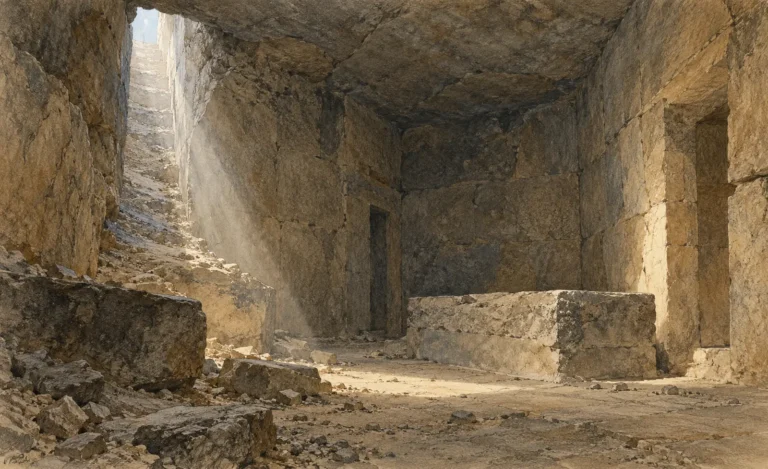
How were Baalbek’s huge stones moved? Stand beside the enormous blocks and the practical questions quickly multiply: how was the route prepared, and how did workers bring each stone into position? In the Bekaa Valley of modern Lebanon, the ancient sanctuary of Heliopolis grew through Phoenician, Hellenistic and Roman phases. Its Roman temples were built on an enormous platform that includes some of the largest dressed stones used in antiquity.
The site is especially famous for the Trilithon, three limestone blocks in the podium of the Temple of Jupiter. Their size is extraordinary. How might quarrying, transport, ramps, lifting systems and labour have worked together at a place supported by a powerful state?
From Heliopolis to a Roman sanctuary
Baalbek was known in antiquity as Heliopolis, the city of the sun. Roman rulers expanded the sanctuary from the first century B.C. onward, adding the Temple of Jupiter, the Temple of Bacchus, the Temple of Venus and monumental courtyards. Earlier sacred activity at the site matters because Roman construction did not begin on an empty landscape.
The quarry and the podium
The nearby quarry preserves enormous unfinished blocks and traces of extraction. The famous Stone of the Pregnant Woman, sometimes called Hajar al-Hibla, remains in the quarry rather than in the temple platform. Its presence shows that the builders tested or prepared very large stones, but it does not by itself tell us exactly how every block was transported or placed.
What engineers can infer
Ancient builders had several advantages that are easy to underestimate: time, organised labour, skilled stonecutters, sledges, rollers or logs where suitable, prepared surfaces, levers and earth ramps. None of these tools needs to be used alone. A heavy block can be moved in stages, with the route and platform doing much of the work. The surviving structure does not preserve the complete construction manual, so reconstructions remain models rather than eyewitness accounts.
What remains uncertain
Researchers still debate the sequence of the podium, the purpose of particular foundation blocks and the exact logistics of moving the heaviest stones. The incomplete evidence leaves room to investigate several possible construction sequences and engineering solutions. Each proposal has to account for the stones, the quarry and the surrounding architecture.
Baalbek’s value lies in the combination of scale and context. It was a functioning religious centre, connected to Roman power, local traditions and the resources of the Bekaa Valley. The stones are astonishing precisely because people made them part of a working architectural system. That question connects with our overview of ancient engineering wonders.
The temples at the centre
The Temple of Jupiter dominated the sanctuary, while the Temple of Bacchus survives as one of the best-preserved Roman temples in the region. Courtyards, stairways and gateways controlled movement through the complex. The architecture was meant to impress, but it also organised ritual, processions and access to sacred spaces.
What happened after Rome
Baalbek continued to be used and altered after the Roman period. Later communities reused stone, adapted buildings and built within the ancient precinct. That layered history is part of the site’s meaning. The largest blocks are only one chapter in a place that remained important because people kept giving it new uses.
\n
Scale is only part of the engineering story
Moving a block was one task; fitting it into a stable podium was another. Surfaces had to be levelled, loads distributed and joints protected from movement. The surviving stones preserve the result of that planning even when the written instructions have disappeared. For a coastal comparison, our examination of Arwad’s megalithic defenses explores how builders worked with an island’s terrain and shoreline.
\n
Further reading: UNESCO World Heritage Centre, Baalbek; Encyclopaedia Britannica, Baalbek.
Images and surviving evidence