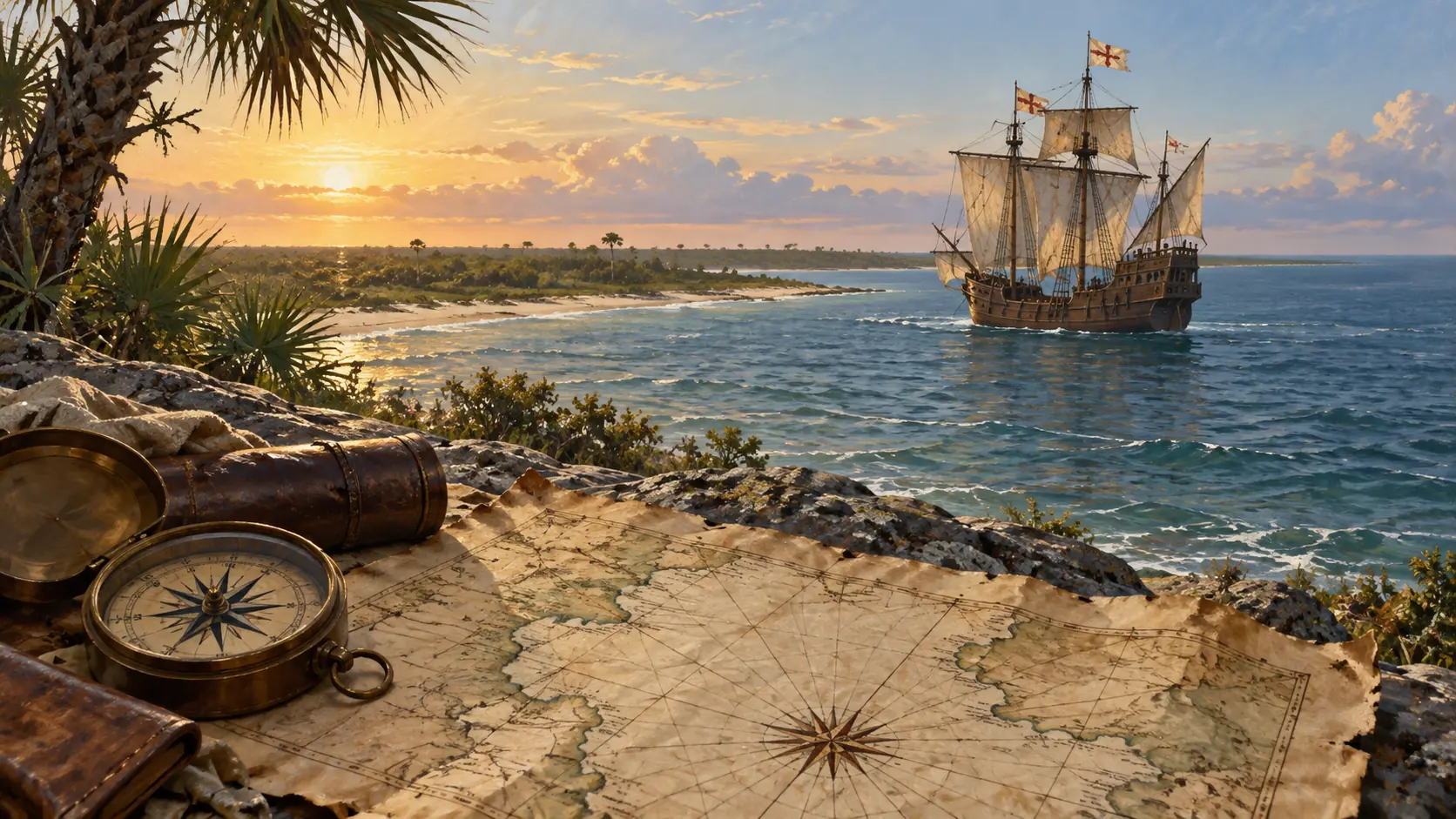
Picture Juan Ponce de León steering through the Caribbean toward a spring that could make an old man young. It is the voyage people remember. Yet the earliest printed account linking Ponce to those waters appeared in 1535, fourteen years after his death.
How did a later story become the reason we give for his 1513 expedition? One place to start is the chronicle that helped attach it to him. Its author was unimpressed by the search he described.
The fountain enters the written story
Gonzalo Fernández de Oviedo published the first part of his Historia general y natural de las Indias in 1535. In Book XVI, Chapter XI, he describes Ponce sailing north and searching the islands around Bimini for rejuvenating water.
Oviedo calls the fountain a fable and ridicules the Christians for believing it. In Chapter XIII, he returns to the subject and mocks Ponce’s judgment. This is a hostile portrayal, rather than Ponce explaining his own intentions.
The passages can be read in the King’s College London edition of Oviedo’s chronicle. They show that the Ponce-and-fountain story was in print by 1535. The explorer had died in 1521 and could no longer answer it.
A voyage and its reputation have different dates
Ponce’s 1513 expedition belonged to Spain’s expansion from the Caribbean into the lands it called Florida. Stories about extraordinary waters circulated in the region, but the surviving expedition record supplies no statement from Ponce that finding a Fountain of Youth was his purpose.
Historian J. Michael Francis traces the later association in “Who Started the Myth About a Fountain of Youth?”, published in 2011. Dating the account is essential: a text written after an explorer’s death preserves what people said about him, which may differ from what he said or did himself.
Could Ponce have heard the stories and wondered about them? He could have. That possibility leaves his private curiosity open; it does not give us a documented reason for launching the expedition.
Reading Oviedo without borrowing his judgment
Oviedo wrote from within Spain’s colonial world. His chronicle describes rival officials, voyages, conquest and struggles over royal favor. The Biblioteca Nacional de España’s account of the work places its first publication in Seville in 1535 and describes his long experience in the Americas.
A chronicler’s access to that world makes his work valuable. It also gives us a reason to read his insults as insults. When he portrays Ponce as foolish, we are hearing Oviedo’s judgment of another man. We still have to ask which documents support the story he tells.
The fountain passage is therefore best used to follow Ponce’s changing reputation. Turning it into an unquestioned account of his motives would let the chronicler decide the whole voyage for us.
Why this legend stayed with the explorer
A spring that reverses aging gives a voyage a single, irresistible goal. Territory, official appointments and colonial rivalry take longer to explain. The fountain supplied an adventure people could retell in a sentence.
There is a similar journey from report to expedition in the story of Cíbola and the Seven Cities of Gold. There, accounts of distant settlements shaped a search for riches. For Ponce, the question is different: when did a story about wondrous water become attached to a voyage that had already happened?
Following the dates brings us to Oviedo’s pages. The explorer sailed in 1513; the account that gave him his most familiar quest appeared in 1535. Between those two dates lies the making of a reputation.
Sources
- Gonzalo Fernández de Oviedo: Historia general y natural de las Indias, first part (1535), Book XVI, Chapters XI and XIII; King’s College London edition.
- J. Michael Francis: “Who Started the Myth About a Fountain of Youth?”, Forum 35(3), 2011, pp. 6–9; University of South Florida record.
- Biblioteca Nacional de España: Oviedo’s chronicle and publication history.