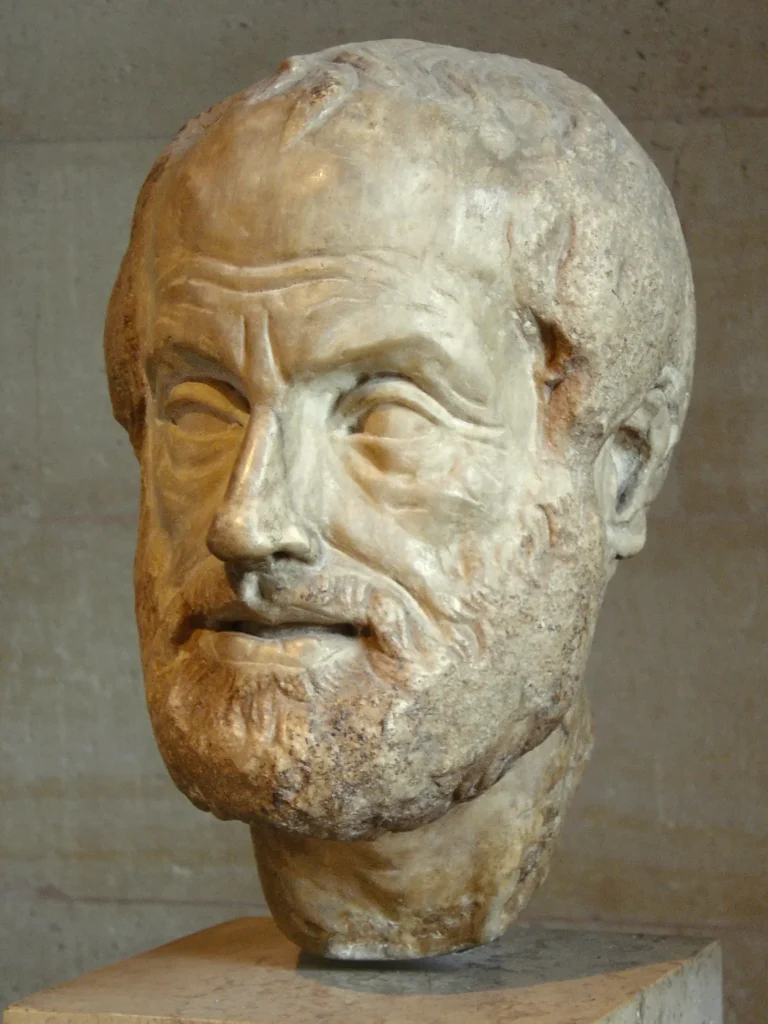
Watch a flame rise and a stone fall, then look at the stars moving across the sky. To Aristotle, those motions belonged to different kinds of bodies. The heavens seemed to turn continually, while earthly things moved towards or away from the ground.
His answer was a fifth kind of substance, commonly known as aether. Alongside earth, water, air and fire, it supplied a material suited to the circular motion of the heavens. The idea would outlive the ancient world by many centuries.
Aristotle’s aether is often mentioned as though it were simply a mysterious ingredient added to a list. In his own account, he was trying to connect what things were made of with the motions he believed were natural to them.
The problem was motion
In Book I of On the Heavens, Aristotle distinguishes straight movement from circular movement. Earthly elements have natural directions: heavy bodies move downwards, while fire moves upwards. Circular motion, he argues, requires a body with a different nature.
The reasoning starts from an observed contrast. A dropped stone does not circle the Earth in the same way as a star seems to circle the sky. Aristotle treated this as evidence of a fundamental difference between the terrestrial and celestial regions.
That made the fifth element more than a substance occupying empty space. It belonged to an explanation of why the heavens behaved as they did. Remove the special celestial motion from the argument, and the reason for that particular substance changes too.
A heaven that did not grow old
Aristotle’s argument also gives the celestial body qualities unlike ordinary earthly matter. In his account, it does not undergo the familiar processes of generation and destruction. The heavens appear enduring, while things around us burn, decay and change.
This helps explain the appeal of the model. It connected everyday experience with a sky that seemed remarkably dependable. Seasons returned, stars followed their paths, and the heavens offered an order against which a changing human world could be measured. Ancient astronomers also developed practical ways of tracking recurring patterns, illustrated by the Antikythera mechanism’s astronomical cycles.
The model’s elegance does not mean every part followed necessarily from observation. Apparent daily motion could be understood in another way if Earth itself moved. A change in that starting point would alter the explanation of the sky without requiring a special circular substance.
For Aristotle, the contrast between falling stones and circling stars called for different kinds of matter. Later accounts of a moving Earth would explain the same apparent contrast without that division.
The ether that light was supposed to travel through
Much later, physicists used the name ether for a different purpose. Waves seemed to require a medium, and light behaved as a wave. A luminiferous ether was proposed as the medium through which light travelled.
This was not simply Aristotle’s fifth element carried into a laboratory. The proposed ether addressed the propagation of light, rather than the natural circular motion of heavenly bodies.
The Case Western Reserve University account of the Michelson–Morley experiment describes the 1887 attempt to detect effects associated with Earth’s motion through such a medium. An interferometer compared light travelling along different paths. The expected effect was not found.
The American Institute of Physics’ Einstein history places the ether question in the changing physics of the period. The experiment belongs to that later debate; it was not a direct test of Aristotle’s ancient account.
One word, several questions about the universe
The persistence of the name can make these ideas seem closer than they were. Aristotle’s celestial substance and the nineteenth-century medium for light arose from different questions and were supported by different arguments.
Modern terms such as fields or quintessence can add further confusion when treated as confirmations of an ancient element. A shared name or an appealing resemblance cannot establish that two theories describe the same thing.
What remains fascinating is the question underneath them: how much of the universe can we explain using the familiar behaviour of things on Earth? Aristotle took the difference seriously enough to give the sky its own substance. Later researchers built instruments to ask whether an invisible medium left a measurable trace. The instruments changed, and so did the question: could a proposed substance produce an effect that someone could measure?