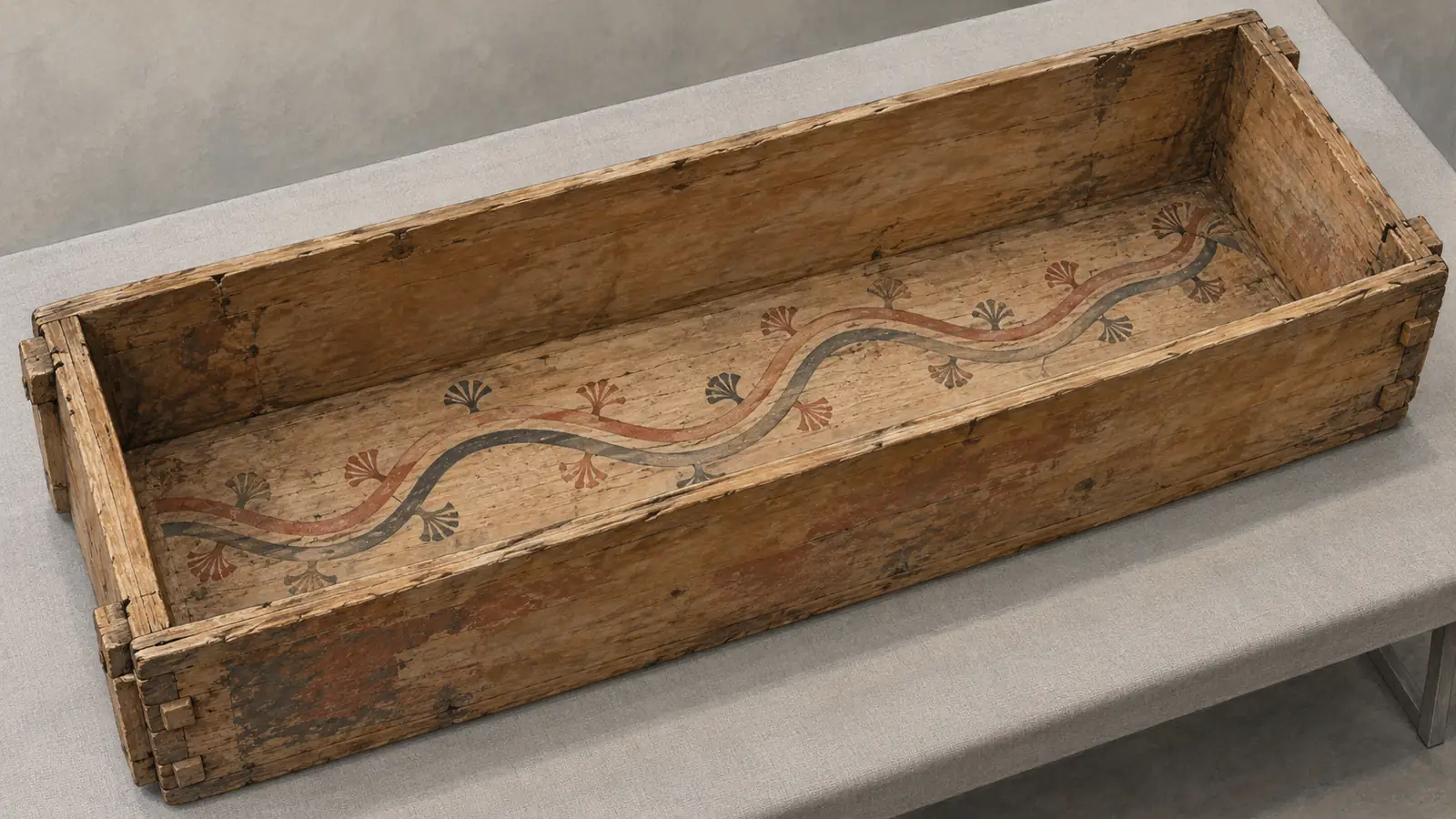
The wooden coffin was so fragile that parts could almost crumble to powder when touched. Yet its bottom still held traces of an Egyptian composition intended to outlast death: the Book of Two Ways.
It belonged to a woman named Ankh, buried at Dayr al-Barsha in Middle Egypt. Conservators rescued enough material to identify an exceptionally early version of the text, written on the coffin bottom beneath her body roughly four thousand years ago.
Calling it a “map of the underworld” gives us an immediate picture. But what if the images also preserved the actions of a ritual—something meant to bring the dead back to life?
A shaft abandoned, then explored again
According to the KU Leuven excavation team’s account, George Reisner stopped work in the shaft in 1915 after encountering modern waste. Harco Willems’s team reopened it in 2012 and found collapsed funerary equipment still partly in its original position.
Years of conservation and documentation followed. The surviving coffin bottom belonged to Ankh, a relative of the provincial governor Ahanakht. The team places it around 2040 BCE, near the beginning of the Middle Kingdom.
Reading the coffin took far longer than finding it. The team first had to conserve wood that could disintegrate under a touch, then document the surviving marks. Each stage affected how much of the text could be recovered.
What survives on Ankh’s coffin
Willems’s study, first published online in 2019, identifies the coffin as B4B. The fragment discussed retains portions of Coffin Text spells numbered 1128 and 1130. Reading its incised hieratic signs was one of the paper’s central problems.
The published documentation includes an enhanced image showing traces of red and black ink, with part of a boat on a sledge. Even this small surviving image helps identify what once covered the coffin bottom. More complete examples on other coffins help scholars compare the composition, but Ankh’s survives in fragments.
Two routes, and a world of gods
The name “Book of Two Ways” was coined by modern scholars for a composition associated with coffins from Dayr al-Barsha. Its two curving routes have commonly been understood as paths through the divine world. The drawings include gates, boats and dangerous beings, accompanied by spells.
These texts sit within the Middle Kingdom Coffin Text tradition. Curiosmos’s introduction to the earlier Pyramid Texts provides a starting point for the longer history of Egyptian funerary writing. The later Book of the Dead belongs to another stage of that history.
A modern road map helps a traveller choose a route through physical space. A funerary composition could do several things at once: identify places, provide words to speak, offer protection and connect its owner with divine renewal. The routes can be considered alongside the words a person was meant to speak and the powers those words were believed to have.
Could the “map” preserve a ritual?
Willems has proposed a connection with the cult of Osiris, the dead god whom Egyptians sought to revive through ritual. KU Leuven’s account of his interpretation describes how texts used in that setting might have been copied onto coffins so that the dead person could share in the god’s revival.
Under that interpretation, placing the composition in a coffin gave its owner lasting access to the words and actions of renewal.
One curious detail concerns gender. Although Ankh was a woman, the composition could speak in masculine terms associated with Osiris. Willems connects this with copying a master text whose protagonist was the male god. A masculine pronoun in such a passage could refer to the divine role Ankh was expected to take on after death.
A coffin designed for continued life
Painted details on other Middle Kingdom coffins help explain how the wooden box itself could serve its owner. In its account of Khnumnakht’s coffin, the Metropolitan Museum of Art explains painted eyes, a false door and protective figures. Such features gave the container a role in the continued existence of its owner.
Khnumnakht’s coffin is a separate object from another place and date. It offers a glimpse of what a decorated wooden container could do in Egyptian belief: words and images could turn the surfaces around a body into equipment for an afterlife.
Ankh lay above a composition that linked its owner with the world of the gods. Whether we read it primarily as routes through that world or words for a ritual of revival, its place beneath her body made it part of the burial itself.
Sources and further reading
- Harco Willems, “A Fragment of an Early Book of Two Ways on the Coffin of Ankh from Dayr al-Barshā (B4B),” Journal of Egyptian Archaeology (online 2019)
- KU Leuven excavation team, discovery and conservation account
- KU Leuven, Willems’s interpretation of the text and Osiris ritual (2020)
- The Metropolitan Museum of Art, The Art of Ancient Egypt, object 32: Khnumnakht’s coffin