In an Egyptian story carved into sandstone, help for a sick princess arrives after a journey lasting a year and five months. The visitor is Khonsu, transported abroad in the form of a divine image. Once the princess recovers, her father decides that Egypt’s god should stay.
The Bentresh stela survives in the Louvre. It gives this journey a royal setting, religious ceremony and an ending in which a frightened ruler finally lets the visitor go home. There is also a puzzle in the stone itself: its story takes place under Ramesses II, but the carving may be centuries later.
The monument and its uncertain date
The Louvre’s object record identifies the stela as C 284, also catalogued as E 13481. Standing 2.27 metres high, it came from the small temple of Khonsu at Karnak. The upper scene shows two divine barques being carried in procession, with offerings made before them.
The text invokes Ramesses II. The catalogue nevertheless describes the monument as probably later than his reign. Its heading gives a tentative Twenty-first Dynasty attribution based on style, while the detailed dating note acknowledges that it has often been placed in the Persian or Ptolemaic period.
Those proposed dates span centuries. The inscription may tell us how later Egyptians imagined Ramesses’s reign, rather than describe an event recorded at his court. Its royal setting and the date of the carving remain separate questions.
How the god reached Bentresh
In James Henry Breasted’s translation of the inscription, Bentresh is the sister of a foreign princess who has become an Egyptian royal wife. When she falls ill, a learned royal scribe is sent to examine her. He cannot provide the cure, and Khonsu’s help is requested.
The narrative distinguishes two manifestations of the deity. One authorises and protects the other, the form dispatched abroad to confront the afflicting spirit. Bentresh recovers on its arrival. The spirit agrees to depart after an offering and feast.
Her father then keeps the god for three years and nine months. In a dream, he sees it leave its shrine as a golden falcon flying towards Egypt. Alarmed, he sends the divine image back with gifts.
The stela describes the illness as an encounter with a spirit and the recovery as Khonsu’s work. It offers no clinical details from which to identify Bentresh’s condition. The feast, offerings and negotiations belong to its account of how a god intervened abroad.
Recognising Khonsu in surviving objects
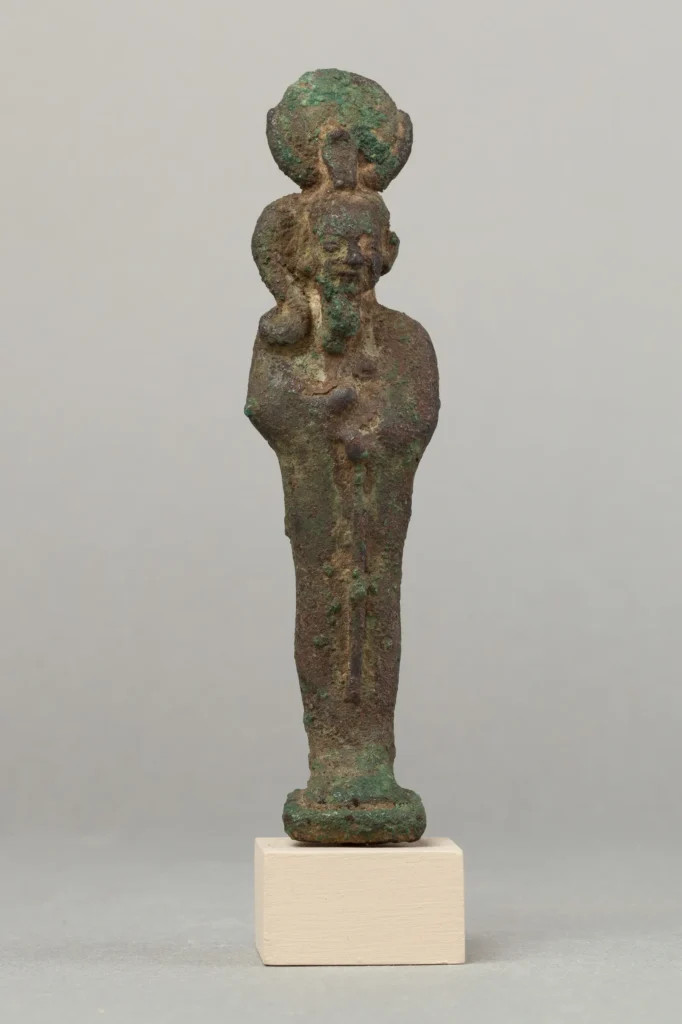
Khonsu appears in more than one form outside this tale, too. A metal figure at the Metropolitan Museum of Art, dated to 664–30 BCE, shows him as a child with a sidelock and moon disk. The museum identifies him as the son of Amun and Mut in the Theban divine family.
A bronze figure in the Walters Art Museum instead gives him a falcon’s head beneath a lunar disk and crescent. Neither statuette is the travelling image from Bentresh’s story. They help us recognise the range of appearances through which Egyptians represented this god.
A divine name could encompass several appearances and roles. As with Ra’s changing forms, a single modern portrait cannot encompass every role.
A guest the ruler could not keep
The foreign ruler receives the help he wants, then tries to keep its source. For three years and nine months, the image remains abroad. The dream finally makes him fear the consequences of holding it there.
That ending gives the statue a role beyond carrying a god’s likeness. In the tale, it arrives, heals and demands a return home through a dream. The ruler treats it as a powerful guest with wishes of its own. Seen that way, a procession of divine images becomes easier to imagine: the Egyptians carrying the barques were accompanying a presence, not merely transporting an object.