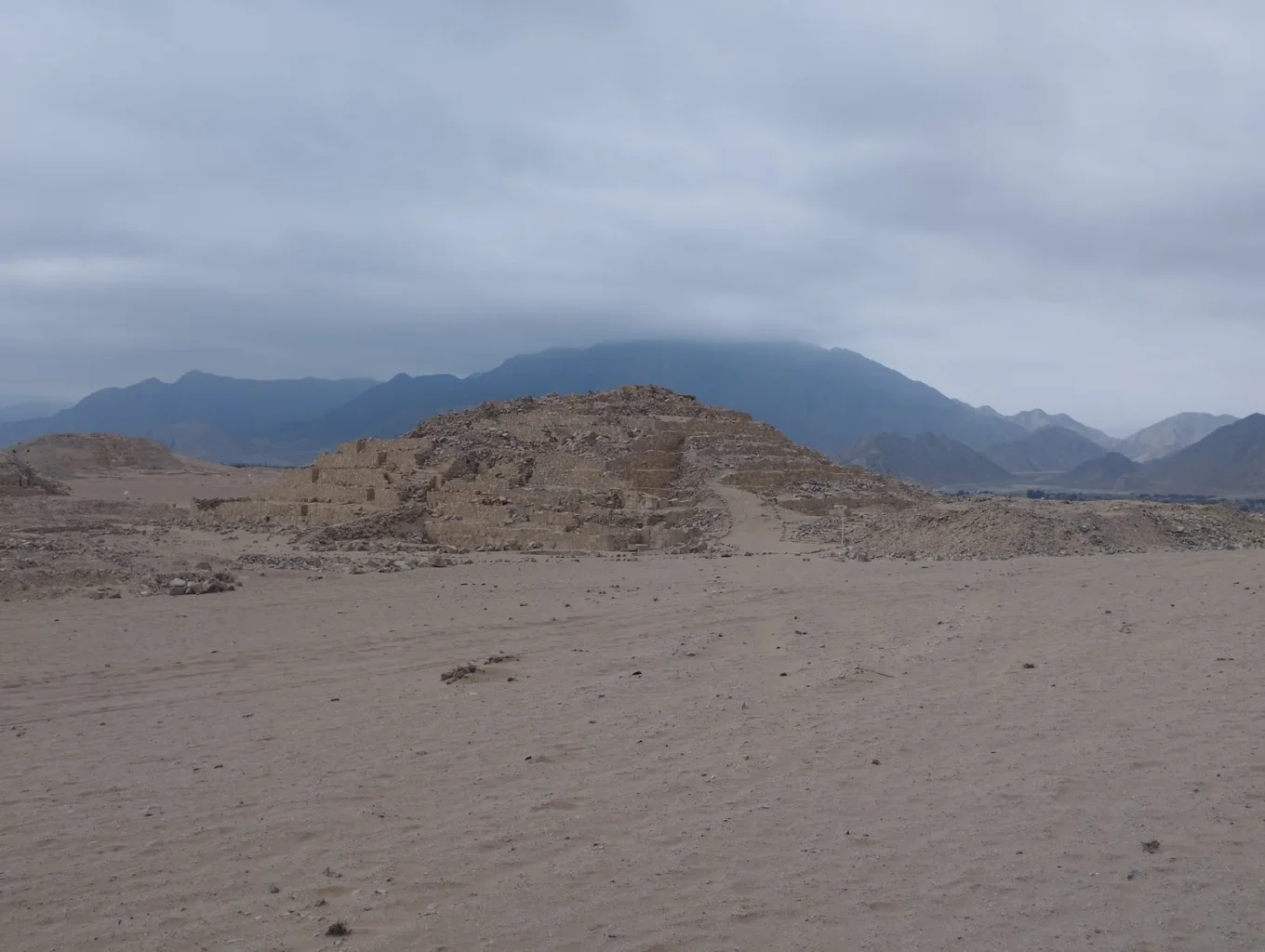
A stone-filled bag sounds like an unlikely thing to place beneath a monumental building. At Caral and other early sites on Peru’s coast, plant-fibre bags called shicras became part of construction fills. Their woven fibres held the stones together.
Could that simple arrangement also help a structure during an earthquake? Researchers put replicas onto a shaking table to find out. The experiment revealed movement resembling a modern engineering principle: letting a foundation roll so that less acceleration reaches the weight above it.
The research was published in 2013. For the team, the question was practical: how would the bags move when the ground beneath them shook?
The bags inside the platforms
Caral’s large platforms and sunken circular courts occupy an arid terrace above the Supe Valley. UNESCO’s account places the site’s development between about 3000 and 1800 BCE and describes architecture that influenced other settlements along the Peruvian coast.
That makes the shicras part of a much wider undertaking than moving loose stone. People had to organise materials and labour, build substantial platforms and maintain ceremonial spaces over generations. Our overview of Caral follows the city; the bags take us inside the construction itself.
The archaeological project’s 2014 account of building methods describes stone-filled shicras within superimposed platforms. It also identifies internal structural walls, substantial stones at corners and bases, and platforms that become narrower as they rise.
The bags therefore worked within an architectural system. Their behaviour is important, but so are the walls holding the fill, the shape of the platforms and the weight they carry. Looking at only one component can give us an incomplete picture of why a building remained stable.
What the shaking-table test found
Hiroshi Fukuyama and colleagues tested replicas based on finds from Caral and Las Shicras. They formed stone-filled plant-fibre bags into roughly 30-centimetre balls and used steel plates to represent the mass of buildings above them.
During shaking, individual bags could rotate. In the tested arrangement, movement increased once acceleration reached roughly 300 gal, about 0.3 times gravitational acceleration. The rotation helped limit the acceleration transmitted to the model above.
Loose-stone foundations behaved differently and were more prone to stones breaking away. The authors compared the bagged-stone response with rolling seismic isolation. They also noted that the measured threshold depended on the replicas and should not be treated as a fixed value for ancient foundations.
The experiment tested a physical effect. It could not establish whether ancient builders understood that effect as earthquake isolation.
Why rolling can make a difference
Imagine a weight resting on a surface that moves sideways. If the connection is rigid, the weight is forced to follow that motion closely. If the support can move relative to the surface, the motion transmitted upward can change.
A stone-filled fibre bag can retain a roughly rounded shape while allowing movement. The fibres matter because they keep the contents together as a unit. Loose stones do not necessarily produce the same coordinated movement.
The packing would make a difference to that movement: how tightly were the bags packed, how many layers were used, and what confined them on each side?
A shaking table makes such questions testable. Researchers can hold some features constant, change another and compare the response. The remaining challenge is to connect a manageable laboratory arrangement with the more complicated structure of an actual platform.
What builders could learn by experience
The archaeological project’s account describes several ways Caral’s builders improved stability, including reinforcing corners and building broad lower platforms. Such decisions can be developed through observation, repair and repeated construction.
Could experience with shaking have encouraged the use of shicras? It is a reasonable question. To investigate it, archaeologists would need to follow where the bags occur, changes in their use and evidence of rebuilding or earthquake damage. The behaviour measured in a laboratory supplies one part of that investigation.
It is also possible for a useful effect to arise from a technique adopted for several reasons. A bag keeps stones together during transport and placement. Its value during shaking could then become apparent through use, whether or not anyone expressed it in the terms of modern engineering.
The builders left their bags and platforms behind, but no written explanation of the decisions. Excavation and experiments must work together to recover as much of that practical knowledge as possible.
The technique is still being demonstrated
In an October 2026 report, Zona Arqueológica Caral described a September workshop in Lima where participants learned the knots and construction of shicras. The project presented the bags as a technique used in the fills of Caral’s monumental buildings.
A practical demonstration brings attention back to the material. Before a bag can become part of a foundation, someone must gather fibres, make secure knots and produce an object capable of holding stone. Monumental architecture contains many such ordinary tasks.
The old woven bags deserve attention for exactly that reason. A small construction choice can affect the behaviour of something much larger. The shaking-table study gives us a glimpse of how, and the surviving platforms give archaeologists a place to keep testing the connection.