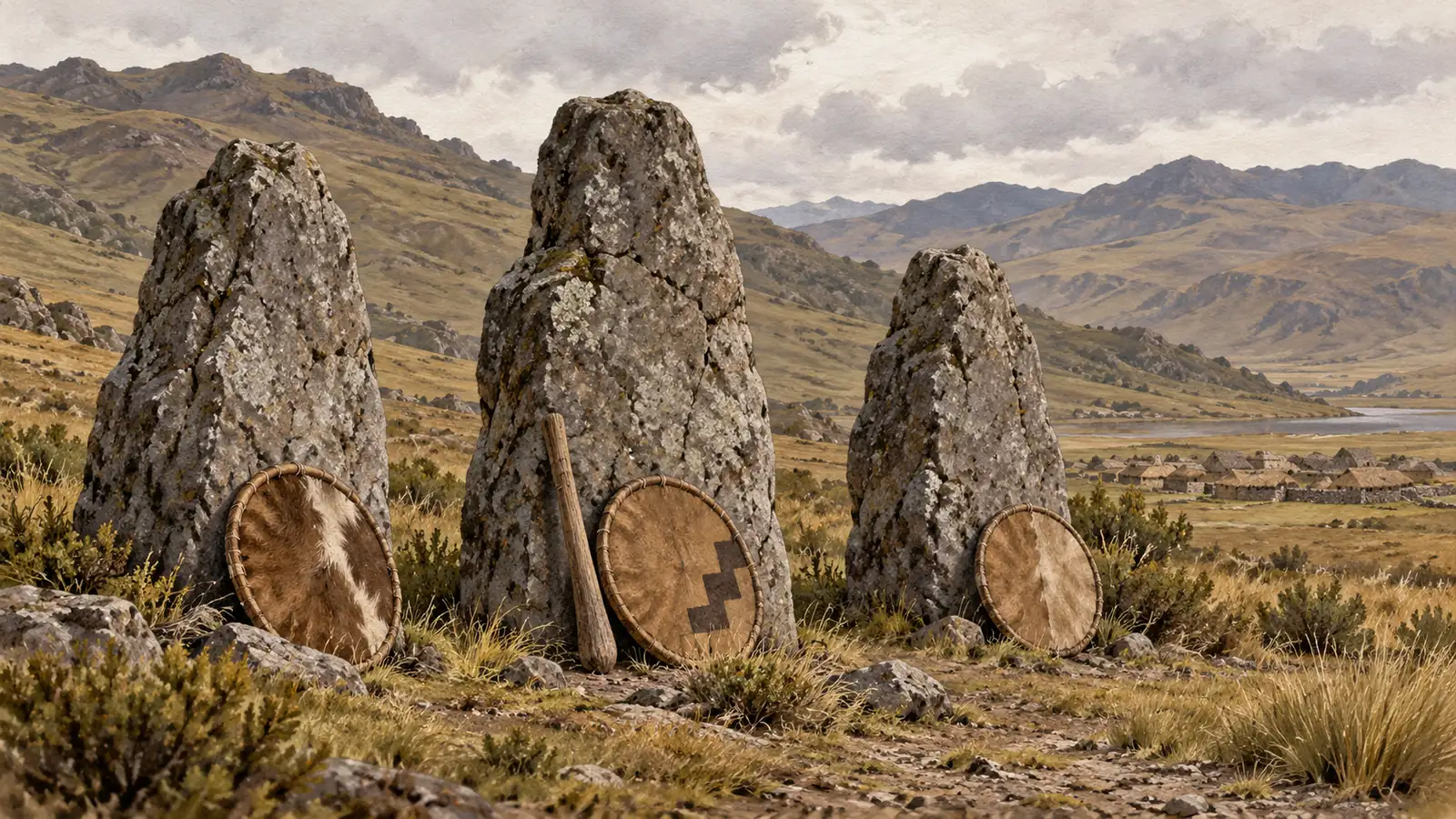
Rows of stones stood outside Cusco, dressed with shields, helmets and clubs. From a distance, they could pass for soldiers waiting to fight. Then, in an Andean account of the city’s defence, the stones got up.
These were the Pururaucas, the extraordinary warriors said to have helped defeat the Chancas. Their story survives in colonial-era writings about the Inca past. Follow it beyond the battle and another question appears: what became of an army that could turn back into stone?
The accounts describe sacred objects with names, places and offerings. Comparing them takes us from an embattled city to the stones its people continued to honour.
The prince who stayed in Cusco
Pedro Sarmiento de Gamboa’s History of the Incas, completed in 1572, places a young Inca Yupanqui at the centre of the crisis. His father, Viracocha Inca, leaves Cusco with his preferred son Urco. Yupanqui stays to defend it.
Here, even the human reinforcements are uncertain. Sarmiento describes people watching from a distance, reluctant to commit themselves until they know which side will win. The defenders must fight while potential allies wait.
Yupanqui also receives a remarkable vision. A radiant figure appears to him at Susurpuquio, promises victory and shows him future conquests in a mirror. In this telling, the city’s defence begins with a divine encounter as well as military preparations.
Sarmiento’s account comes with its own political baggage. It was commissioned under the Spanish viceroy Francisco de Toledo, whose administration sought to portray Inca rule as illegitimate. Reading the chronicle means listening for the inherited story and the colonial argument surrounding it.
When the waiting stones joined the battle
Juan de Santa Cruz Pachacuti Yamqui Salcamaygua preserves a different, wonderfully physical scene. As reproduced and discussed by historian Luis Galdames, an official associated with the Coricancha arranges stones with military equipment so they resemble seated warriors.
Inca Yupanqui addresses them as brothers and urges them into action. As the enemy presses forward, the stones rise and fight. The apparent decoys have become the reinforcements the city needs.
In this telling, the stones begin the battle dressed for war and become warriors themselves. The account places the preparations and the transformation side by side.
Galdames’s 1987 study of stone and transformation in Andean thought compares such passages across the chronicles. His approach asks how people understood a landscape in which a stone could also be a powerful presence.
The warriors did not retire quietly
Bernabé Cobo’s version extends their service beyond the first victory. The warriors return to stone after fighting the Chancas, yet can take human form again in later wars. They remain available to the ruler who recognises them.
A 2020 study of the Andean sacred landscape brings together accounts of their subsequent treatment. The ruler identifies particular stones, gives them individual names and has them brought ceremonially to Cusco. Some are placed in the Sun temple; others receive locations elsewhere, with attendants and offerings.
After the battle, the story continued in Cusco. A named stone with a caretaker and regular offerings belonged to an enduring relationship between the community and its sacred places.
The same study notes that chroniclers and an early Quechua dictionary give differing explanations of the name Pururauca. Translating it as a single, universally agreed phrase would make the surviving record look tidier than it is.
A victory with more than one remembered hero
Even the ruler’s identity shifts between accounts. Viracocha Inca and his son Inca Yupanqui, later known as Pachacuti, do not occupy identical roles in every version. Viracocha is also the name of a deity. Mixing the god and the ruler together can produce a much smoother story, but a confusing history.
Polo de Ondegardo’s report, available in the 1873 Narratives of the Rites and Laws of the Yncas, links the promised heavenly reinforcements with the authority the Incas claimed for further conquest. A rescued city could become the starting point of a much larger ambition.
The expanding state eventually reached places such as Chan Chan on Peru’s northern coast. The stone-warrior tradition belongs to the remembered beginnings of that expansion, when Cusco itself was still in danger.
The battle ends, but the Pururaucas remain: stones with names, places of honor and people who brought them offerings. In Cusco, the city’s extraordinary defenders were not forgotten when the fighting stopped.
Sources
- Pedro Sarmiento de Gamboa, History of the Incas, 1572; Clements Markham’s 1907 translation, especially chapters XXVI–XXIX and the introduction.
- Luis A. Galdames Rosas, Vitalidad de la piedra y petrificación de la vida: notas sobre mentalidad andina, Diálogo Andino 6, 1987, including quoted chronicle passages.
- El paisaje petrificado. Deidades, personajes y etnocategorías andinas, Interciencia 45(10), 2020, especially the Pururauca discussion and references to Cobo and Polo de Ondegardo.
- Polo de Ondegardo’s report in Clements Markham, translator and editor, Narratives of the Rites and Laws of the Yncas, 1873, pp. 151–155.