Imagine returning from an errand and finding that everyone you know has vanished. The streets belong to your city, but your home is unfamiliar. You ask after a friend, and a stranger answers as though you have named someone from another lifetime.
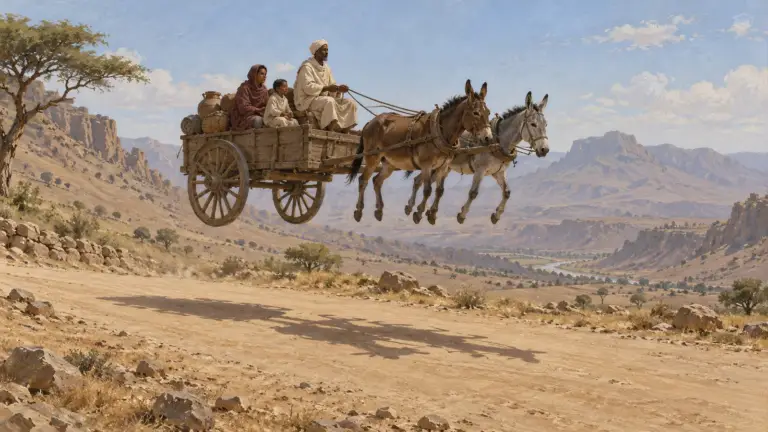
That is the predicament of Abimelech in the Paralipomena of Jeremiah, also known as 4 Baruch. He has gone out to gather figs and stopped beneath a tree. What feels like a brief rest carries him across sixty-six years.
The story has an obvious appeal to anyone drawn to time slips and unusual experiences of time. Reading it closely reveals another question running beneath the surprise: how could someone return to a world that has suffered a catastrophe while he was away?
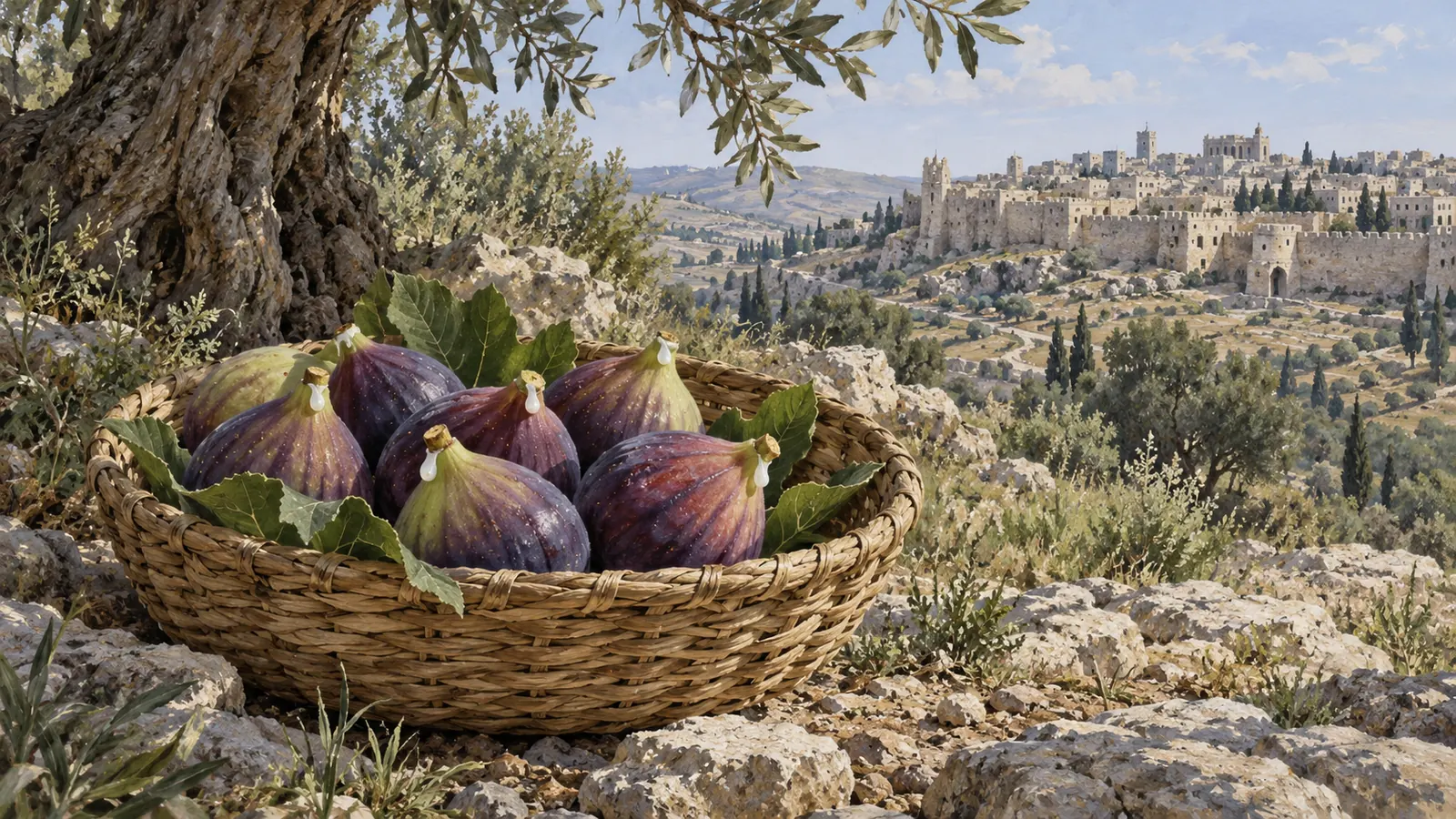
A basket that belongs to another season
In chapters 3–5, Jeremiah sends Abimelech outside Jerusalem before the city’s destruction. After sleeping, he returns with fresh figs, worried that his errand has taken too long. He cannot recognise his surroundings. An old man explains that the people were carried into Babylon decades earlier and points to the season: figs should not be fresh now.
Later, Baruch recognises the preserved fruit as a sign of divine protection. An eagle carries a letter and figs to Jeremiah in Babylon; the narrative also gives the bird a part in reviving a dead person.
The figs are a wonderfully concrete choice. We can picture fruit softening in a basket far more easily than we can picture sixty-six missing years. The author places those two timescales beside each other and lets their incompatibility drive the encounter.
Abimelech’s first concern is familiar, too. He thinks he is late. The reader knows that his anxiety belongs to a day that has disappeared from everyone else’s life.
The Ethiopian who helped Jeremiah
The character has a connection to the biblical Book of Jeremiah. In Jeremiah 38, Ebed-melech, described as an Ethiopian serving in the royal household, intervenes when the prophet is trapped in a muddy cistern.
He obtains the king’s permission to rescue Jeremiah. The account even includes the practical detail of old cloths placed beneath the prophet’s arms to protect him from the ropes. In chapter 39, he receives a promise of deliverance because of his trust in God.
The later sleep narrative develops that relationship into an extraordinary rescue of its own. Reading the two accounts together gives Abimelech a history before he reaches the tree. He has already acted to save someone else.
Readers interested in the setting can explore Curiosmos’s introduction to ancient Babylon. The sleep story uses the separation between Jerusalem and Babylon to keep its characters apart until a message can cross the distance.
A story with more than one history
The title Paralipomena refers to things left out or omitted. It signals a work expanding the Jeremiah tradition, rather than another chapter simply overlooked in a modern Bible. Scholars also call it 4 Baruch; the different names can make the same work look like several separate books online.
In his Society of Biblical Literature commentary, Jens Herzer examines its Jewish setting and subsequent Christian editing. He argues for a Jewish composition around 130 CE, although dating the work remains a scholarly question. Its setting in the Babylonian exile is much earlier than that proposed date.
Why tell a story about one destroyed Jerusalem to people who knew the loss of another? An author could use the earlier disaster to address the fears of a later generation. Herzer connects the work’s hope of return with Jewish life after the Roman destruction of Jerusalem in 70 CE.
The exact year of composition need not be settled for that reading to be useful. It directs attention to the people who copied and received the story, as well as the extraordinary event within it.
The question of time
What if the most unsettling part of a journey through time were coming home? Abimelech’s experience lets us consider that possibility from the inside: familiar landmarks remain, but the people who made them familiar are gone.
There is a modern scientific comparison worth making carefully. Time dilation is measurable: atomic clocks can tick at different rates because of their motion or position in a gravitational field. NIST’s clock experiments examine that effect by comparing precision instruments under controlled conditions.
The ancient narrative offers no comparable measurements or physical mechanism. Its connection with modern time-travel stories lies in the experience it imagines—one person’s short interval set against a much longer interval outside.
Abimelech carries the only ordinary thing that still belongs to the morning he remembers. Everything around him has changed; the figs have survived. That small detail gives the missing years a disturbing intimacy, even as the story offers its promise of protection and return.
Sources
- Paralipomena of Jeremiah, longer version, translation by Robert A. Kraft and Ann Elizabeth Purintun, chapters 3–7.
- Jens Herzer, 4 Baruch: translation, introduction and commentary, Society of Biblical Literature, 2005.
- Jeremiah 38:7–13 and 39:15–18, King James Version.
- NIST, Relativity and Optical Clocks, 2010.