

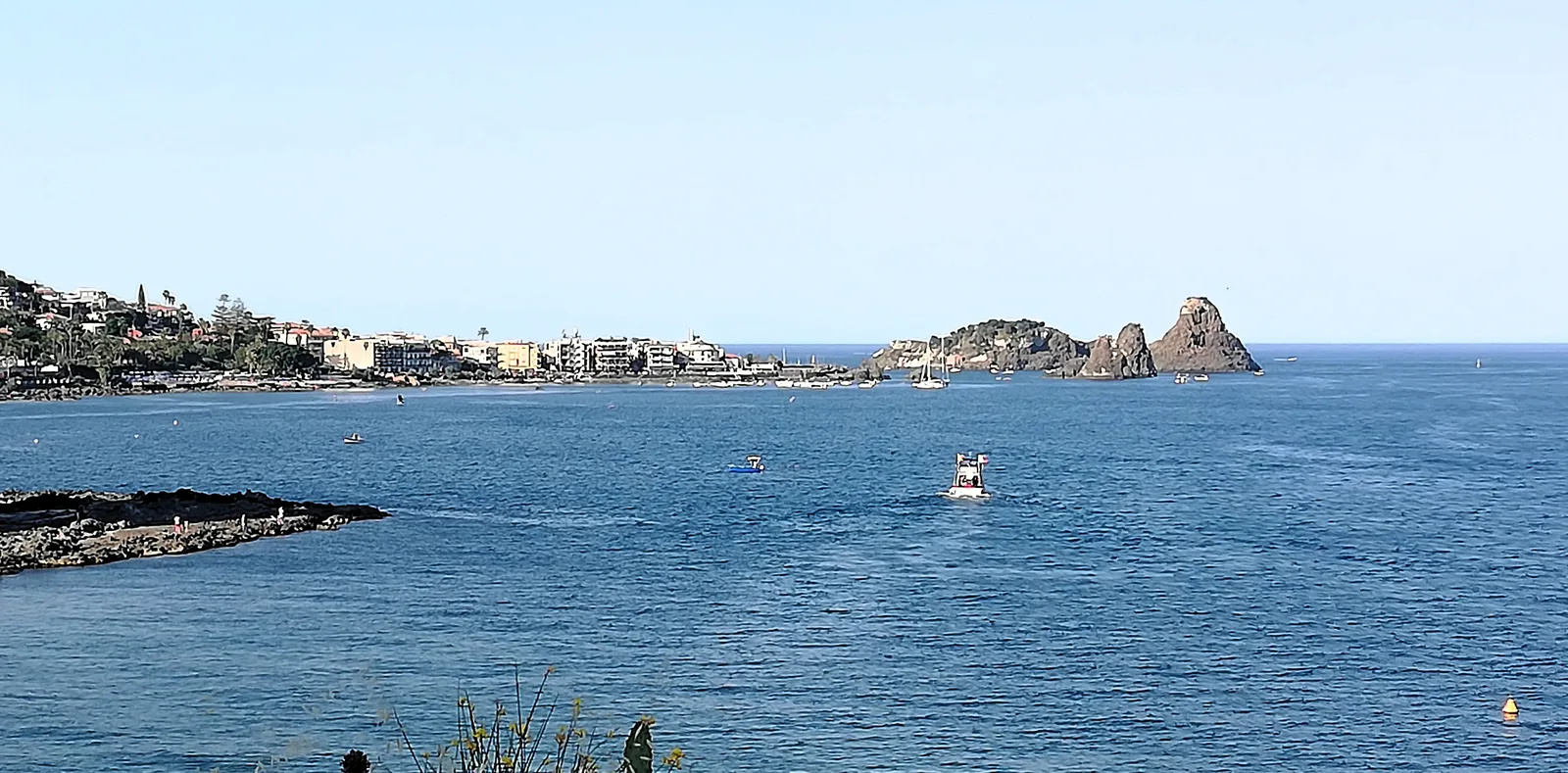
Dark rocks rise from the sea off Aci Trezza, on Sicily’s eastern coast. Local tradition gives them a dramatic origin: they are the stones Polyphemus hurled after the escaping Odysseus. Geology gives them a much older volcanic history.
Put those accounts beside one another and an intriguing question emerges. Could volcanic landscapes have helped shape the stories told about the Cyclops?
Homer gives us the giant and the fleeing ship. Later writers place Polyphemus in Sicily, where Etna and the offshore rocks supply a vivid setting. Following that journey helps us explore what the landscape contributed.
The cave in the Odyssey
In Book 9, Odysseus tells how he and his men entered the dwelling of Polyphemus, a one-eyed giant who kept sheep and consumed some of his visitors. The survivors used wine, a sharpened stake and a false name to escape.
When the giant called for help, Odysseus’s claim to be named “Nobody” made the other Cyclopes misunderstand the danger. The men later slipped out beneath the animals. From his ship, Odysseus taunted Polyphemus, who threw rocks toward the sound.
The story supplies a cave, a fire, a wounded eye and flying stones. Those features make a volcanic comparison easy to picture. A crater might resemble an eye, an eruption can throw rock, and a roar can give a landscape something like a voice.
As a reading of the imagery, that is worth exploring. Identifying the origin of the tale is a further question, requiring more than a resemblance between a giant and a volcano.
When the Cyclops acquired a Sicilian home
Classicist Isabella Nova’s 2023 study, “The Cyclops Comes to Sicily,” follows the episode’s geography through ancient texts. She explains that the Odyssey leaves the location undetermined, while writers from the fifth century BCE onward consistently connect it with Sicily.
Once the giant had a Sicilian home, audiences could picture his cave against scenery shaped by Etna.
We can see the Sicilian association in a primary text. At the beginning of Euripides’s satyr play Cyclops, Silenus describes being driven to the rock of Etna and enslaved by Polyphemus. Etna is part of the setting.
Thucydides also mentions Cyclopes among Sicily’s earliest reputed inhabitants. He leaves their origins to the poets and common accounts. The passage shows the tradition circulating, while preserving his distance from an ordinary historical identification.
Reading these accounts together gives the legend a chronology. A story can find a new home, and that home’s landscape can then become part of the way the story is told.
What the rocks record
Etna’s park authority describes the basaltic formations around Aci Trezza, Lachea Island and Aci Castello as evidence of early volcanic activity, including eruptions beneath the sea. They belong to the long geological development of the Etna region.
This creates a striking difference in timescale. The rocks were already ancient when people attached the Cyclops story to them. Their physical history is investigated through rock types, deposits and geological relationships; their legendary history is followed through texts and local traditions.
The legend gives the scattered rocks an immediately imaginable arrangement: a giant onshore, a departing boat and stones landing in the sea. It is an effective way to give a distinctive coastline a story.
Could a sailor looking at that coastline have found the legend convincing? The setting certainly supplies visual encouragement. That tells us something about the story’s appeal, even while the rocks retain their volcanic origin.
Etna gathered more than one giant
A 2025 study in Geoheritage, by David Chester, Angus Duncan and Stefano Branca, examines the religious and cultural accounts used to understand eruptions around Etna. It includes the Cyclops Islands tradition alongside other stories attached to the volcano.
Greek and Roman authors also associated Etna with buried giants and the forge of Hephaestus, known to Romans as Vulcan. The smith’s workshop offered one way to imagine fire and powerful activity beneath the ground. Vulcan belongs to the wider Roman religious world, with roles that extend beyond this particular mountain.
Nova’s study points out that Greek stories contain several groups of Cyclopes: giant builders, divine craftsmen and the beings encountered by Odysseus. Similar names and shared landscapes could draw their stories together over time.
That makes Sicily an unusually rich place to follow the meeting of myth and geology. We can ask how a volcanic island shaped the reception of a tale without needing to reduce every monster to a natural event.
At Aci Trezza, the two histories remain visible together: rock left by ancient volcanic processes and a story about a giant who tried to stop a ship. Looking closely at each gives the other more depth.
_08_06_2025_01.jpg)