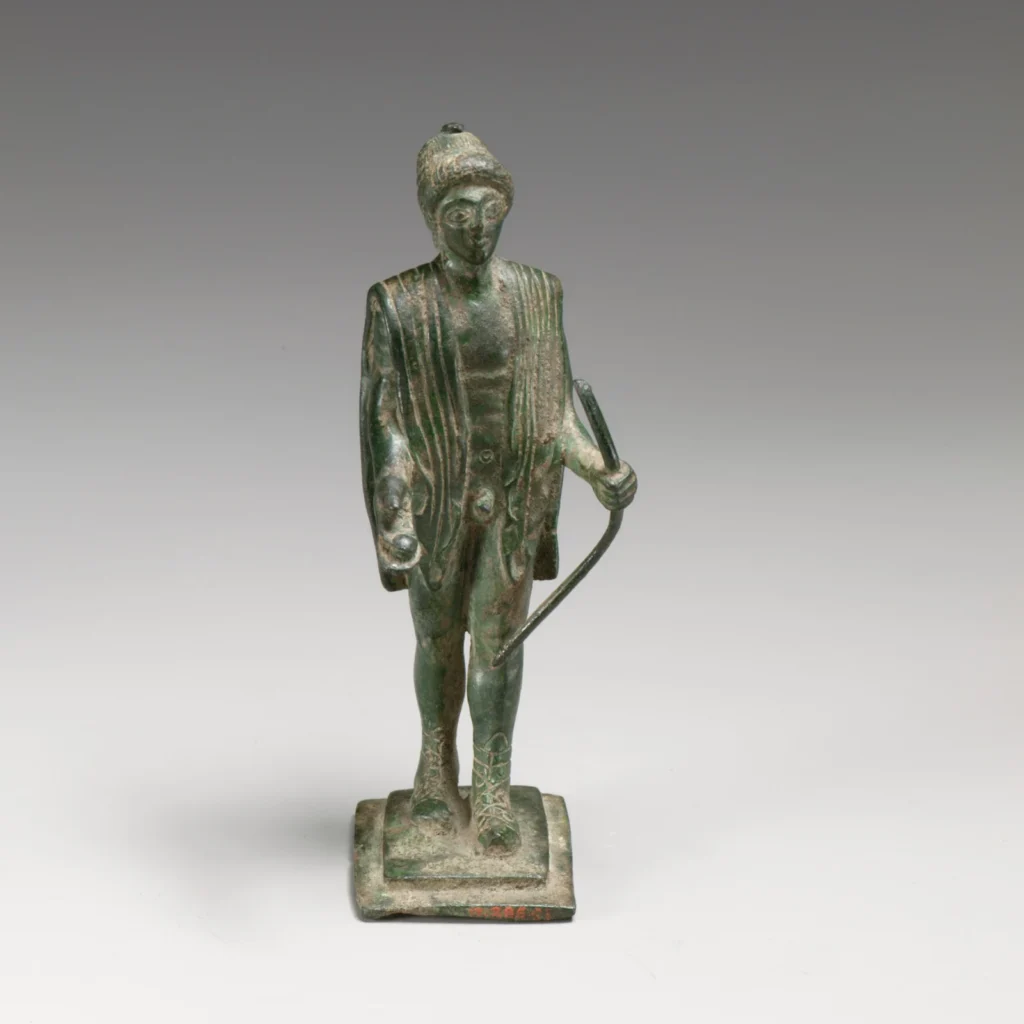
A traveller from the far north crosses the world with an arrow. In one ancient account, he carries it without needing food. In another, the arrow carries him over rivers, marshes and mountains.
Abaris is one of those figures whose story becomes stranger as we follow it through surviving literature. His association with Apollo, healing and Hyperborea places him at the edge of the familiar Greek world. The arrow makes that distance feel almost impossible to cross by ordinary means.
Did the arrow become a vehicle as the tale was retold, or did different versions already circulate? Herodotus and Iamblichus preserve the contrast, although the surviving passages leave the history between them open.
The arrow Abaris carried
In Book Four, chapter 36 of his Histories, Herodotus refers briefly to Abaris while discussing the Hyperboreans. He declines to give the whole tale. The detail he does include is extraordinary enough: Abaris travelled around the earth carrying an arrow and taking no food.
In G. C. Macaulay’s translation, the arrow is carried. Herodotus does not describe Abaris riding it or explain how it could move through the air. His short reference nevertheless assumes a story existed that his account could leave untold.
Herodotus’s decision to pass over the tale is intriguing. What else had his audience heard? The brief reference gives us a traveller who needs no food, but leaves the rest of his adventure untold.
A name associated with healing charms
Plato supplies a different glimpse. In Charmides, Socrates mentions charms associated with Abaris the Hyperborean during a discussion of treatment and temperance.
The reference does not describe the arrow’s journey. It places Abaris’s name in a setting where words, healing and the condition of the person receiving treatment belong together. Abaris could therefore evoke more than unusual travel.
The two references give Abaris different reputations: a traveller sustained without food and a name associated with healing charms. They are glimpses of a legendary figure, with little of the detail needed to reconstruct a historical life.
The arrow becomes a vehicle
A much fuller encounter appears in sections 90–93 of Iamblichus’s On the Pythagorean Life, translated by Gillian Clark. Abaris is an elderly priest of Apollo returning from Greece with gold collected for the god. His arrow helps him cross otherwise impassable landscapes by riding on it.
In Italy he meets Pythagoras and recognises him as Apollo in human form. Pythagoras receives the arrow and shows him a golden thigh as confirmation. Abaris stays to help the community and receives instruction, including divination through numbers.
The encounter forms part of an account of how Pythagoras adapted teaching to different pupils. Abaris’s unusual experience allows him to receive instruction without the usual lengthy preparation. The traveller’s arrival serves a philosophical purpose as well as providing a marvellous episode.
What if the arrow meant more than movement?
The carried arrow and the ridden arrow give us different images of the same legendary traveller. In the first, a man bears a remarkable object through the world. In the second, it helps overcome physical barriers and accompanies his recognition of a divine teacher.
In Iamblichus’s telling, the arrow takes Abaris to a teacher he recognises as divine. His journey across difficult terrain ends with unusually swift admission to Pythagoras’s instruction. The flight can therefore be read as part of the philosopher’s portrait of an exceptional pupil, as well as a marvellous adventure.
Hyperborea itself gives the journey its distant starting point. Its uncertain geography helps make Abaris an arrival from beyond the familiar world.
The distinction between carrying the arrow and riding it is easy to lose in a modern retelling. Keeping it in view lets us follow two different adventures: the endurance of a man who needs no food, and the flight of a priest bound for a divine teacher. Each belongs to Abaris’s story, but each ancient author gives the traveller a different purpose.