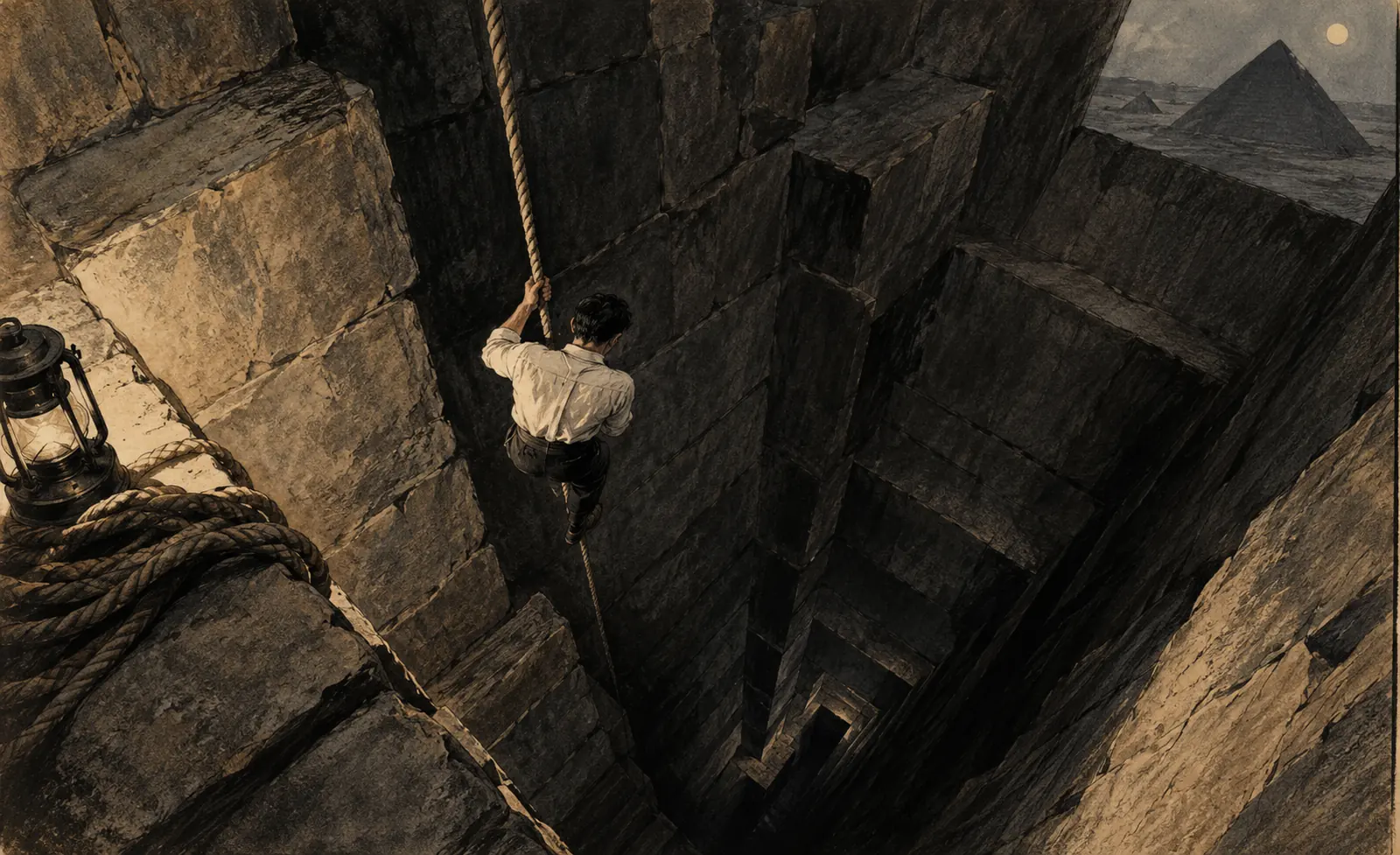
The man lowered into the darkness is Harry Houdini. His wrists and ankles are bound, the rope keeps descending, and the familiar pyramids above him seem to conceal a world far larger than the one tourists visit.
It is a perfect trap for an escape artist. The ropes are a problem he knows how to solve. The place at the bottom is another matter.
This scene belongs to Under the Pyramids, a story H. P. Lovecraft wrote for Houdini. It first appeared in the May–June–July 1924 issue of Weird Tales, under the title Imprisoned with the Pharaohs. The publication record connects those two titles to the same work.
It is fiction. Yet its first-person voice, real monuments and famous narrator help explain why the story can feel like a report of something witnessed.
A narrator readers already knew
Houdini’s name changes the stakes before the underground horror begins. An anonymous traveller might be helpless when tied up. This narrator has a professional reason to believe that he can free himself.
That confidence is part of the suspense. Physical skill offers an answer to confinement, while Lovecraft’s imagined Egypt introduces dangers for which skill may be useless. The partnership works because the reader expects an escape, then begins to doubt what escape would even mean.
Following the narrator through the story also shows how easily a recognisable person can lend authority to invented events. The name on the page provides familiarity. It does not establish that the episode happened.
The rope measures the fear
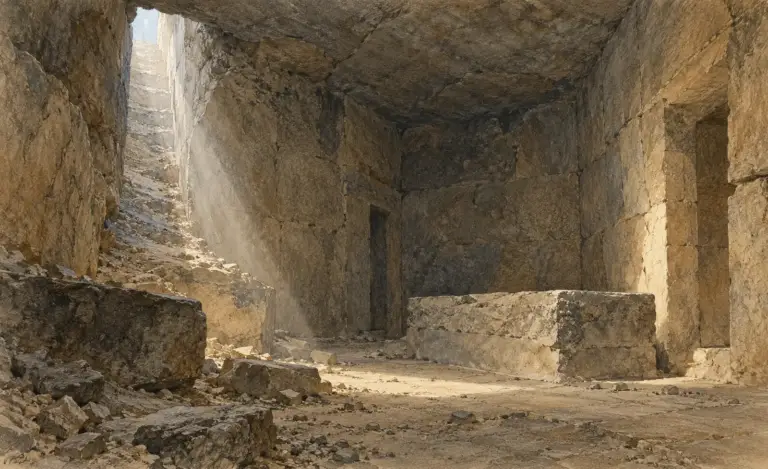
Lovecraft repeatedly makes the underground world difficult to measure. A descent feels impossibly long; later, the amount of falling rope seems to confirm an extraordinary depth. The narrator’s loss of consciousness leaves him unsure how much of the experience he can trust.
Darkness removes the usual landmarks. A rope becomes the only apparent measure of distance, then that measure itself turns frightening.
There is a similar reversal when moving air seems to offer a route towards the surface. Something that might guide a trapped person becomes another source of uncertainty. Readers are drawn into interpreting small physical clues alongside the narrator.
Those clues also show why a literary passage cannot serve as an excavation record. The narrative is designed to unsettle measurements and perception. An archaeological report needs the dimensions, findspot and documentation that the story deliberately makes unreliable.
The Sphinx grows beyond the monument
The story’s final image turns an apparently complete creature into part of something much bigger. Its question about what the Sphinx originally represented acquires a grotesque new scale.
The force of that ending comes from enlargement. Giza is already imposing; Lovecraft imagines an underground presence that dwarfs the familiar monument. The reader is invited to look again at a known shape and wonder how much it might conceal.
That is a powerful imaginative question. It also belongs to the work’s invented world. Curiosmos has covered actual underground spaces in the Longyou caves, where the mystery begins with chambers that can be examined. Lovecraft starts with visible archaeology and lets fiction extend beyond it.
Reading the whole story
The same reading should notice how the narrative portrays Egyptian guides and inhabitants. Its repeated suspicion and degrading descriptions help manufacture an atmosphere of threat. They tell us about the story’s prejudices, not about the character of the people living around Giza.
Brown University’s Lovecraft collection preserves manuscripts, letters and editions that support the study of the writer’s work. Its manuscripts let us follow the making of a twentieth-century story, including the imagined ancient world within it.
Its lasting fascination lies in the encounter between two kinds of confidence. Houdini’s narrator trusts his ability to escape a physical trap. Lovecraft gives him a trap whose dimensions keep changing. A century later, that simple tension can still make a familiar pyramid feel unsettling.