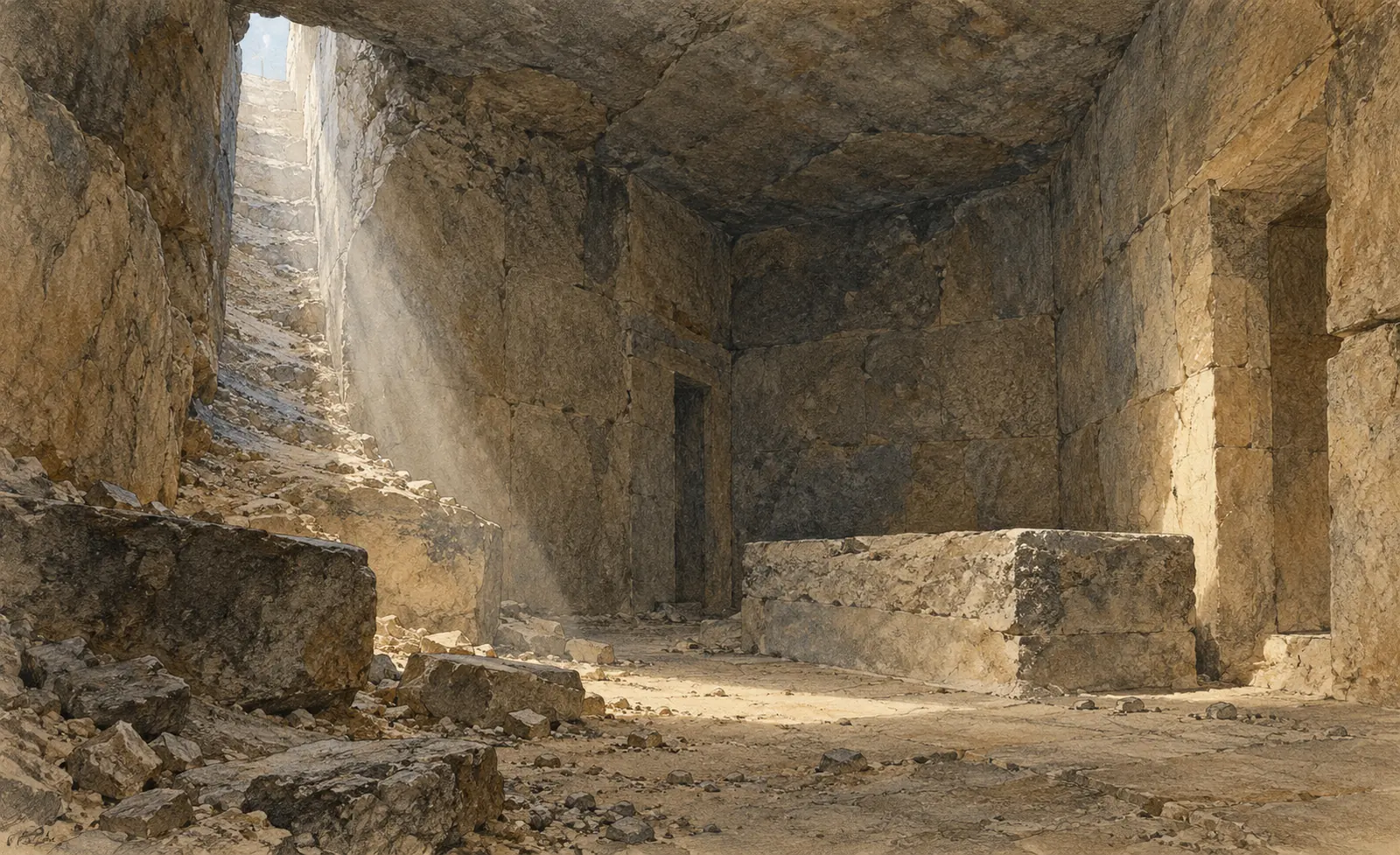
A sealed chamber, an invisible danger and warnings against disturbing the dead: the ingredients of the pharaoh’s curse also invite a very earthly question. Could something inside an Egyptian tomb have harmed the people who entered it?
In 2024, Ross Fellowes proposed an unusually ambitious answer. He argued that some ancient Egyptian funerary language described radioactive material, and that underground chambers may have held hazardous residues. His paper appeared in the Journal of Scientific Exploration. It did not report the excavation of a nuclear-waste deposit.
Radiation has been measured in Egyptian burial spaces. Could those readings support Fellowes’s proposal? The answer depends on what the instruments detected, how he reads the texts and what is known about the deaths.
The proposed connection with uranium
Fellowes reads references to saffron cakes, portions of two, three and five, and invisible emanations as descriptions of uranium-235 and its effects. He also interprets passages about dangerous remains as accounts of waste storage. This is his proposed reading of religious texts, rather than a chemical identification of an excavated substance.
If ancient people encountered a harmful mineral, they might have described its effects through the religious language available to them. Establishing that connection would require the mineral and the wording to point to the same substance independently.
The International Atomic Energy Agency’s fuel-cycle account describes yellowcake as uranium concentrate produced through ore processing. Uranium-235 is an isotope, meaning one particular form of the element’s nucleus. Natural uranium contains about 0.7 percent uranium-235; making a concentrate and increasing that isotope’s proportion are separate operations.
A yellow substance mentioned in a text therefore cannot be identified as enriched uranium by its colour alone. Archaeological samples could tell us much more: their chemical composition, isotope ratios and location within an undisturbed deposit.
What was measured inside the tombs
A separate radiation survey of Egyptian pyramids and tombs measured radon-222, its short-lived decay products, thoron decay products and gamma radiation. Its fieldwork included Saqqara. Radon concentration was measured using scintillation cells; other methods assessed the radioactive products left by the gases.
These measurements concern the air people breathe and the radiation around them. They do not, by themselves, identify a buried industrial residue. A high reading is a starting point for tracing a source.
The World Health Organization explains that radon is a naturally occurring radioactive gas produced through uranium decay in rocks and soils. It has no colour, smell or taste. It can accumulate indoors, with concentrations influenced by the building, ground and ventilation. Its established health concern is lung cancer from exposure over time.
Investigators would need to examine the surrounding geology, cracks, air exchange and seasonal conditions. Repeated measurements, together with samples from the walls and deposits, could distinguish a persistent local source from gas entering through the ground.
The deaths need their own investigation
Fellowes also assembled records for 505 Egyptologists and associates. The paper acknowledges incomplete exposure histories, anecdotal causes of death and the absence of a practical unexposed comparison group. Those gaps prevent a measured radiation dose from being linked to each person’s illness.
Our earlier account of Tutankhamun’s tomb and the curse stories concerns the famous discovery. The radiation proposal reaches further, across different sites, people and periods. That broader claim needs correspondingly detailed evidence.
The most revealing next discovery would be a securely documented deposit with an unusual radioactive composition, found in a context that shows how it was placed there. A matching inscription would make the connection stronger still. Until such evidence emerges, the paper offers a hypothesis to investigate. The tomb air, meanwhile, is something researchers can measure directly.