On the last night of April, the towns around Germany’s Brocken fill with witches and devils. In Sweden, people gather around bonfires and sing to welcome spring. Both celebrations belong to Walpurgis Night, but following them closely reveals different stories attached to the same date.
One leads into a mountain associated with supernatural gatherings. Another marks the welcome end of a northern winter. Literature, religious calendars and local celebrations have all helped shape the night as people know it today.
How did a seasonal threshold become such a good setting for strange stories? The landscape around the Brocken offers part of the answer, including an unsettling sight a visitor can encounter in perfectly ordinary weather.
The mountain in the witch story
The Brocken is the highest peak in the Harz Mountains, at 1,141 metres according to the regional tourism authority. Its exposed position brings rough weather, helping separate the summit from the towns below in both experience and imagination.
The authority describes Goethe’s use of the mountain and Walpurgis Night in Faust. Its account of present-day celebrations quotes the witches’ journey to the Brocken and describes festivities on 30 April throughout the region.
Literature gives a local setting an audience far beyond the people who can see it from home. A reader can encounter the Brocken as a destination for witches before ever knowing its paths, weather or geology. Later visitors arrive with the scene already in mind.
The costumes and performances of today’s festivals add another layer. They are organised celebrations of a story, with local groups and organisers keeping the occasion active. For a night, townspeople and visitors can step into the mountain story themselves.
A giant shadow in the mist
There is a real phenomenon named after this mountain: the Brocken spectre. The Met Office explains that it appears when the sun is behind an observer and casts their shadow onto mist or cloud.
The shadow can look like a distant giant. Without a clear surface against which to judge its size, a person may read it as a large figure standing farther away. Mist gives the outline a temporary, shifting body.
You can imagine how arresting that would be on a mountain. A human-shaped form appears where there is no visible ground for it to stand on, and its movement follows yours. Understanding the geometry makes the experience more interesting: the observer is part of the apparition.
The phenomenon can occur on other misty mountains and is also seen from aircraft. Its name links it to the Brocken, rather than confining it there.
Could experiences like this have fed the region’s supernatural atmosphere? It is easy to imagine the shadow leaving a strong impression. A direct link with the witch tradition remains an open historical question; the optical effect itself depends on the observer, sunlight and mist.
Across the Baltic, a welcome for spring
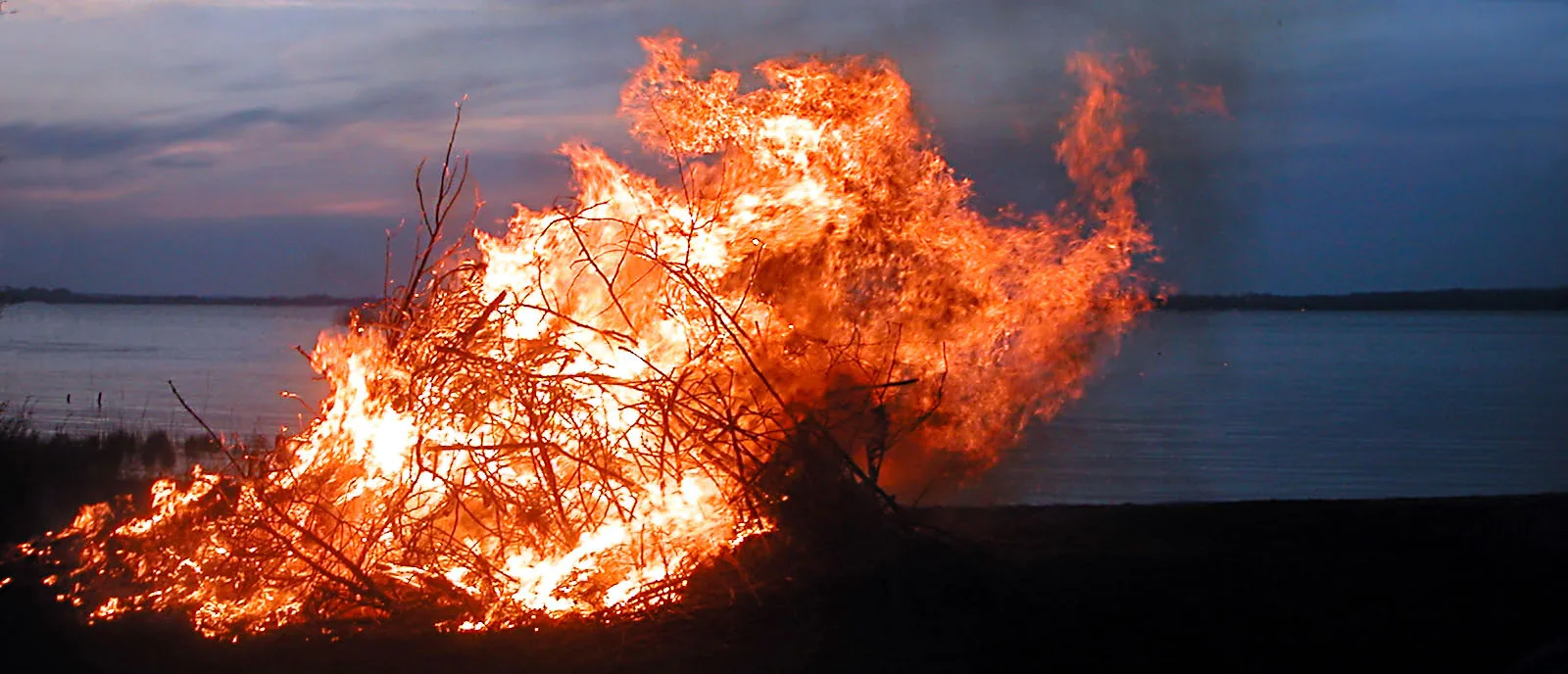
Sweden’s official tourism organisation describes Valborg, celebrated on 30 April, as an evening of bonfires, singing and community gatherings. Its account also preserves an older protective interpretation of the fires: keeping witches and spirits away.
The emphasis of the modern celebration is on welcoming spring. Families and friends gather outdoors; choirs sing; students mark the approach of the warmer season. The following day is May Day, with its separate political and public-holiday observances.
The name comes from the saint Walpurga. Nordiska museet traces the observance to a Catholic feast introduced to Sweden from Germany during the Middle Ages. It describes the later shift toward a folk celebration as the religious calendar changed after the Reformation.
The museum also presents several explanations for the bonfires. Protecting animals as they went out to pasture is one; the influence of German witch traditions is another. These are interpretations of a developing custom, rather than a single agreed account of its first fire.
At Skansen, the open-air museum in Stockholm, the chronology is more precise. Its first Walpurgis celebration took place in 1892, with student singers joining in 1894. An old observance acquired a new venue, and a museum helped carry it forward as a public event.
That contrast is useful. The Harz celebration puts witches into the scene through costumes and performance. In the Swedish account, the protective fire once kept threatening beings at a distance. Similar supernatural language can belong to different actions.
The shared date leaves room for both versions. In one place, people dress as the creatures of the night; in another, neighbours gather around a fire to greet spring.
What a festival keeps—and what it changes
Walpurgis Night lets us watch several ways a tradition can survive. A dramatic scene keeps a mountain in readers’ imaginations. A bonfire brings neighbours together when the season changes. An organised festival turns a local legend into something people can join.
The fantastic beings have their own histories, just as the creatures of ancient mythology do. Stories about them can move from the page to a stage, a costume or a town celebration.
Skansen’s dated celebrations give us one firm point in that changing history; Goethe’s mountain scene gives us another route through its imagery. A bonfire photograph and a page from a play answer different questions about the same night.
And on the Brocken, the weather can still add a strange encounter of its own. With the sun at your back and mist ahead, the figure in the cloud may be you.