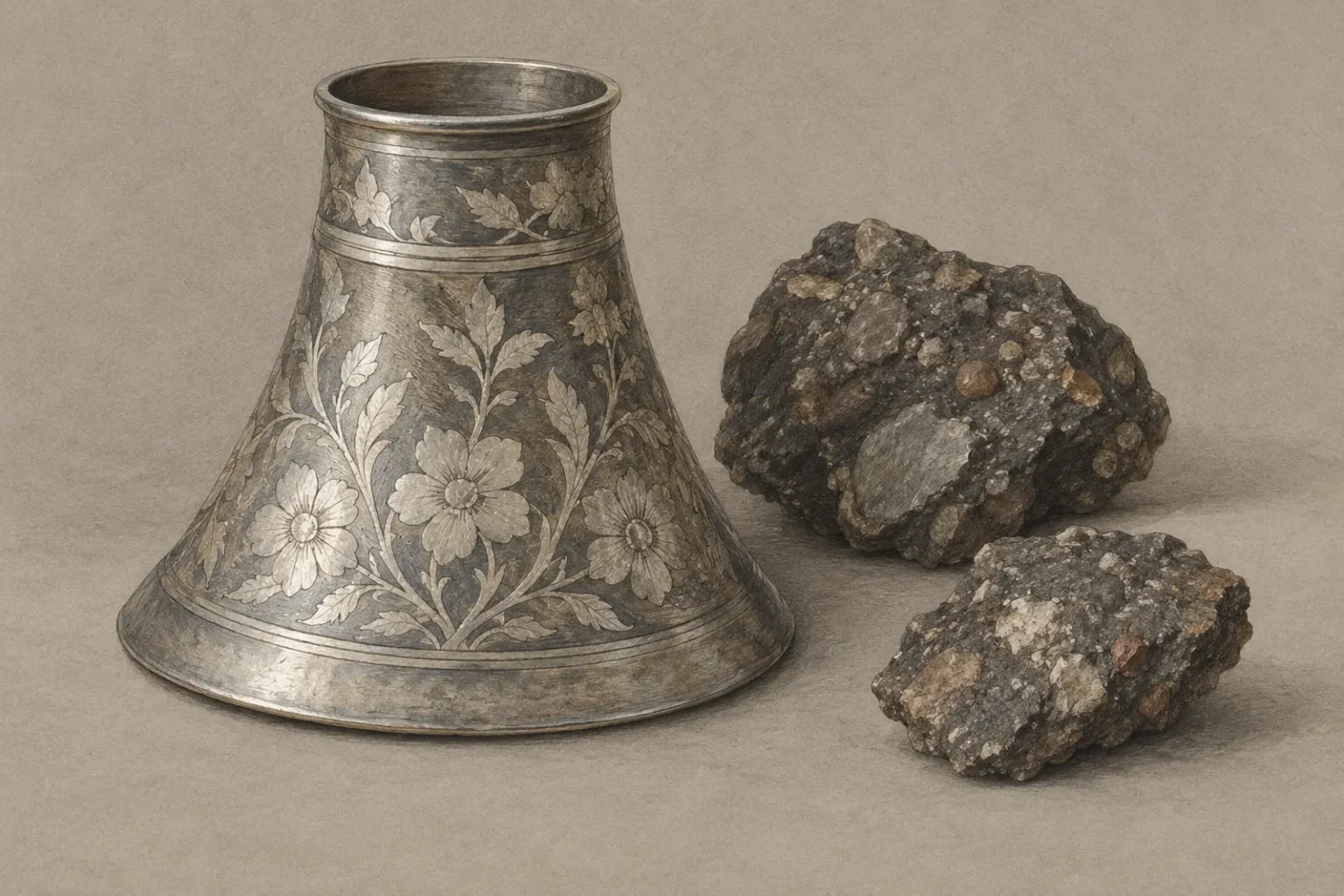
The explosion scattered rock across Meeting House Hill in Dorchester, Massachusetts. Among the debris, according to a report published in 1852, were two pieces of a decorated metal vessel. Once fitted together, they formed a bell-shaped object with floral ornament.
A decorated metal vessel among shattered rock was an unusual find. Later accounts have made the Dorchester vessel famous as an object supposedly trapped in ancient rock. The earliest report gives us a more precise place to begin.
Scientific American’s June 5, 1852 issue carried the account on page 298 under the heading “A Relic of a By-Gone Age.” The magazine attributed the story to the Boston Transcript. Its details describe both an intriguing object and a discovery whose circumstances make its age difficult to establish.
Flowers worked into a metal bell
The reunited vessel reportedly stood about four and a half inches high. Its base measured six and a half inches across, its top two and a half inches, and the wall about an eighth of an inch thick. Six floral or bouquet-like designs decorated the surface, with a wreath of vines around the lower part.
The account describes silver inlay and says the main metal appeared to be zinc or a compound containing a considerable amount of silver. Those are observations recorded in the report, rather than the results of a chemical analysis. They tell us how the object looked to its examiners.
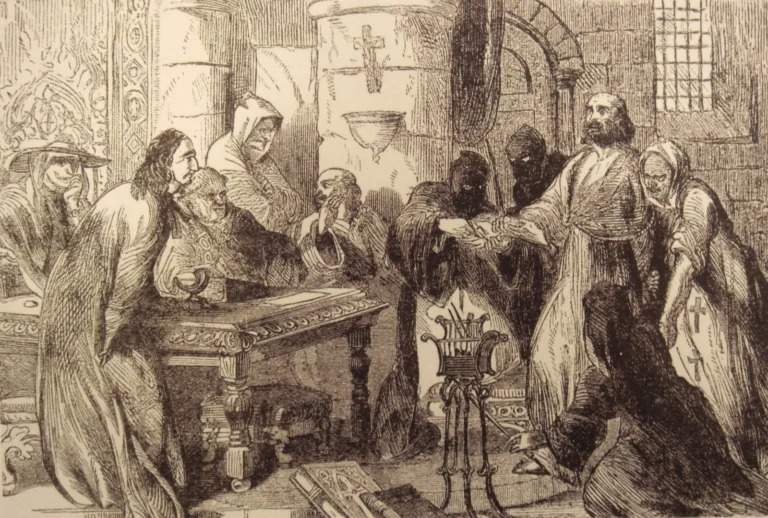
The report names John Kettell as its owner and mentions Dr. J. V. C. Smith, a traveller familiar with objects from the East, examining it. Recognition by a well-travelled observer could offer a lead, but it would not supply a manufacturing date by itself.
The claim about fifteen feet of rock
The original account does make the extraordinary claim: it says the vessel was blasted from solid puddingstone about fifteen feet below the surface. That detail is not merely a modern addition. It is part of the mystery as first presented.
The same report says the two pieces were discovered among material scattered by the explosion. That is the difficulty. It does not describe an observer seeing the intact vessel enclosed in undisturbed rock before the blast, nor provide a recorded section showing its precise position.
An explosion can bring together debris from several places. To establish an object’s geological context, the relationship between object and rock has to be documented before that relationship is destroyed. Finding the pieces afterwards leaves questions about exactly where they lay and how they arrived there.
How did the writers establish the reported depth? The surviving account gives the figure, but no description of the vessel’s position before the explosion.
The rock’s age and the vessel’s age
Puddingstone is a name for conglomerate, a rock containing rounded fragments within a finer matrix. USGS geological records for the Dorchester unit describe ancient rocks in the region. That regional geology cannot, on its own, date the reported vessel or identify the precise rock involved in the blast.
For a metal object to inherit the age of its surrounding rock, it would have to be demonstrably enclosed when the rock formed. A younger object entering a crack, cavity or disturbed area would have a different history. The discovery account does not allow those possibilities to be separated confidently. Documenting a find’s surroundings is also central to the investigation of Lake Michigan’s reported mastodon stone, where an intriguing appearance has prompted questions about its history.
The shape and decoration offer another route: comparison with documented manufactured objects. Such a comparison would be much stronger with the vessel itself, reliable photographs, or an identifiable collection record. The dimensions in the newspaper remain a starting point, not a substitute for an examination.
A report worth reading in full
The Scientific American item ends with a playful editorial exchange involving learned naturalists and a local craftsman. Its tone is quite different from the solemn certainty of many later retellings.
The original page shows how the discovery was discussed in 1852, before later authors attached more definite ages to it. The vessel may yet have a recoverable history, but the surviving report asks us to begin with the blast, the broken pieces and the people who described them. An identifiable collection record or a documented match to another vessel could now take the investigation further.