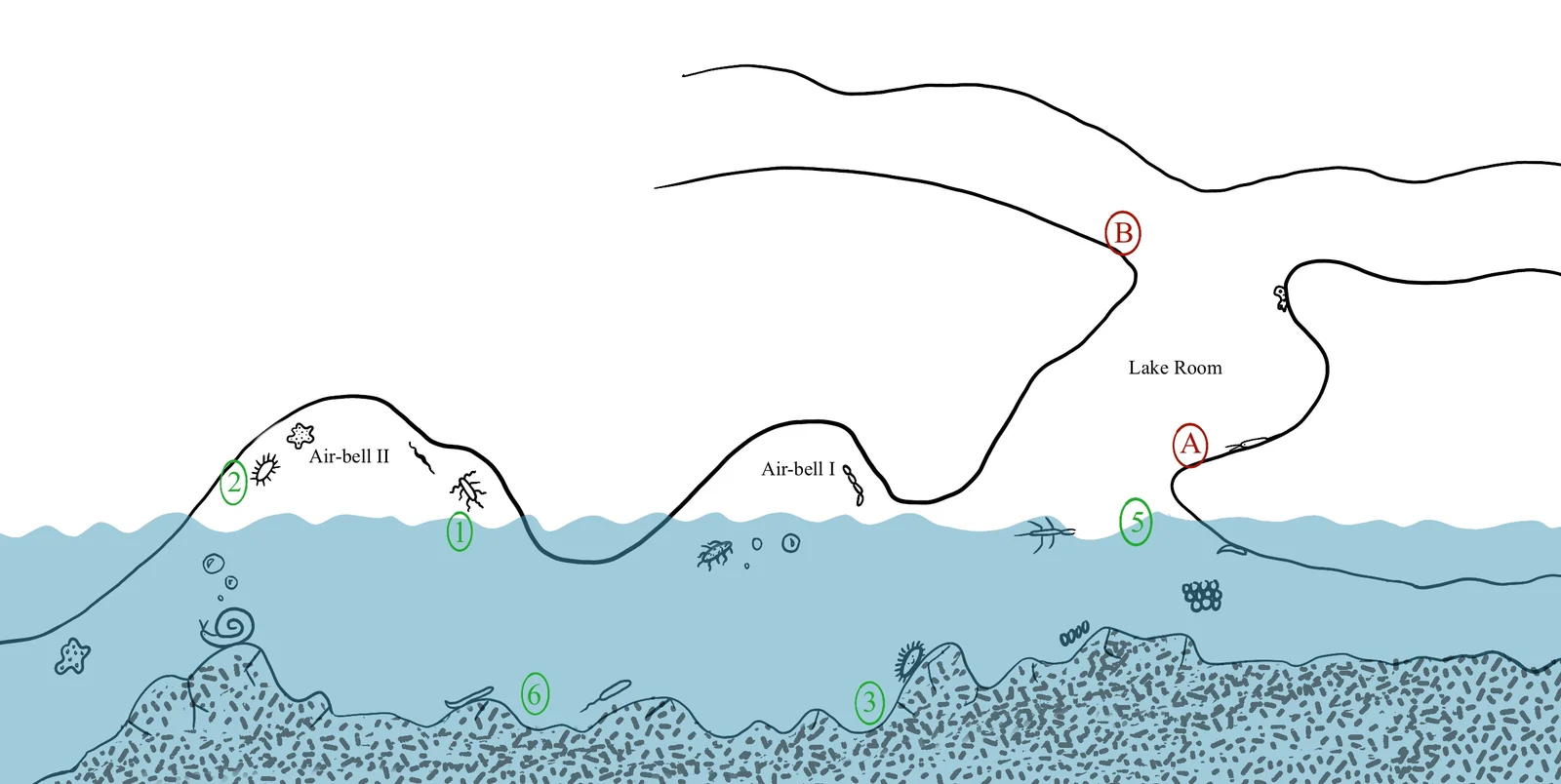
There are no green leaves at the bottom of Movile Cave. No grass, no sunlit pond, no patch of moss catching daylight. Yet the water and damp passages beneath southeastern Romania support a food web that includes spiders, leeches and other invertebrates.
The food begins with microbes. They use chemical energy available underground, building organic matter that other organisms can eat. In a place where a plant could never grow, microbial growth helps keep animals alive.
Discovered in 1986, Movile gave biologists a chance to trace how food was being made and consumed underground. Later research moved beyond the water’s edge to study microbes in the cave’s dry galleries.
How food is made in the dark
Most familiar food webs begin with photosynthesis. A plant uses sunlight to build organic molecules, an animal eats the plant, and another animal may eat the first. Take away the light and that route to fresh food disappears.
Chemosynthesis provides another route. Some microbes obtain energy through chemical reactions and use it to fix inorganic carbon into organic matter. The reactions vary between organisms, depending on the chemicals available.
At Movile, sulfur- and methane-related processes help sustain microbial growth. Grazers feed on microbial material, while predators feed on smaller organisms. A spider’s meal can therefore be traced back to chemical reactions taking place far below the surface.
Comparable processes support communities at deep-sea vents and cold seeps. Movile gives researchers a much smaller underground setting in which to trace chemical energy through a living community.
The evidence behind the food web
In their 1996 Science paper, Serban Sarbu, Thomas Kane and Brian Kinkle reported carbon and nitrogen isotope evidence supporting a food web based on chemosynthetic microbial mats. At the time, they described 48 invertebrate species, 33 endemic to the system.
Those were the species counts reported in 1996; research on the cave’s animals has continued since then.
Isotopes are forms of the same element with different masses. Measurements of their relative abundance can help researchers follow carbon and nitrogen through a food web. Comparing a consumer’s isotope measurements with those of possible foods helps test what it has been eating. Finding an animal beside a microbial mat, on its own, would leave that question unanswered.
Microbial life in the dry galleries
A 2022 sediment study widened the investigation. Researchers sampled seven locations in December 2019, including sites near the water and in upper, dry galleries. They sequenced community DNA and reconstructed 106 medium- to high-quality microbial genomes from the mixed genetic material.
Genes indicated potential for carbon fixation, methane use, sulfur oxidation and ammonia oxidation. Computer models also suggested possible exchanges of compounds among microbes. Chemical food production could extend beyond the floating mats that had attracted so much earlier research.
The DNA shows which reactions these communities may be able to perform. The models explore how the microbes might exchange nutrients. To find out how much food each pathway produces, researchers would also need measurements of the reactions taking place in the cave.
Where the “5.5 million years” comes from
Movile is often described as a cave sealed for 5.5 million years. The research group at GESS separates two events: cave formation began in the late Miocene, about 5.5 million years ago, while layers of clay and loess sealed its natural surface access during the later Quaternary.
Groundwater continues to supply the chemicals on which this food web depends. The cave has a long history of isolation from the surface, alongside an active underground water system.
The distinction changes how we picture the animals, too. The age of a passage tells us when part of their habitat formed; it does not tell us when a particular species arrived or began evolving there.
A living system that needs careful access
GESS describes access through an 18-metre shaft and limits research visits to protect the cave. Its lower passages have oxygen-poor air and unusual gas concentrations. Visits require permission and careful protection of the underground environment.
The giant crystals at Mexico’s Naica caves tell another underground story, involving mineral growth and material trapped inside crystals. At Movile, researchers can follow food through a living community, from microbes to the animals that eat them.
A spider waiting in darkness still depends on a meal. At Movile, following that meal backward leads through smaller animals and microbial growth to reactions in the cave’s water and sediments. Sunlight never has to reach the spider’s world for food to be made there.
Sources and further reading
- Sarbu, Kane and Kinkle, “A Chemoautotrophically Based Cave Ecosystem,” Science (1996)
- Chiciudean et al., “Competition-cooperation in the chemoautotrophic ecosystem of Movile Cave,” Environmental Microbiome (2022)
- GESS research group, Movile Cave overview and access information
- NOAA Ocean Exploration, photosynthesis and chemosynthesis