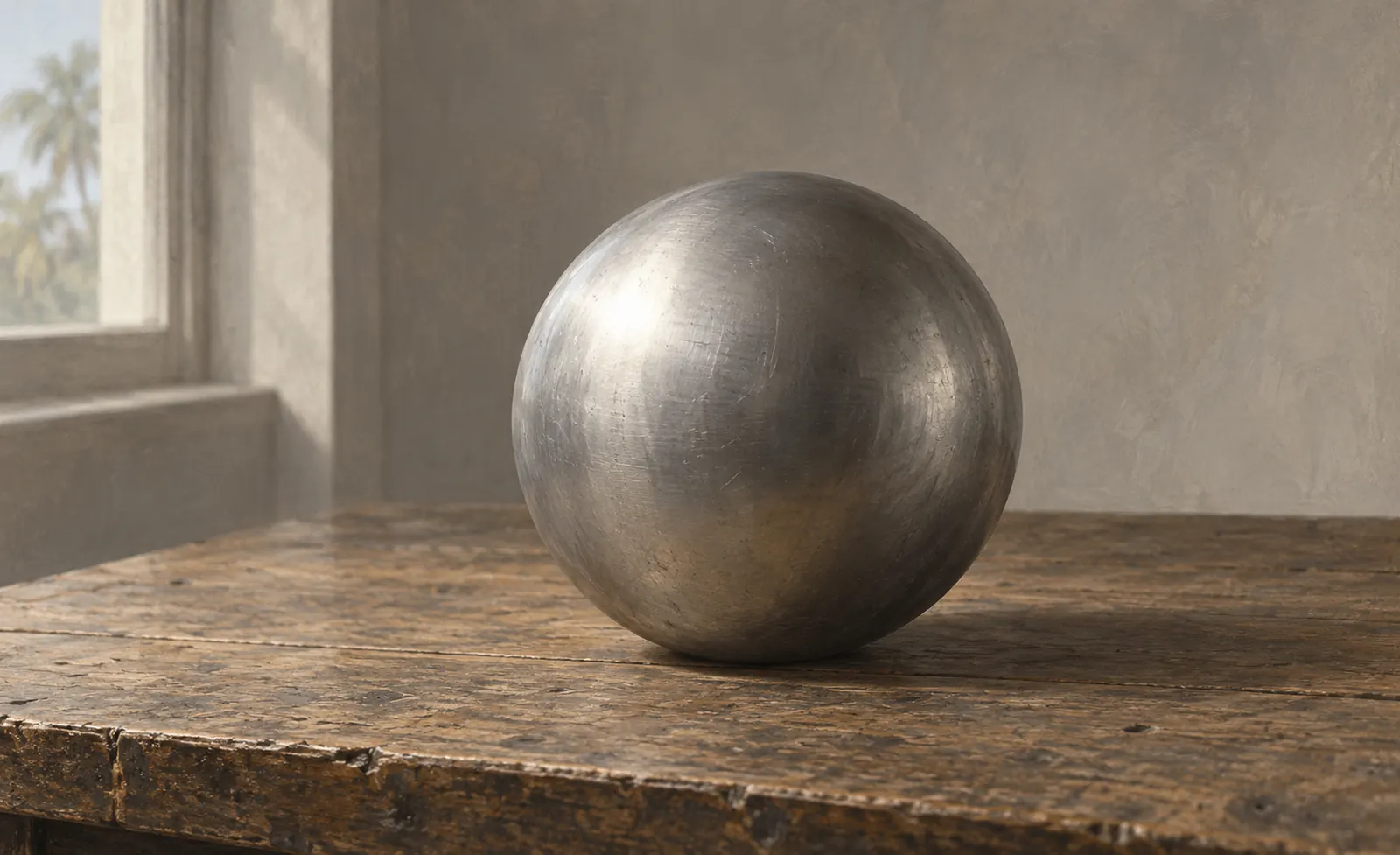
When the Betz family found a metal sphere in Florida in 1974, they brought it home. The object was heavy, smooth and unfamiliar. Soon, accounts of strange movement and sounds turned a puzzling find into a story that travelled far beyond the family’s property.
The Betz sphere still attracts attention because it seems so simple. There are no obvious controls, inscriptions or exposed mechanisms to explain what it was for. If an object behaves unexpectedly and its owner cannot identify it, almost any origin can begin to seem possible.
Contemporary newspaper reports followed the sphere from the family’s home to technical examinations. Read together, they show which claims were tested and which questions remained unanswered.
The story reached the newspapers
WJCT’s archive of material associated with its Betz investigation includes early newspaper coverage and accounts from people involved. Photographer Lou Egner was among those whose observations helped bring the story to wider attention.
The family reported unusual behaviour, including movement and sounds. Such observations belong in the history of the case. Even a familiar object can move in surprising ways, as our look at a baseball’s motion and UAP observations explores. The conditions under which they occurred also matter: a ball on a household floor, for example, is being observed in a different setting from a ball on a level laboratory surface.
The family’s accounts and the investigators’ measurements describe different encounters with the ball. Comparing them requires knowing the conditions of each test.
What the Navy reported in April 1974
An Associated Press report carried by the Winnipeg Free Press on April 15, 1974, survives in a contemporary news-clipping collection. Navy spokesman Chris Berninger described an approximately eight-inch, 22-pound hollow sphere with a shell about half an inch thick.
The report identified high-grade stainless steel and described successful X-rays after earlier equipment had been unable to penetrate the shell adequately. Material inside the sphere was offered as an explanation for noise. The Navy considered it an Earth-made object, although the report did not supply an identified manufacturer.
The missing manufacturer leaves an important question open. Establishing that a material is familiar does not immediately establish an object’s original job. An industrial component can remain difficult to identify when it has lost the machinery, paperwork or markings that once explained it.
The report also offered uneven stone flooring as an explanation for movement. That was an explanation attributed to investigators, rather than a reconstruction of every event the family described. The report does not show that investigators reproduced every movement described by the family.
The same clipping collection carries an April 23 United Press International report on J. Allen Hynek’s examination. Hynek said his group found no evidence of an extraterrestrial origin, while expressing interest in further experiments. His reported response kept the object open to investigation without claiming that its origin had been solved.
Searching for a manufacturer
Later investigations discussed possible industrial origins, including a valve-related component, and a story about metal spheres lost by an artist. WJCT’s collection preserves those leads. A plausible resemblance, however, is only the beginning of an identification.
The strongest match would connect dimensions, weight, construction and an identifiable route to the place where the family found it. A contemporary catalogue or a surviving comparable component could narrow the possibilities further. Knowing what an object resembles and knowing where it came from are different stages of the inquiry.
This is one reason the case has endured. The tests addressed some extraordinary claims, but the everyday question remained appealing: what was this heavy ball doing there in the first place?
A mystery with a recoverable history
The original case brought a family, newspaper photographers and technical investigators into an unusual search for the identity of an unmarked metal ball.
Returning to the dated reports also reveals how an investigation works in public. A failed first X-ray can sound astonishing in isolation; learning that later equipment obtained images changes the account. A conclusion about manufacture can coexist with uncertainty about provenance.
Perhaps the most productive next step would be a securely documented match to a known component, or a fresh examination with a clear record of the object’s custody. Until then, the sphere’s history is best followed through what each witness and investigator actually reported. The unanswered question is still a simple one: who made the ball, and how did it reach the Betz property?