Horns rise above a carved face. Heavy bells hang against a shaggy costume. Beside the figure stands Saint Nicholas, ready to hand out gifts. His companion has brought a chain and a switch.
Krampus gives the winter celebration an edge. Children waiting for kindness also meet a creature meant to frighten them. Adults watching a street procession may know perfectly well that a person is beneath the mask, yet the horns, noise and darkness still do their work.
Where did this figure come from? His appearance seems to invite an ancient origin. The surviving records lead us through household customs, religious theater and a surprisingly inventive trade in images of the monster.
The saint and his difficult companion
Ethnologist Susanne Breuss, writing for the Wien Museum, describes Krampus as the frightening counterpart to Saint Nicholas. In Vienna, records of their joint household visits reach back to the seventeenth century. Around the evening of December 5, the pair would reward or reprimand children for their behavior.
Breuss notes that the custom’s origins remain uncertain. One suggested connection is with the older practice of a child bishop temporarily taking an adult authority’s place. The tame devil accompanying the saint gave the visit two contrasting roles, with Nicholas holding authority over his alarming helper.
Remove Nicholas from the scene and the costume can look like an independent creature from a much older belief system. Put the two together, and we see a drama about judgment, reward and punishment.
How far back can we follow him?
In the Goethe-Institut’s interview-based episode on Krampus, anthropologist Matthäus Rest discusses records reaching back to the late sixteenth century. This gives us a documented early modern history, while leaving the question of earlier influences open.
Older seasonal beliefs may have contributed to the traditions that later surrounded Krampus. Demonstrating that connection would require a trail of evidence: names, descriptions, objects or accounts showing how one practice developed into another.
Our investigation of the Roman ring sometimes linked with Tolkien’s One Ring follows another proposed connection between an older object and a later story. In both cases, tracing the connection requires more than a familiar appearance.
Horns alone cannot supply that trail. Many cultures have imagined horned beings, and a resemblance can suggest a question without settling ancestry. The uncertainty makes the search interesting; it also gives us a reason to look more closely at the records we do have.
Krampus and Perchten are different figures
The masks can make them easy to confuse. Salzburg’s tourism authority distinguishes Krampus, the companion of Saint Nicholas, from Perchten associated with other winter customs. The latter include both the elaborate Schönperchten and the frightening Schiachperchten.
Perchten traditionally appear during the season around the winter solstice and Epiphany. Modern processions and costume groups can mix the figures, and the calendar has become less tidy. A photograph of a horned winter performer therefore needs its location, date and local name before we can confidently identify the tradition.
Before calling a photograph an ancient Krampus ritual, it is worth asking the performers what character they are portraying. Their local name and calendar may tell a different story from the caption.
A monster small enough for the post
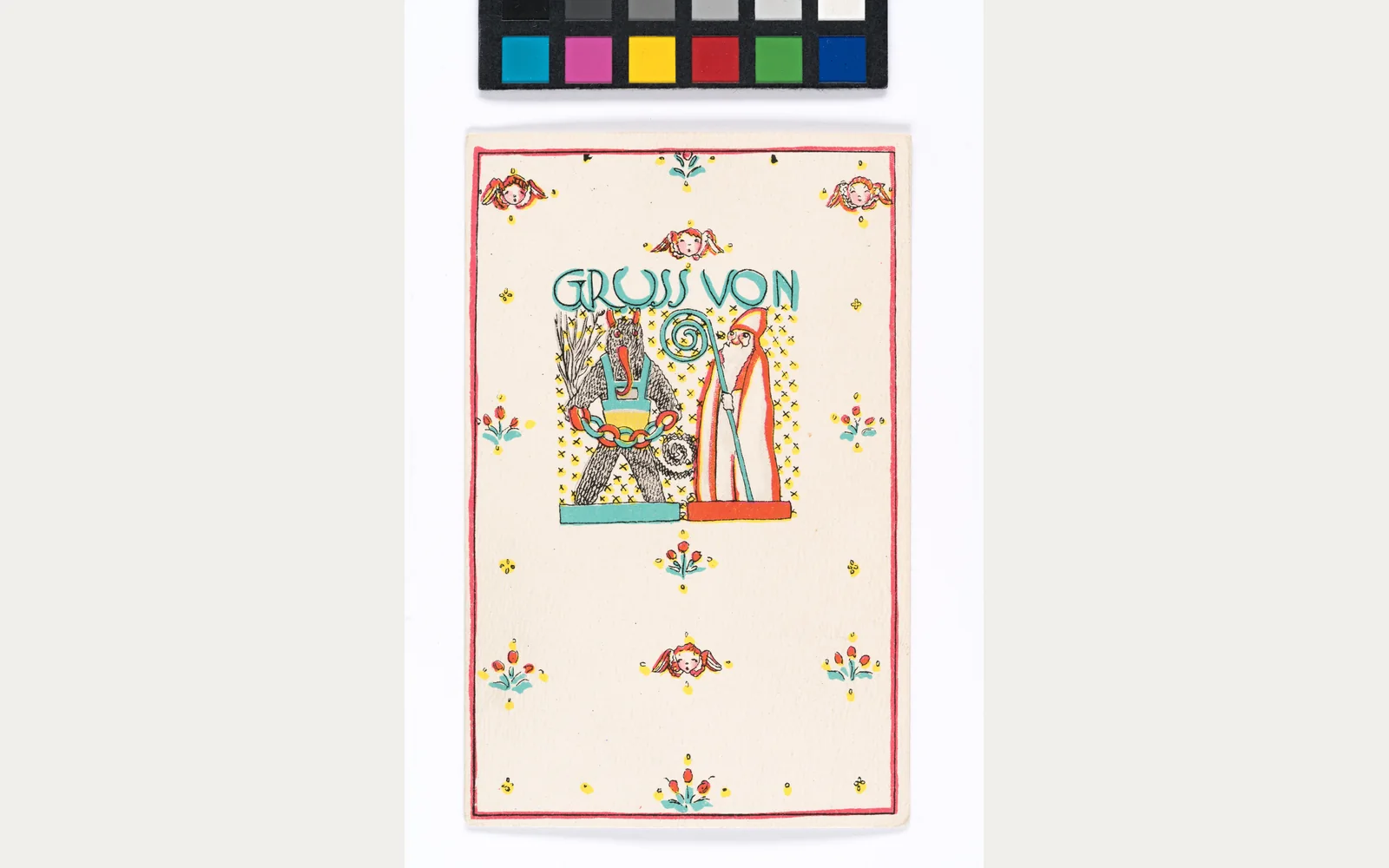
Krampus also traveled on paper. The Wien Museum holds a 1912 postcard designed by Arnold Nechansky for the Wiener Werkstätte. Catalogued as a Krampus and Nicholas card, it measures just 14 by 9 centimeters and was made using color lithography.
Someone could choose the postcard, write on it and send it to a person who never attended a procession. The figure could belong to a seasonal greeting as well as a frightening encounter.
The Goethe-Institut’s account describes the nineteenth-century revival and the spread of postcards. It also explores modern costume changes, including influences from horror films and new lighting effects. The performers keep making choices about what will startle an audience.
Why he keeps coming back
Krampus survives through people who carve masks, dress up, visit homes and exchange images. A household visit and a large parade can share a character while giving the audience very different experiences.
The carved mask, clanging bells and changing costumes keep that encounter lively. Something wild arrives inside a familiar celebration. We can ask about its older roots while also following the people who have kept changing its face.