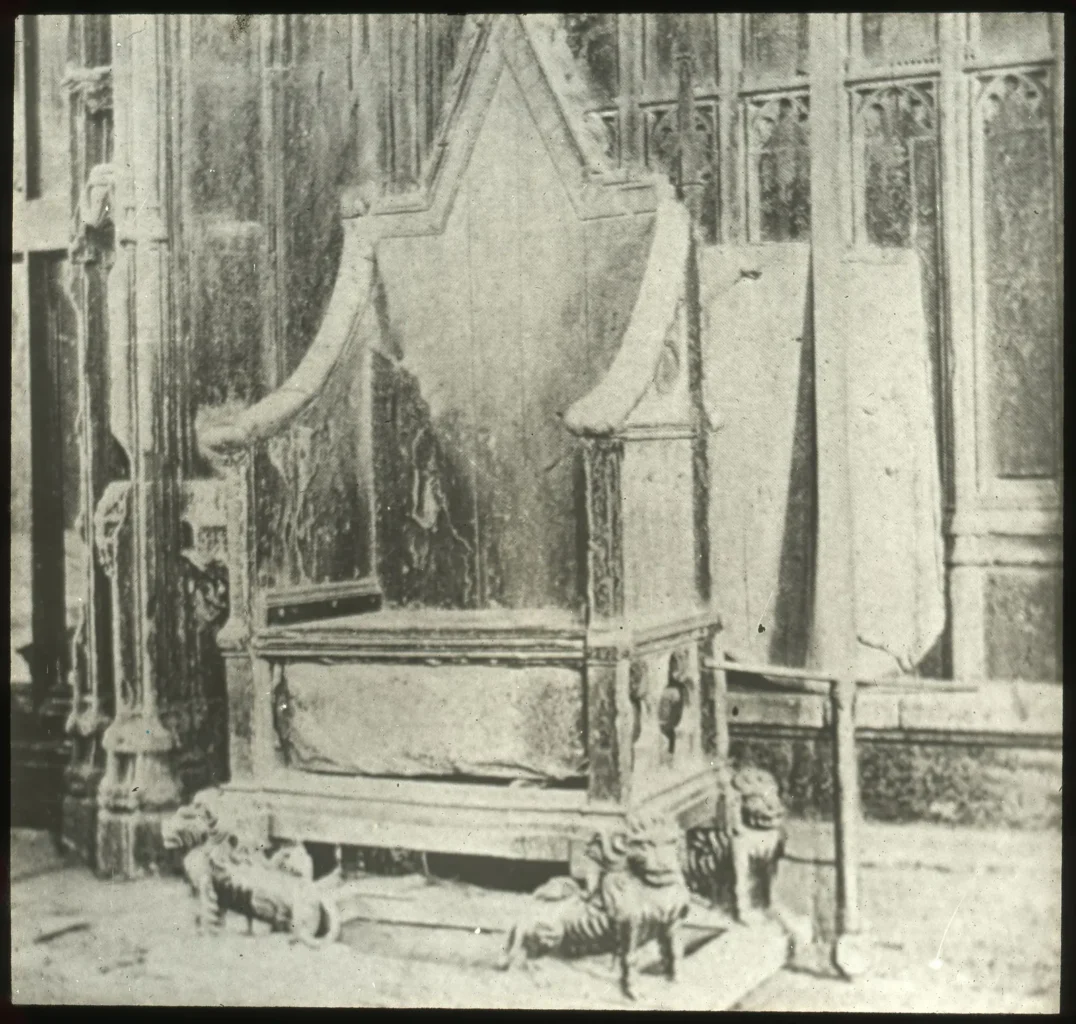
On the underside of the Stone of Destiny, in a small recess near the back, someone cut three tiny X-shaped marks. They are easy to miss on a block of sandstone famous enough to have been carried away by a king, stolen by students and placed beneath Britain’s coronation chair.
The marks were described in the 2023 conservation announcement. Nobody has established who made them or what they meant. Someone once held a fine tool against this surface. The small cuts survive, even though their purpose has been forgotten.
Kings and students left records of their encounters with the stone. Other people left only scratches, stains and material lodged in its pores.
A royal stone with a long journey
Perth Museum, its present custodian, identifies Alexander III’s coronation at Scone in 1249 as the first documented use of this stone. That is a date in the surviving record, rather than proof that its ceremonial life began that year.
Older traditions carry it much farther, connecting Scotland’s royal stone with Ireland and journeys through the ancient world. Those traditions invite questions about how royal authority was explained and inherited. They also describe movements that cannot be followed from a continuous chain of contemporary records.
The museum notes that geological investigation places the sandstone’s origin near Scone. Its local stone and its far-travelling legends can therefore be studied as different parts of its history. For another place where kingship gathered around a striking landmark, Curiosmos’ guide to historic sites in Ireland includes the Rock of Cashel.
The fracture with a known date
In 1296, Edward I took the stone to England. It remained associated with the coronation chair at Westminster for centuries. One of its most dramatic later journeys began on Christmas Day in 1950, when four Scottish students removed it from Westminster Abbey.
Historic Environment Scotland’s account names Ian Hamilton, Gavin Vernon, Kay Matheson and Alan Stuart. The stone broke during the operation. Stonemason Robert Gray subsequently repaired it in Glasgow, and it reappeared at Arbroath Abbey in April 1951.
The 1950 fracture can be tied to named people and a known repair. The smaller marks have no such paper trail. Their shapes and chemistry must provide the clues.
The stone returned permanently to Scotland in 1996. It travelled south again for Charles III’s coronation in May 2023, before moving to Perth Museum in 2024.
What the tests found on the surface
The technical report released in 2024 brings together close inspection, scientific analysis and digital recording. The three X-shaped cuts are roughly a millimetre wide. Their appearance resembles Roman numerals, but that resemblance supplies neither a date nor a translation.
A dark, heart-shaped patch contained elevated zinc. This refines the earlier public announcement, which suggested contact with copper alloy. The detailed report leaves the stain’s origin and age unresolved, while proposing contact with a zinc-rich object as a possibility.
White material in pores and recesses was consistent with gypsum. The researchers considered an applied plaster, perhaps associated with mould-making. No documented moulding episode has been securely attached to it.
Portable X-ray fluorescence measures elements near the surface. It can show that one patch differs chemically from another. It does not reveal the identity of the person who caused a stain, or turn an undated deposit into an itinerary.
The small marks nobody has explained
The crosses may have been a way of labelling the stone; the plaster may record an attempt to take a mould. Either would bring an otherwise forgotten encounter into view. A dated comparison or an account of the work could help establish which explanation fits.
For now, the three little cuts remain anonymous. A king could carry away the stone and have his conquest recorded for centuries. Whoever made these marks left a far smaller signature, but one that has proved just as durable.