
A Fox News essay by Michael Guillén argues that the biblical “kingdom” aligns with the limit of what the universe allows us to see. Astronomers and physicists say the boundary is real, but its meaning is not.
Michael Guillén, a physicist who has taught at Harvard University and worked as a science editor at ABC News, has pushed a provocative claim into the public bloodstream: that the biblical Paradise may have a physical “address” in the universe.
In a January 18, 2026 opinion essay for Fox News, Guillén argues that modern cosmology, taken literally, points to a specific location for “heaven.” His calculation places it about 439 billion trillion kilometers from Earth, a distance he links to the boundary of the observable universe, sometimes called the cosmic horizon.
The number sounds like science-fiction arithmetic, but it maps onto a familiar concept in cosmology: the observable universe has a limit, not because reality ends, but because information does. The universe is finite in age, and light travels at a finite speed. As a result, there are regions whose light has not had enough time to reach Earth since the beginning of cosmic expansion.
That distinction is the core of the dispute. Guillén treats the horizon as a meaningful border in the universe itself. Astronomers and cosmologists typically treat it as a boundary in observation, a limit in what can be seen and measured from here.
The horizon is real, but it is not a wall
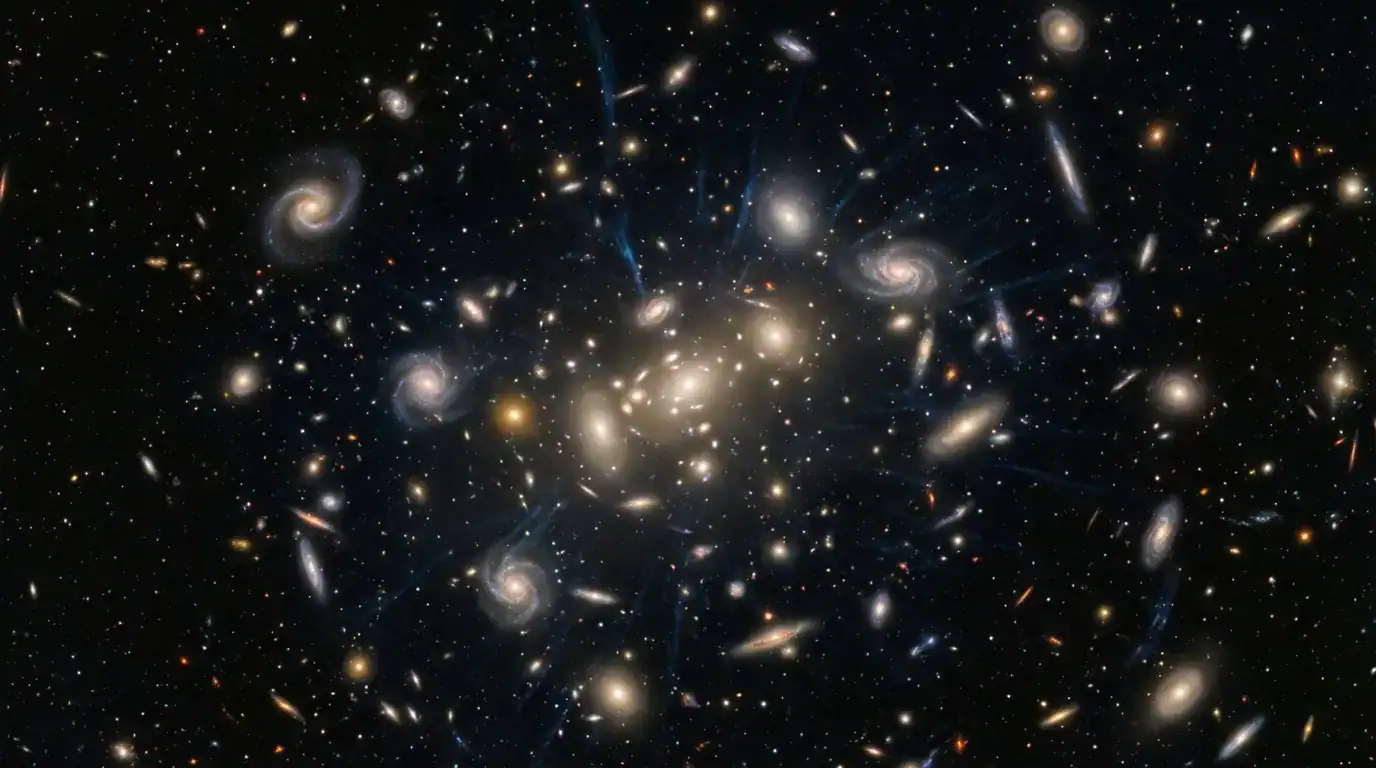
Cosmologists use “horizon” as shorthand for a family of limits that arise from cosmic history. The most basic one is the particle horizon: the farthest distance from which light could have reached an observer since the universe began. Because space has expanded while that light was traveling, the observable universe is far larger than a simple “age times speed of light” estimate.
A standard summary of the size appears in Encyclopaedia Britannica, which explains why the observable universe extends to more than 46 billion light-years in any direction, and why its diameter is about 93 billion light-years. That scale is not a claim about a physical edge. It is a claim about how far our past light cone reaches, given the expansion of space.
Those expansion calculations rest on measurements of the universe’s age and composition, anchored by observations of the cosmic microwave background. The European Space Agency’s Planck mission science highlights summarize a key result: an age of about 13.8 billion years.
In this standard picture, the horizon is not a boundary you could fly toward and eventually touch. It is not a shoreline at the end of space. It is a limit defined by light travel time and expansion history. The universe can continue beyond it. What cannot continue is observation and causal contact, at least not under the universe’s present expansion.
That is why some astronomers reject the move Guillén is making. Even if the horizon is physically meaningful in the sense that it is measurable and real, it does not follow that it marks a special place in a theological sense. In mainstream cosmology, the horizon is a feature of what can be known from a given vantage point, not a sign that something unusual begins on the other side.
Why inflation matters to the argument
Guillén’s claim draws rhetorical strength from a true statement: there are parts of the universe that are, in practice, unreachable by any signal we can send today. Inflation and later accelerated expansion sharpen that point.
The basic idea of cosmic inflation is that the early universe experienced an extremely rapid expansion that stretched space. NASA’s educational overview of cosmic inflation describes it as an expansion of space itself, not objects traveling through space in the everyday sense. A consequence of that history is that some regions that were once in contact are now far beyond each other’s horizons.
Later, the expansion rate changes again. Today’s universe appears to be expanding in a way consistent with dark energy in the standard model of cosmology, which affects which galaxies can ever be reached by signals sent now. This is the physics behind the popular statement that some distant regions are “gone for good” as far as communication is concerned.
But the same physics undercuts the horizon-as-destination framing. A horizon is not a coordinate where something must exist. It is a statement about what can be causally connected.
The pushback from astronomy
The debate in recent coverage has featured the astronomer Alex Gianninas as an explicit counterpoint to Guillén’s approach. His position, as presented, is that the cosmic horizon is not a physical wall. It is a consequence of the speed of light and the finite age of the universe, reinforced by the universe’s expansion history.
That view aligns with the standard definitions used in cosmology. It also leads to a blunt conclusion: there is no scientific basis for treating the horizon as the border of a divine realm, any more than there is for treating it as the summit of Mount Olympus. The horizon is a limit of observation, not a marker of metaphysical geography.
A different route: not far away, but “higher-dimensional”
A second line of argument, offered here through physicist Michael Pravica, rejects the idea that Paradise should be placed at a vast linear distance at all. Pravica, a professor of physics at the University of Nevada, Las Vegas, argues that searching for Paradise by distance is «intelectualmente limitante».
Instead, the proposal turns to higher-dimensional thinking. The illustrative model is familiar from popular explanations of geometry: treat the universe as a two-dimensional circle. If Paradise is “outside” the circle, expansion pushes it farther away. If it is “within” in a higher dimension, the relationship changes. The question becomes less about distance and more about whether there are aspects of reality not captured by the dimensions humans perceive.
The argument uses a second analogy drawn from quantum-era storytelling: a sheet of paper with two distant points. Fold the paper and the points meet. In that picture, what seems far in ordinary space can be adjacent through a shortcut that exists only because the space has been reshaped.
These analogies can help a reader picture what “extra dimensions” mean in a loose sense. They do not, on their own, establish that any such dimension exists in nature, or that it contains a specific religious realm. In modern physics, extra dimensions show up in certain theoretical frameworks, but the step from mathematical possibility to physical reality is decided by evidence.
Pravica’s broader point is methodological. He argues that inspiration precedes measurement, and that ideas once thought untestable can later become testable as techniques advance. The history of physics supports the narrow part of that claim: many concepts became measurable only after new instruments and new mathematics emerged. What it does not support is the leap from “possible to imagine” to “true in the world.”
Where the argument lands
Guillén’s essay places Paradise at the cosmic horizon, tying a religious image to a well-defined concept in cosmology. Gianninas’s response, as presented, draws a hard boundary around what science can claim: the horizon is real, but it is not a wall and it is not evidence of anything beyond the reach of observation.
Pravica’s alternative shifts the claim from a faraway edge to an overlapping realm, suggesting that Paradise could be “near” in a dimensional sense while remaining invisible to current measurement. It is a different map, but it relies on the same move: translating a theological concept into a physical claim.
The measurable part of this dispute is straightforward. The universe has an age on the order of 13.8 billion years, as summarized by ESA’s Planck results. Because space has expanded, the observable universe extends far beyond 13.8 billion light-years in distance, reaching beyond 46 billion light-years in radius, as explained in Britannica’s overview. The rest is interpretation.
Physics can describe horizons, expansion, inflation, and the limits of causal contact. It does not assign theological meaning to those limits. The controversy persists because it sits at a seam that has always been hard to seal: the desire to use the language of measurement to speak about purpose, transcendence, and ultimate meaning.