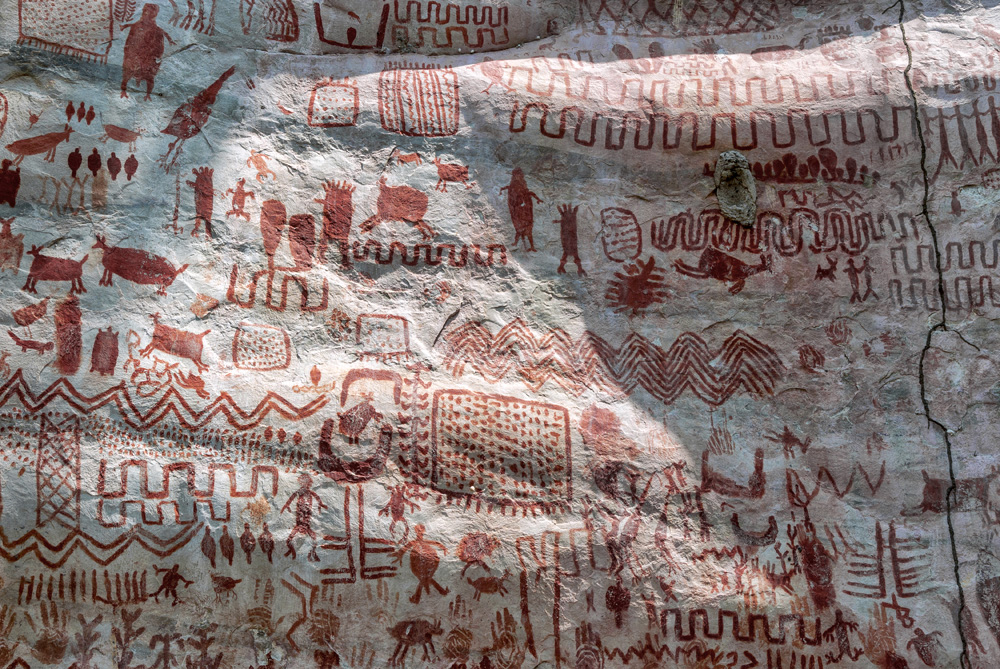

Deep in southern Colombia, Chiribiquete spreads across rainforest, rivers, and ancient table mountains whose rock shelters hold tens of thousands of paintings. Their scale is real, their age is still being argued over in places, and together they form one of the largest and oldest visual archives anywhere in the Americas.
Chiribiquete is not a ruin in the usual sense. It is a living landscape, a vast protected region in the Colombian Amazon where sheer stone walls rise out of the forest and carry a painted record of people, animals, ritual, movement, and memory. The comparison to the “Sistine Chapel” has stuck because the imagery is not confined to a few isolated figures. It runs across cliff faces and rock shelters at a scale that changes the way the Amazon is usually imagined, from blank green immensity to a place with walls full of human marks.
Since its 2018 inscription as a UNESCO World Heritage Site, Chiribiquete has come into wider view as both a cultural and natural stronghold. UNESCO describes it as Colombia’s largest protected area, set at the meeting point of the Amazon, Andes, Orinoco, and Guyana regions, where biodiversity and deep human history occupy the same ground.
The scale matters. Following its expansion, conservation groups described Chiribiquete as the world’s largest national park protecting a tropical rainforest, covering 4.3 million hectares of forest, rivers, escarpments, and tepuis. Those tepuis, the flat-topped sandstone massifs that define the skyline, give the place its strange force. They look less like mountains than fragments of another geology, stranded above the canopy and cut off by cliffs.
Fifty murals, sixty shelters
The numbers alone explain why Chiribiquete refuses to stay a local curiosity. Conservation and heritage sources describe 50 monumental murals with more than 70,000 figures, while the UNESCO evaluation gives an even tighter count of 75,234 paintings identified on the walls of 60 rock shelters at the foot of the tepuis. Those are not casual traces. They are organized, repeated, layered, and spread across a landscape so large that what has been documented still feels like part of a bigger archive rather than the whole of it.
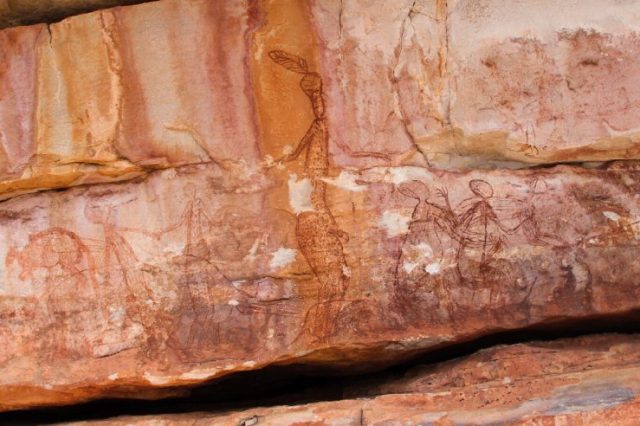
What appears on those walls is equally important. Official descriptions point to hunting scenes, battles, dances, ceremonies, plants, geometric figures, and a dense animal world that includes jaguars, deer, tapirs, and capybaras. The paintings are dominated by mineral reds, with ochre, white, and black also appearing in some figures, and the imagery often places animals at a larger scale than humans, which gives the walls a distinct visual hierarchy.
This is where Chiribiquete becomes more than an impressive picture gallery. The jaguar recurs so strongly in the official interpretation that the park carries the formal UNESCO title “The Maloca of the Jaguar.” The animal is read as a sign of power and fertility, and the broader iconography has long been linked to shamanic practice, to ceremonies involving altered states, and to a sacred order binding people, animals, land, and sky. That reading is an interpretation, not a caption written by the painters themselves, but it is grounded in recurring motifs and in indigenous traditions that still regard the region as spiritually charged.
The walls that science reached late
Outside archaeology came to Chiribiquete late, largely because the place is remote, difficult to access, and for decades lay inside a zone shaped by conflict and limited state reach. The source text is right to place Carlos Castaño-Uribe near the center of the modern story, although “discovery” needs care here. Indigenous peoples did not need Chiribiquete to be discovered. What Castaño-Uribe did was help bring it into the Colombian conservation and research system after first seeing the massif from the air in the 1980s and then encountering the rock paintings on expedition in 1990.
That sequence matters because Chiribiquete did not become famous through a temple facade or a city plan. It came into view through cliff walls in the forest. In that sense, it differs from the old stone centers people often reach for in comparison. These are not cave paintings in the classic European sense, hidden inside deep chambers. They are paintings on rock shelters and exposed vertical surfaces, placed where stone, light, and distance all matter. Some shelters appear to face sunrise, others sunset, suggesting that placement may have carried cosmological weight as well as practical visibility.
Where the dating tightens
The source text pushes Chiribiquete back at least 20,000 years, and there is a real basis for that claim in the heritage record. The UNESCO evaluation refers to 49 radiocarbon dates associated with excavations at the painted shelters and describes a proposed chronological sequence stretching from 20,000 years ago to the present, including one site, Abrigo del Arco, dated as early as 19,500 BCE. That is why Chiribiquete enters discussions about the earliest human presence in Amazonia and, more broadly, about how early people marked the tropical forest in durable visual form.
But this is also where the evidence narrows and the language needs control. UNESCO itself notes that the chronological attribution of the paintings and the claim of a continuous sequence still require confirmation, and the park’s own current educational material describes many of the pictographs as roughly 12,000 years old, while also acknowledging that others are later. That does not reduce the force of the site. It simply means that the age of human activity in and around the shelters is better established than the exact age of every painted figure on every wall.
A sacred place kept closed
The modern temptation is to treat Chiribiquete as a destination. Everything in the official record pushes the other way. UNESCO states plainly that indigenous communities regard the area as sacred and as a place that should remain unaltered, while both heritage and park authorities have stressed that access must remain tightly restricted. The isolation that kept the site out of view for so long is part of what preserved it.
That sacred status is not a romantic footnote. It is part of the present reality of the park. UNESCO and conservation sources both note that voluntarily isolated indigenous groups are believed to move within or near the region, and official management has treated tourism itself as a potential threat, both to the paintings and to the rights of those communities. Even the strongest public storytelling around Chiribiquete has tended to rely on overflights, photographs, books, and documentary work rather than ordinary visitation on the ground.
That leaves Chiribiquete in a rare position. It is famous enough to attract global fascination, old enough to reshape arguments about the human past in the Amazon, and protected enough that most of it remains beyond the reach of casual sight. Whatever future work does to the oldest dates, the central fact is already secure: Chiribiquete holds a documented painted archive of more than 75,000 figures across shelters and murals in a rainforest park of extraordinary scale, and that alone places it among the defining archaeological landscapes of the Americas.