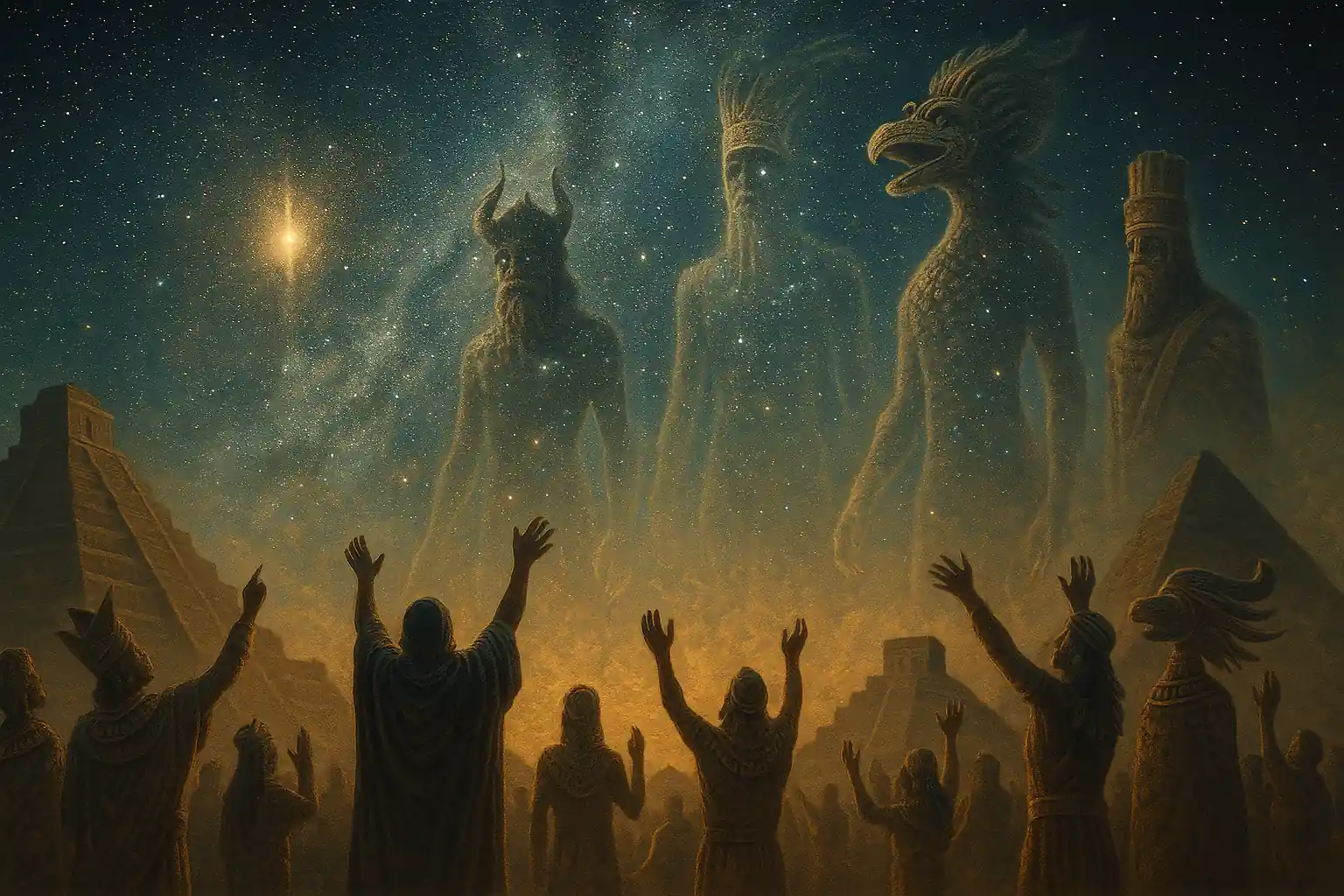
For many ancient civilizations, the sky was not a distant backdrop. It was the place from which authority, order, and sacred knowledge first arrived, and that belief shaped how people understood kingship, time, ancestry, and the very beginning of the world.
That pattern appears again and again, even when the cultures involved had no contact with one another. In Mesopotamia, divine rule comes down from above. In Mesoamerica, gods linked to Venus and the sky teach, create, and return. In West Africa, later ethnographic accounts describe star-centered traditions that became famous far beyond Mali. These stories do not all mean the same thing, and they do not rest on the same quality of evidence. Still, across a wide sweep of the ancient world, people repeatedly placed the source of civilization above them.
Order lowered from above
The world of the ancient Sumerians was already saturated with this idea. In the Sumerian King List, kingship is “lowered from heaven,” and placed in specific cities before passing from one center to another. In the Babylonian Atrahasis, the gods divide power, assign labor, and eventually create humans to carry burdens the divine world no longer wants to bear. The point was larger than theology. Rule, work, and social order were imagined as things established from beyond the human sphere, not invented from scratch on the ground.
That does not turn the Anunnaki into visitors in any modern, mechanical sense, and the texts themselves are not field reports. They are mythic and political literature, shaped by temple culture, kingship, and memory. But their language matters. It tells us that early Mesopotamian civilization linked legitimacy to descent, from the heavens to the city, from divine decree to human law. The old story of civilization beginning with irrigation ditches and grain stores misses part of the picture. For these societies, order also had to be cosmological.
A star and an argument
The Dogon case is harder ground, and that is exactly why it remains interesting. French ethnographers Marcel Griaule and Germaine Dieterlen reported that Dogon religious specialists described Sirius as part of a more complex system, including an unseen companion associated with great density and a long orbital cycle. They also recorded traditions of the Nommo, ancestral beings linked to descent, instruction, and the reordering of the world. That material later became famous because it seemed to place striking astronomical claims inside an oral tradition from Mali.
But this is where the evidence narrows. Later anthropologist Walter van Beek, in a major restudy, reported that his team could not recover the detailed Sirius lore described in the earlier accounts, and the Harvard-Smithsonian Chandra archive also summarizes the possibility that elements of the story were shaped by contact with outsiders or by over-interpretation during fieldwork. That does not erase Dogon cosmology, ritual depth, or the importance of celestial ancestry in Dogon thought. It does mean the Sirius B claim should be treated as contested rather than cleanly established. The fascination remains, but it has to remain attached to the real state of the evidence.
Venus and the returning god
In Mesoamerica, the sky was tracked with a discipline that still startles. The Dresden Codex Venus tables map the 584-day cycle of Venus across a 104-year span, tying the planet’s appearances to danger, warfare, and ritual timing. At Teotihuacan, a classic study of the Temple of Quetzalcoatl notes the presence of Venus symbolism associated with the Feathered Serpent. This is the world behind Quetzalcoatl, the god whose identity moves between culture hero, creator, wind deity, and celestial force. He does not fit into a single neat box, but his ties to knowledge, rule, and the returning pattern of Venus are old and durable.
The K’iche’ Maya Popol Vuh adds another layer. Its opening pages place creation in the “womb of the sky,” and later the text presents divine powers such as Heart of Sky and Quetzal Serpent as agents of formation, speech, and ordered making. Elsewhere in the same work, celestial transformation is explicit, with figures rising into the sky as sun, moon, and constellation. This is why the old Mesoamerican material feels so alive even now. The heavens were not decoration. They were active territory, full of beings whose movement explained time, legitimacy, and return.
When the sky kept time
Part of the power of these traditions came from repetition. Bright stars returned. Planets vanished and came back. Seasons turned on a schedule that could be watched, remembered, and formalized. In Egypt, Sirius carried that force with particular clarity. The British Museum notes that the heliacal rising of Sirius marked the coming of the Nile inundation, which helps explain why the star became more than a point of light. It became a signal of renewal, timing, and divine order. The same logic lives inside stories about Egyptian pyramids aligned with the stars and in broader arguments about ancient sites and the stars.
That wider pattern reaches far beyond the Mediterranean and the Americas. The National Museum of Australia describes long Indigenous traditions of reading the sky through ancestral stories, while the Polynesian star compass preserved by Hōkūleʻa shows how stars could become a working map for movement across open ocean. In other words, celestial knowledge was never only symbolic. It could regulate ceremony, steer canoes, frame a calendar, and anchor memory. That is also why monuments and stone circles were marking the sky before writing. People were fixing recurring events in place long before they wrote theoretical explanations for them.
Power in a celestial key
Once the sky becomes the source of timing and order, it also becomes the source of authority. That is the political edge running beneath many of these traditions. Sumerian kingship descends from heaven. Mesoamerican rulers inherit legitimacy through beings tied to Venus, storm, and cosmic cycles. Egyptian royal ideology joined rule to stellar destiny. Even where the details differ, the structure repeats. Power is strongest when it can present itself as aligned with what endures above ordinary human life.
This is why these stories have lasted. They were never random fantasies pinned onto the sky for decoration. They were systems for placing human life inside a larger order that people could watch night after night. Some parts of that inheritance are textually secure. Some, like the Dogon Sirius material, remain disputed and should stay in that category. But the larger fact is clear enough. Many early civilizations believed that the deepest forms of order came from above, and they built calendars, rituals, monuments, and political authority around that conviction.