The boundary between Earth and space is usually taught as a clean line: cross it, and you are “in space.” New analyses of ultraviolet observations challenge that tidy picture by showing that Earth’s outermost atmospheric layer extends far beyond the Kármán line, reaching past the Moon’s orbit.
Researchers studying Earth’s farthest atmospheric halo, the geocorona, report that neutral hydrogen associated with Earth can be traced to at least about 630,000 kilometers from the planet, roughly 50 times Earth’s diameter. The Moon orbits at an average distance of about 384,000 kilometers, meaning it moves through this extremely rarefied outer envelope.
The finding does not change how spacecraft fly or how astronauts experience space. It does, however, sharpen scientists’ understanding of what Earth’s atmosphere looks like at its vanishing edge, and it clarifies how planetary atmospheres can fade gradually into interplanetary space rather than ending abruptly.
A halo so thin it is almost nothing
The geocorona is the outermost extension of the exosphere, the upper layer of the atmosphere where particles can travel long distances without colliding. In this region, hydrogen atoms are so sparse that the “air” is closer to a near-vacuum than anything felt in the upper stratosphere or even in low Earth orbit.
Scientists detect the geocorona not by sampling it directly but by watching it glow. Hydrogen atoms scatter ultraviolet light at a wavelength called Lyman-alpha, which is blocked by the lower atmosphere and must be measured from space. That faint ultraviolet signature is what allowed researchers to estimate how far Earth’s hydrogen envelope can be tracked before it becomes indistinguishable from the background hydrogen in the solar system.
Old spacecraft data, new look
The key measurements came from the Solar and Heliospheric Observatory, a joint mission of NASA and the European Space Agency, which has observed the Sun from space for decades. One of its instruments, SWAN, maps ultraviolet light from hydrogen.
Although SOHO was designed for solar science, its ultraviolet observations can also capture the hydrogen glow around Earth. Using that capability, researchers revisited SWAN observations taken between 1996 and 1998 and used them to estimate the extent of the geocorona. The analysis, reported in the scientific literature, describes detectable hydrogen intensities out to roughly 100 Earth radii, corresponding to about 630,000 kilometers. (Earth’s radius is about 6,371 kilometers.) See the study record in the Journal of Geophysical Research: Space Physics.
A separate institutional summary from CNRS described the same result as an atmosphere reaching “far beyond the Moon,” emphasizing that this is an extension of Earth’s most tenuous atmospheric layer rather than a dense shell.

The Moon is inside Earth’s atmosphere, technically
Because the geocorona is part of Earth’s atmosphere in the broad physical sense, the result supports a counterintuitive statement: the Moon lies within the farthest reach of Earth’s atmosphere. In practical terms, “within Earth’s atmosphere” at that distance means passing through a scattering of hydrogen atoms, not anything that would slow a spacecraft, carry sound, or resemble air.
That distinction matters because “space” is not defined by a physical wall. The FAI’s 100-kilometer Kármán line is a widely used convention for record-keeping and public communication, not a boundary where the atmosphere suddenly ends. Above that altitude, atmospheric density continues to drop, but it never reaches a hard cutoff.
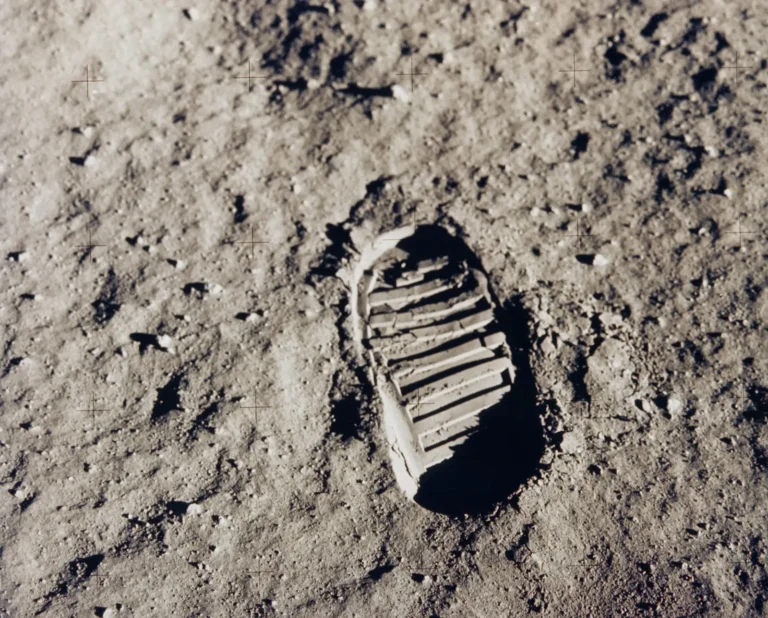
In that same spirit, the result also reframes a popular way of speaking about the Apollo missions. Astronauts who walked on the Moon were undeniably in deep space by every operational measure, but the Moon’s surface is still embedded in a whisper-thin extension of Earth’s atmosphere. NASA has highlighted that Apollo-era instruments could even see this outer atmosphere from the lunar surface, including observations made during Apollo 16.
A photograph from 1972, understood differently now
The geocorona is not new. Scientists have studied it for decades, and it has been observed in ultraviolet before. What is new is the quantified extent derived from the SOHO/SWAN ultraviolet maps.
During Apollo 16, astronauts deployed a far-ultraviolet camera/spectrograph on the Moon’s surface. The instrument, described in a classic paper in Science, returned ultraviolet imagery and spectra, including views related to Earth’s outer atmosphere: Apollo 16 Far-Ultraviolet Camera/Spectrograph. Images later associated with those observations have been published through space-agency channels, including ESA’s media archive of Earth’s geocorona from the Moon.
In 1972, the point of the Apollo instrument was ultraviolet astronomy and atmospheric science, not a headline about where Earth “ends.” With the SOHO-based analysis in hand, those lunar-surface observations sit in a different frame: not simply a picture of Earth from the Moon, but a view that includes the faint hydrogen envelope extending outward.
What changes, and what does not
Nothing about the result alters how satellites are tracked, how rockets are launched, or how mission planners define the hazards of spaceflight. The density of hydrogen atoms at those distances is far too low to create drag comparable to what spacecraft face in low Earth orbit. The result is conceptual and scientific, not operational.
What it changes is the mental model. Many diagrams depict Earth’s atmosphere as a stack of layers that taper off quickly, with “space” beginning soon after. The geocorona shows that the final layer fades gradually and can be traced far from the planet, forming a large, asymmetric envelope shaped by sunlight and the solar wind.
The measurement also matters for planetary science beyond Earth. Astronomers often search for tenuous gases around other worlds by looking for ultraviolet signatures, including hydrogen scattering. Understanding Earth’s geocorona as a real, measurable example helps scientists calibrate what a faint atmospheric halo looks like, how it can be detected, and what its limits are.
A planet’s edge, in other words, is not always a line. Sometimes it is a gradient. Earth’s outer atmosphere is one of those gradients: present far past the point where human intuition expects it to be, yet so thin that it changes almost nothing about the daily business of exploring space