
''People think the prehistoric age was primitive, but this monument proves that wrong.''
Researchers argue the West Java hill is a layered, man-made structure, but other archaeologists say the evidence does not yet support the oldest-pyramid claims.
On a steep hill in West Java, Indonesia, the megalithic site known as Gunung Padang has become the center of an unusually public argument about what counts as proof in archaeology and how far geophysics can take a historical claim.
The site, long visited by locals and studied mainly as a set of stone terraces, has been recast by one research team as something far larger: a multi-layered structure built in phases, potentially beginning deep in the last Ice Age. If that reading were confirmed, it would place major construction far earlier than the widely accepted timeline in which large-scale building projects appear after the end of the last glacial period and the start of the Holocene epoch, about 11,700 years ago.
But the claim is also a cautionary case. The most prominent journal article advancing the “buried prehistoric pyramid” interpretation in Archaeological Prospection was later described as “now-retracted” in an editor’s account of the controversy and peer-review process in ArchéoSciences. The retraction, and the earlier criticism from outside researchers, has not ended interest in what lies beneath Gunung Padang. It has, however, tightened the burden of proof on the most dramatic dates.
A terrace complex with a long paper trail
Gunung Padang sits in the Cianjur area of West Java. It is widely described as a stepped complex of stone terraces on a hill of volcanic origin, with much of the visible construction made from columnar volcanic rock. The site appears in early 20th-century colonial-era documentation, including a 1914 reference tied to Dutch archaeological reporting, according to a history of research published through the University of Indonesia’s scholarly repository.
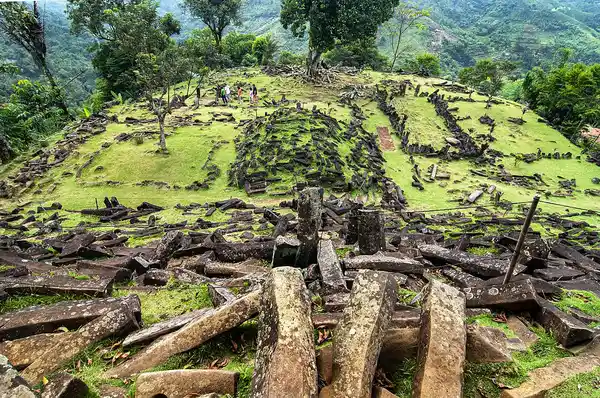
For decades, the mainstream description has focused on what can be seen on the surface: five terraces and retaining walls built from stacked stone columns, a form that appears at other megalithic sites in Indonesia. The disagreement begins when the discussion shifts from the visible terraces to what might be inside the hill itself.
The “layered pyramid” argument
The strongest version of the pyramid claim comes from a team led by Danny Hilman Natawidjaja, a geophysicist affiliated with Indonesia’s National Research and Innovation Agency (BRIN). The team’s basic argument is that Gunung Padang is not simply a natural hill topped with terraces, but a constructed, multi-stage monument whose oldest phases lie below later additions.
The methods cited by the team are typical of subsurface prospecting: ground-penetrating radar, seismic imaging, core drilling and targeted excavation. In public presentations and reporting around a conference appearance at the American Geophysical Union, the researchers said those tools revealed multiple layers with different internal textures and voids, including features interpreted as chambers or cavities.
One reason the claim attracted wide attention is the proposed timeline. In the most ambitious framing, radiocarbon dates tied to material recovered from cores were presented as evidence that some deeper components belong to a period as early as tens of thousands of years ago, with later building phases layered above. That would place initial construction far earlier than the conventional picture of monument-building, which becomes common only after stable Holocene climates support larger, settled populations.
What the dates do, and do not, demonstrate
The debate turns on a familiar problem: radiocarbon dating can reliably measure the age of organic material, but organic material found in or near stonework is not automatically the age of the stone construction itself.
In reporting based on a Nature news account, archaeologists who reviewed the claims said the dates cited by the team came from soils lodged between rocks in drilled cores. Critics argued that the ages of those soils could reflect natural deposition and movement of organic material through the ground rather than the timing of construction. In that view, a very old date would establish that ancient soil exists in the hill, not that humans shaped the hill at that time.
Other objections go beyond the dating method. Some researchers have said the geophysical data may be real and even valuable, but that it does not, by itself, show deliberate shaping or masonry. Natural processes can organize stones downslope, and volcanic geology can produce layers, fractures and voids that look regular in certain scans. As Scientific American reported, some archaeologists said the paper’s leap from subsurface signals to a built pyramid was not adequately supported by excavation evidence from the deepest layers.
The question is not whether Gunung Padang is important. Even critics have described it as an “amazing” site worth studying. The question is whether the available evidence supports labeling the hill’s core as intentionally sculpted architecture, and whether the oldest radiocarbon dates can be tied to building events rather than to older material trapped in a natural formation.
Retraction, and what it means for the claim
The journal publication that put the pyramid case into formal academic circulation did not end the argument. It intensified it.
In the aftermath, the dispute became partly about publishing standards as well as archaeology. An editor’s retrospective discussion in ArchéoSciences describes the paper as “now-retracted” and recounts the concerns that surfaced after publication. Coverage of the retraction in Retraction Watch reported that the action followed questions about what, exactly, had been dated and how those samples were linked to the claimed construction phases.
A retraction does not prove that every underlying observation is wrong. It does signal that, in the view of the journal and its editorial process, the published version did not meet the standards required for its conclusions. For readers trying to gauge what is solid and what is speculative, that distinction matters. Subsurface scans can highlight targets for excavation. They cannot, on their own, establish human construction, let alone a Paleolithic building chronology.
What would settle the question
The cleanest way forward is also the hardest: excavation that reaches the deepest alleged construction layers, paired with careful stratigraphic documentation and dating that is clearly tied to human activity. Charcoal from hearths, worked tools in sealed contexts, construction fills with unmistakable cultural material, or datable binders linked to masonry would all strengthen an argument for deep antiquity. Without that, age claims risk resting on ambiguous proxies.
Gunung Padang sits at an awkward intersection of disciplines. Geophysics can reveal internal structure, but archaeology must demonstrate human agency. The site may yet yield surprises. For now, the safest reading matches what many specialists have told reporters: Gunung Padang is a significant megalithic terrace complex, and the strongest claims about it being the world’s oldest pyramid remain unproven