Göbekli Tepe still dominates any conversation about the deep origins of monument building, but another hill in southeastern Turkey has been pressing on that story with growing force. Karahantepe, often described as Göbekli Tepe’s “sister site”, makes the old site look less like a lonely marvel and more like part of a wider Stone Age landscape of skilled builders, shared symbols, and serious communal effort.
The hill beside the legend
For years, Göbekli Tepe carried the weight of singularity. Its great T-shaped pillars, carved animal reliefs, and astonishing antiquity seemed to arrive from nowhere, as if monumental architecture had appeared in one sudden flash on a limestone ridge above the plains of Upper Mesopotamia. The site’s best-known phases fall between about 9600 and 8200 BCE, and the people who raised its enclosures were still living at the threshold of agriculture, not in the settled, fully agrarian world that older textbooks once treated as a precondition for monumental building.
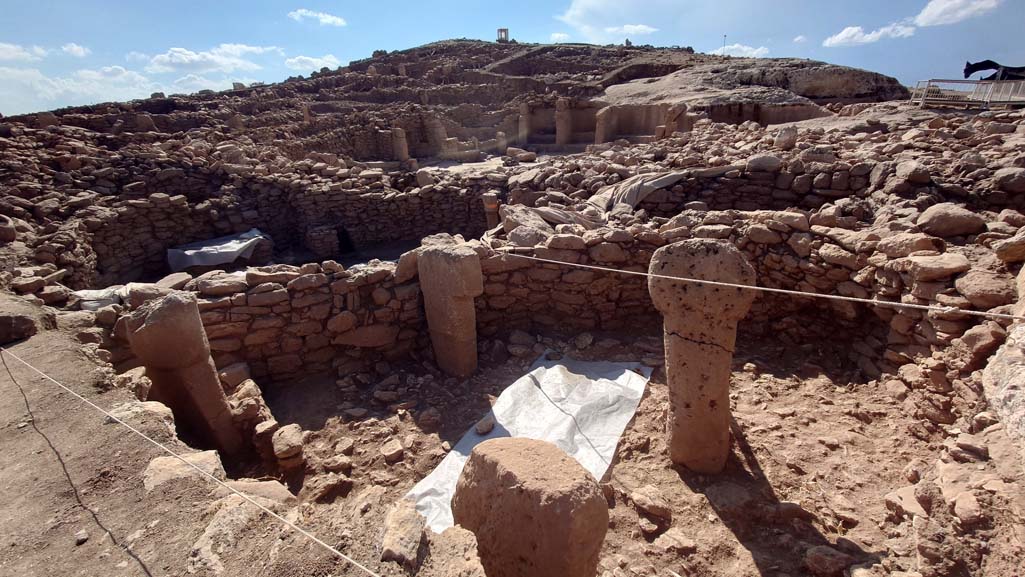
Karahan Tepe changes the shape of that picture. It lies in the Tek Tek Mountains National Park, east of Şanlıurfa, on a high limestone plateau where the stone itself supplied both building material and the raw blocks for T-shaped pillars. The site was identified in 1997, and the first academic notice followed in 2000 in Bahattin Çelik’s A New Early-Neolithic Settlement: Karahan Tepe. Later work, including Çelik’s Karahan Tepe: a new cultural centre in the Urfa Area in Turkey, pushed the scale of the place into sharper focus, with reports of 274 architectural elements and at least 266 in-situ pillars observed on the slopes. That is a serious concentration of stone, and it places Karahan Tepe far beyond the category of minor satellite site.
Stone before the plow
This is where the site matters most. Karahan Tepe belongs to the same broad prehistoric horizon that made Göbekli Tepe famous. Together, the two sites force a harder look at an older, neat sequence in which people first settled down, then farmed intensively, then produced social surplus, and only after that found the labor and organization needed to build in stone on a monumental scale.
The evidence from southeastern Anatolia is rougher, older, and more interesting than that tidy sequence allowed. These monuments were raised by communities still very close to hunter-gatherer life, or living in the first unstable phases of sedentism and cultivation. The old claim that complex communal architecture could only appear after agriculture now looks too simple. At these sites, labor, symbolism, and planning were already being gathered into durable forms while the social world itself was still changing.
That does not mean a hidden super-civilization is waiting behind the stones. It means the transition into settled life was more inventive, more regionally varied, and probably more socially ambitious than the old linear model admitted. In the hills around Şanlıurfa, people were quarrying, carving, hauling, arranging, and marking stone with images of animals and humans at the very beginning of the Neolithic. Karahan Tepe strengthens that point because it shows Göbekli Tepe was not alone in doing it.
A site with its own character
The resemblance between the two sites is real, but Karahan Tepe is not a copy. Even from the early surveys, the place had its own profile. Çelik’s work drew attention to reliefs and sculptural fragments that included serpents and animal imagery. Later excavation has made the site look even more distinct. The terrain breaks into multiple zones, with terraces where pillar tops still show on the surface, an area associated with more domestic activity, and quarry zones where the pillars themselves were cut from the bedrock. That gives Karahan Tepe a lived topography. It reads less like a single ceremonial pocket and more like a complex settlement with special architecture embedded inside a broader occupied landscape.
That distinction matters. Public fascination around Göbekli Tepe has often leaned toward the idea of an isolated ritual center, a place detached from ordinary life. Scholars have argued over that for years. Karahan Tepe complicates the split between temple and settlement because its archaeological footprint suggests a site where special buildings, carved pillars, everyday tools, and residential traces belong to the same world. The people here were not arriving from some unknowable elsewhere to perform rites on an empty hill. They were shaping a local landscape with repeated habits, practical skill, and symbolic intent.
There is also a difference in mood. Göbekli Tepe’s imagery is famous for wild animals, abstract power, and the sheer visual command of its central pillars. Karahan Tepe, at least from what has emerged so far, feels more bodily. Human faces and anthropomorphic forms have become a stronger part of its visual identity, and the architecture seems to press visitors into tighter, more enclosed relationships with stone. Even before the full site is exposed, it carries a different emotional register.
The wider landscape comes into view
The deepest shift, though, is not about one site versus another. It is about the growing realization that both belong to a larger archaeological field now gathered under the Taş Tepeler project, a coordinated effort to study a network of early Neolithic settlements, camps, hunting grounds, and related sites in the Şanlıurfa region. The project’s own description is clear about its ambition. This is an attempt to understand how prehistoric societies in the northern Fertile Crescent moved toward sedentary life, food production, and new forms of social organization.
That broader frame makes Karahan Tepe more than a curiosity beside a celebrity. If Göbekli Tepe once looked like a breach in the historical record, Taş Tepeler suggests something more expansive and more persuasive. The region may have hosted a whole constellation of communities experimenting with stone architecture, symbolic carving, and new collective practices. Some may have been more residential, some more ceremonial, some both at once. The old temptation was to treat Göbekli Tepe as a miracle. The newer evidence points toward a regional tradition.
That is a much bigger story. A single anomaly can always be fenced off. It can be labeled exceptional, strange, without parallel. A cluster is harder to dismiss. A cluster means environment, resources, movement, shared knowledge, and recurring social needs. It suggests people across these uplands understood certain architectural forms and certain images in ways their neighbors could recognize.
Where the evidence narrows
Even so, Karahan Tepe still asks for restraint in the right places. Large claims outrun the excavation. Only part of the site has been opened, and archaeology here is still in the stage where every new trench can rearrange the argument. Dates, functions, and relationships between specific structures will become clearer only as more of the site is published in detail.
The strongest ground at present is architectural and contextual. Necmi Karul’s Buried Buildings at Pre-Pottery Neolithic Karahantepe underlines a crucial point. The structures revealed so far were deliberately filled, and the excavated buildings are treated as “special buildings” rather than ordinary houses. That matters because intentional burial is not casual abandonment. It suggests a formal end to a building’s use, perhaps even a ritual closure, and it helps explain why so much survived beneath the hill.
That does not solve the old question of purpose. Karahan Tepe may have hosted gatherings, rites, feasting, memory work, political display, or several of those at once. Early Neolithic communities did not separate social, symbolic, and practical life in the neat compartments modern language prefers. A place could be inhabited, worked, revered, and buried without fitting our later categories. The stones are eloquent, but they do not hand over a full script.
Still, the central implication is already difficult to avoid. Karahan Tepe makes it harder to treat Göbekli Tepe as a freak event suspended outside normal human development. The evidence now points toward a regional Neolithic culture in which monumental building, carved symbolism, and deliberate architectural closure were already established practices. Karahan Tepe has not told us everything about who built these places or exactly why, but it has made one conclusion far firmer than it was a decade ago. Göbekli Tepe was not standing alone on that ridge.