Ancient societies across Egypt, Jordan, Bolivia, and Peru carved doorways directly into stone with a control that still feels difficult to absorb. Some were symbolic thresholds for the dead, some framed sacred architecture, and some seem to open onto nothing at all, yet together they preserve the same stubborn fact: long before modern steel, people were cutting rock into forms that still look deliberate, measured, and unnervingly exact.
Stone before steel
The first mistake is to treat all of these monuments as if they belonged to a single lost technique. They do not. Sandstone is not granite. Limestone is not andesite. A façade in Jordan does not pose the same technical problem as a ritual niche in an Egyptian tomb or a tightly cut block in the Bolivian highlands. But the larger pattern is real. Across very different civilizations, builders kept returning to the doorway as a charged form, a boundary, a point of contact, a place where belief could be given a physical edge.
That does not mean the work was magical or inexplicable. Experimental archaeology has shown that ancient stoneworkers could do far more than modern shorthand usually allows. In Egypt, granite-working tests at Aswan and wider research into ancient Egyptian stone technology point to labor-intensive methods involving pounding, sawing, drilling, and abrasives. Hard stone could be shaped. The real point is not that the ancients had no way to do it. It is that the work demanded enormous time, planning, skill, and material knowledge, and in some places the finish still exceeds what most people expect from those tools.
The doorway matters because it concentrates all of that skill into a form the human eye reads instantly. A wall can be abstract. A platform can feel remote. A doorway is different. It announces intention. It tells you that someone wanted to mark passage, even when no one was ever meant to walk through it. That is why these carvings keep pulling modern attention back to the same question. The stone is still there. The geometry is still there. The method is the part that recedes.
Egypt’s doors for the dead
In ancient Egypt, the false door was not an architectural mistake or a decorative joke. It was a formal element of tomb culture, a carved threshold through which the spirit of the deceased was believed to move between the world of the living and the realm beyond it. Museum examples preserve the logic clearly. Jambs, lintels, recessed surfaces, and central niches reproduce the grammar of a real entrance even when the wall behind them remains closed.
Most of these classic false doors are not the polished granite panels of modern internet legend. Many surviving examples are limestone, painted stone, or relief-cut chapel walls. That quieter fact does not diminish them. It sharpens them. Egyptian craftsmen were not casually sketching a doorway into soft rock. They were translating architecture into symbolism with exact proportions and durable execution, then placing that image inside a funerary system built around ritual access, offerings, and memory.
The harder-stone question belongs beside this tradition rather than inside it. Egypt also produced granite sarcophagi, hard-stone vessels, statues, and architectural elements that required punishing levels of control. The research record suggests that these results were achieved not by mystery machines but by methods that were slow, exacting, and abrasive in the literal sense. That matters because it gives the Egyptian doorway a wider technical setting. The false door was symbolic, but it emerged from a civilization that knew stone at every level, from quarry extraction to fine surface finish.
A façade cut from the cliff
Petra shifts the scale from chamber ritual to civic theatre. The Nabataean city, now recognized by UNESCO as a rock-cut caravan center between Arabia, Egypt, and Syria-Phoenicia, is “half-built, half-carved into the rock,” a phrase that captures the odd double vision of the place. Its most famous monuments look assembled from columns, pediments, cornices, and blocks, yet the cliff itself is the building material. The façade is the mountain, disciplined into architecture.
That is where Petra’s doorways become so arresting. They are not simply entrances cut into shelter. They are compositions carved into vertical faces at monumental scale, with symmetry, proportion, and decorative detail held together across a living wall of sandstone. What looks built is often hewn from a single mass. The illusion is part of the achievement. Petra teaches the eye to see construction where there was subtraction, not assembly.
Sandstone is more forgiving than granite, and Petra should not be folded into the same technical category as Egypt’s hardest stone or Bolivia’s andesite. Even so, that concession does not reduce the feat. Rock-cut architecture removes the safety net. A block set badly can be replaced. A cliff cut badly keeps the mistake forever. The Nabataeans paired stone skill with water management and desert urbanism, and the result was a city where entrances carried both practical and ceremonial force. They announced power before anyone crossed the threshold.
The geometry of Puma Punku
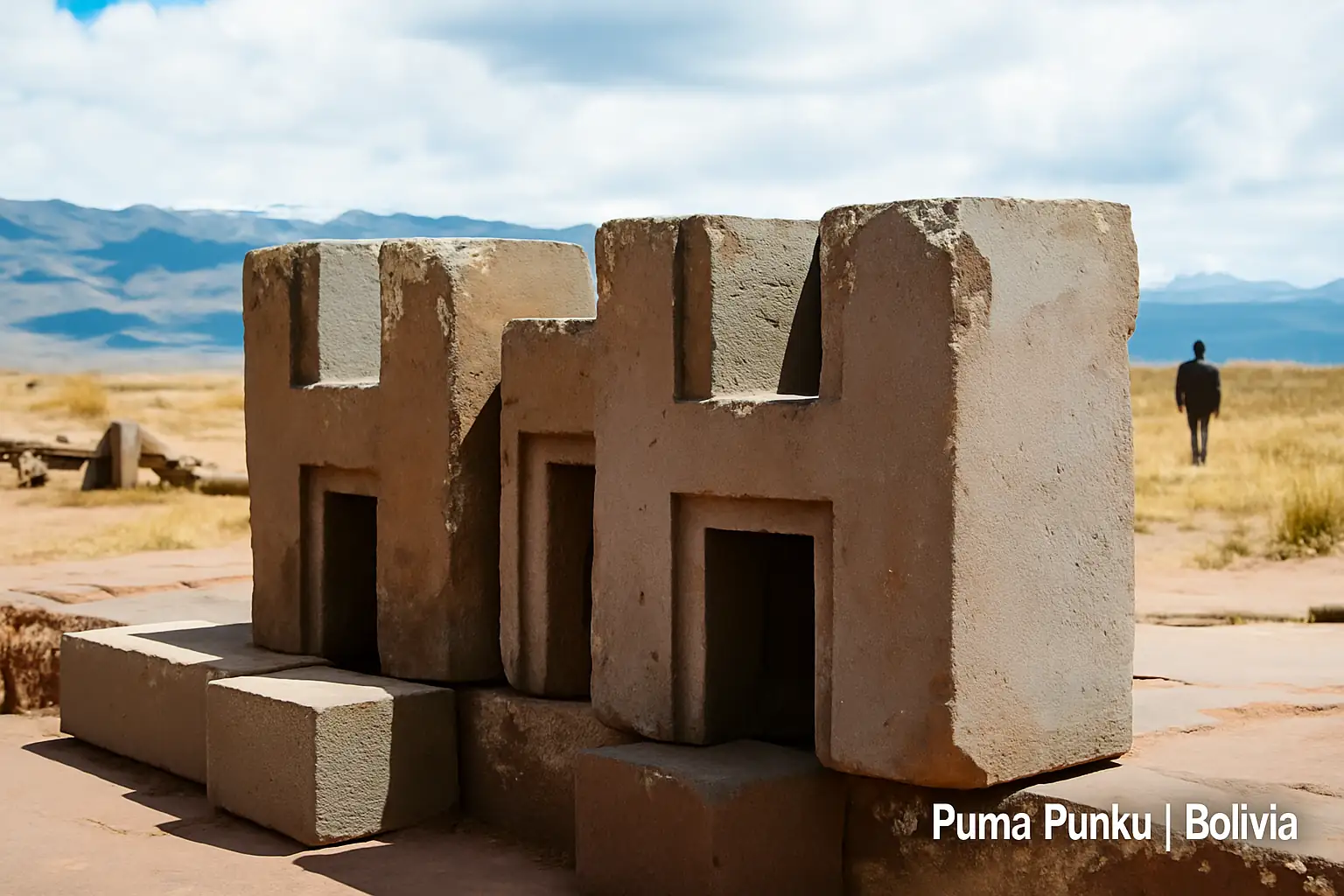
Puma Punku, part of the wider Tiwanaku cultural center, brings the argument back to precision. Modern chronologies place major work at the monument largely in the AD 600s, and the site is known for oversized blocks and finely carved ashlars. Recent scholarship describes stonework with flat planes, geometric corners, and precision fitting, the kind of workmanship that makes the ruin look less eroded than interrupted.
This is the place where doorway language starts to feel almost mechanical. The surviving blocks and gateways carry notches, channels, recesses, and square-edged cuts that seem to belong to a disciplined system rather than isolated acts of carving. A reconstruction study in Heritage Science notes how extensively the Pumapunku stones have been measured and documented, while later modeling work has helped scholars think through how the shattered pieces once related to one another. The site no longer needs fantasy to feel difficult. Its surviving geometry is enough.
That does not mean the entire process is unknown, or that no explanation is possible without importing modern machinery into the past. It means something more exact. There is still no neat account that turns Puma Punku into ordinary masonry. Quarrying, transport, sequencing, shaping, and placement remain matters of serious reconstruction, especially because the monument was looted, scattered, and badly restored. The best current work narrows the field. It does not close it.
A doorway with no room behind it
Then there is Hayu Marca near Lake Titicaca, often called the Gate of the Gods. Unlike the Egyptian false door, whose ritual function belongs to a documented mortuary tradition, Hayu Marca lives in a looser zone where archaeology, local reverence, tourism, and legend blur together. The carved recess in the rock is real. The stories attached to it are harder to pin down. Accounts of a priest passing through the doorway and vanishing belong to the realm of oral tale, not settled historical record.
That uncertainty is part of the site’s hold on the imagination. Hayu Marca strips the doorway down to its most unsettling minimum. There is no obvious chamber, no carved hall behind the opening, no architectural program on the scale of Petra. What remains is the threshold alone, isolated in the landscape and complete enough to insist on intention. Even where the evidence narrows, the form keeps its power. Human beings carved a door where a door could not function in any ordinary sense, and that choice still presses on the mind.
Where the explanation holds, and where it thins
Taken together, these sites do not point to a single lost civilization or one vanished universal technique. They point to something harder to compress and, in some ways, more impressive. Ancient builders in different places learned to work different stones for different ends, from Egyptian funerary symbolism to Nabataean cliff façades to Tiwanaku precision masonry. The doorway kept returning because it could do several jobs at once. It could separate worlds, frame authority, organize ritual movement, and turn bare rock into a statement of control.
The strongest evidence does not support the idea that these monuments are impossible. It supports the idea that modern people often underestimate the sophistication of ancient labor. In Egypt and Petra, the broad outlines of method are increasingly intelligible even when the manpower behind them remains staggering. At Puma Punku, and even more at Hayu Marca, the explanation becomes thinner and more uneven. The doorways remain, the workmanship remains, and the cleanest conclusion is also the most demanding one: ancient stoneworkers achieved levels of planning, finish, and symbolic force that still outrun our easy summaries of the ancient world