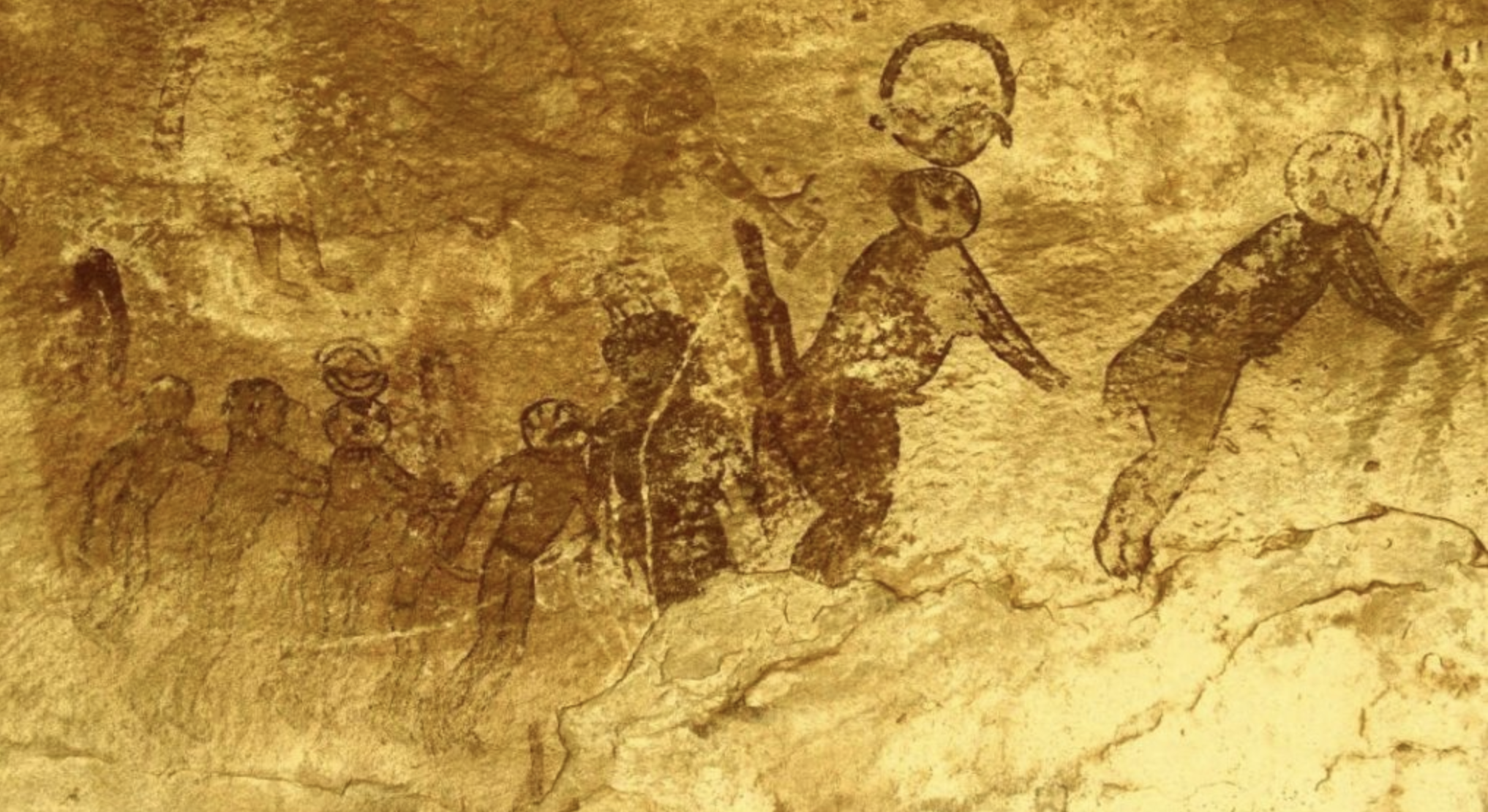

High in Algeria’s Sahara, more than 15,000 prehistoric images trace a vanished green world and the strange human figures that still fuel debate.
High on the Tassili n’Ajjer plateau in southeastern Algeria, the Sahara preserves one of the largest painted archives on Earth. More than 15,000 prehistoric images, spread across a maze of sandstone walls and rock shelters, record a lost world of grass, water, cattle, dancers, and human forms so strange that they still draw modern viewers toward the line where archaeology meets interpretation.
A gallery carved into distance
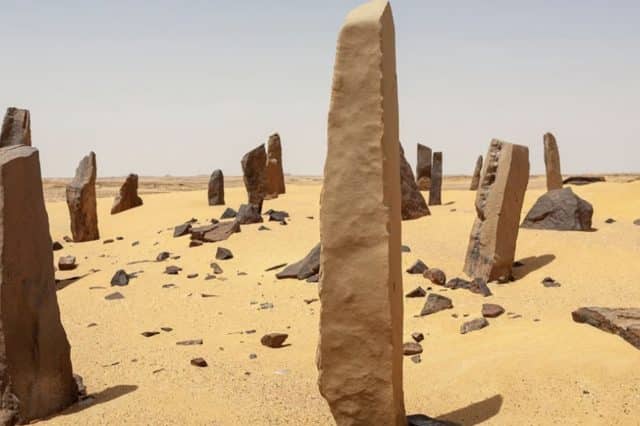
Tassili n’Ajjer is easy to call remote and still not do it justice. The plateau rises from the desert near the borders of Libya and Niger, a vast field of eroded sandstone whose arches, pinnacles, and corridors make the landscape look almost engineered. Within that stony expanse lies a UNESCO World Heritage site, a place recognized not only for its dramatic geology but for a body of rock art that stretches across thousands of years.
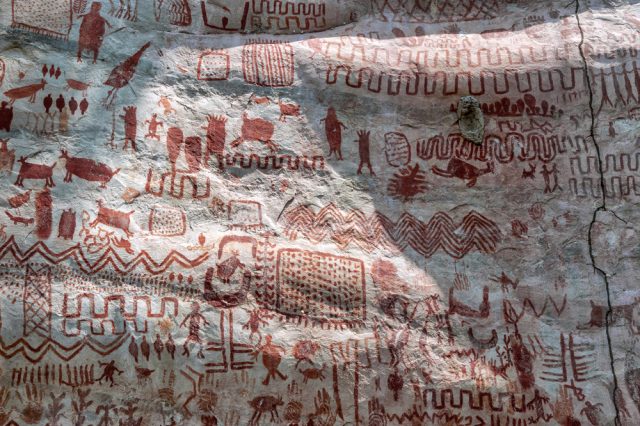
This is not a single cave with a few famous panels. It is an enormous visual territory, more than 70,000 square kilometers in scale, with paintings and engravings scattered across shelters, cliff faces, and hidden recesses. The effect is less like entering a room and more like walking into a continent-sized archive. The walls hold hunters, herders, masked figures, antelope, cattle, giraffes, and scenes dense with movement. They also hold the record of change, because Tassili is not just a gallery of images. It is a gallery of shifting climates, shifting lifeways, and shifting ideas about what mattered enough to paint.
Its chronology is broad, and not every date sits on equally firm ground. Yet the overall sequence is clear enough to be remarkable. The rock art periods trace a long passage from a wetter Sahara filled with wild fauna to a later world of cattle keeping, horses, and camels. What now feels like the edge of habitability was once a lived-in landscape.
When the Sahara held water
To understand Tassili, the first step is climatic. The paintings belong to a Sahara that was not yet the Sahara we know. During the African Humid Period, large parts of North Africa were greener, wetter, and far more hospitable than the modern desert. Lakes spread across basins that are now dry. Grasslands and scattered woodlands supported animals that seem almost surreal in a Saharan setting today, including hippos, crocodiles, elephants, and giraffes.
That older environment lives on in the art. Early panels emphasize wild fauna and human figures that are often stylized, abstract, or monumental. Later work brings in the settled logic of pastoral life. Cattle become central. People appear in groups, in processions, in encounters that suggest ceremony, status, or labor. By the time horses and then camels enter the visual record, the Sahara itself is becoming harsher, and the art begins to reflect a region tied to mobility, trade, and adaptation.
Tassili matters because it turns prehistory into something visible and sequential. The plateau lets us watch a society change its subjects as its world changes around it. That is why these paintings feel larger than decoration. They are evidence from the inside.
Life, labor, and ritual on the walls
Some of the most vivid scenes at Tassili have nothing to do with mystery in the modern sensational sense. They show people occupied with the basics and ceremonies of life. There are dancers with raised arms, groups that appear to be performing or processing together, herders managing livestock, and scenes that suggest the social weight of cattle in a changing Saharan economy.
Those images matter because they do what writing would do much later. They preserve action. They record attention. They show what a community chose to repeat on stone. The figures do not stare passively from the walls. They move. They bend. They run. They gather. They turn daily life into form.
The change in style across the millennia is part of the fascination. Early art includes abstract marks and handprints. Later panels become fuller, more ambitious, more narratively charged. The temptation is to hear the ancient artists cracking a modern line at their own progress, “We started with stick figures, but we’ve gone pro now!” The joke works because the visual jump is real. So does another imagined aside in front of the pastoral scenes, “Farming? Been there, done that. Where’s my tractor?” Even that bit of humor points to something solid beneath it. These paintings preserve work, subsistence, and skill, not as dry data but as lived experience.
Their survival sharpens the effect. Sheltered by stone and preserved in one of the driest regions on Earth, many panels have lasted for thousands of years. The phrase “toughest art on the block” may be playful, but it fits. The desert that erased so much also helped keep this record in place.
The figures that changed the conversation
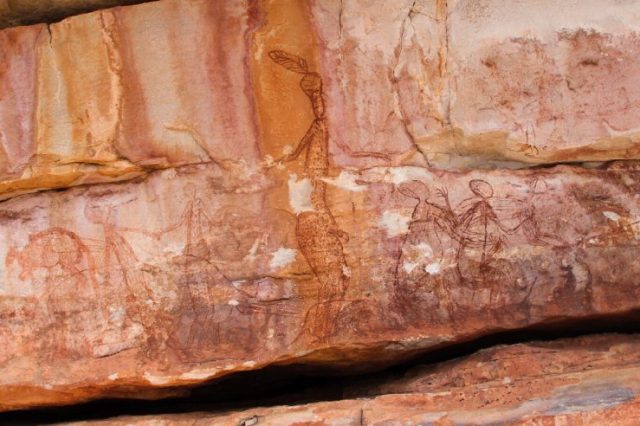
Then there are the images that made Tassili famous far beyond archaeology. Some of the plateau’s human figures look uncannily unfamiliar to modern eyes. They have round, featureless heads, elongated or floating bodies, and an outsized presence that breaks from the more grounded realism of herders and animals. In the most dramatic cases, they seem less like portraits of ordinary people than presences from another visual register.
These are the so-called Round Head paintings, and they sit near the center of Tassili’s enduring pull. Their power lies partly in scale and partly in ambiguity. Some figures tower over smaller humans. Some appear to hover. Others look masked, transformed, or lit from within by the sheer boldness of their outline. It is not hard to see why later readers, raised on science fiction and ancient-astronaut fantasies, reached for extraterrestrial language.
One of the site’s best-known images, the Running Horned Woman, shows how rich that ambiguity can be even without leaving the ground of serious interpretation. She is adorned, in motion, and painted with a degree of elegance that sets her apart. Scholars have read the image in different ways, including as a ritual or sacred figure rather than a scene from ordinary daily life. Whatever the precise meaning, the painting carries intention beyond simple recordkeeping.
This is where Tassili becomes hard to forget. It does not only show a past society managing animals and surviving climate change. It shows a past society imagining, performing, and perhaps invoking forces larger than ordinary life.
Where interpretation tightens
The alien reading is the loudest modern story attached to Tassili, but it is not the strongest one. Those famous “otherworldly” figures can be placed more plausibly within ritual, masked performance, altered states, or symbolic art tied to belief. In some panels, the body shapes and apparent motion have encouraged comparisons with shamanic experience. In others, their form may simply reflect a style whose logic we do not fully share.
That does not flatten the mystery. It gives it firmer ground. The problem is not that the paintings are too strange to mean anything. It is that they may belong to several different communities, painted over long spans of time, with different beliefs and purposes. The same visual vocabulary may not carry the same meaning from one shelter to the next.
Dating adds another layer of caution. Direct dating of the paintings has often proved difficult, and some earlier attempts ran into problems of contamination or unreliable samples. More recent work has leaned on contextual methods, including optically stimulated luminescence dating of surrounding sediments and broader archaeological comparison. That has helped refine the sequence without pretending every figure has a neat label and exact year.
This is the right place to leave the door open without taking it off the hinges. Tassili’s strangest images are real. Their visual force is real. Their meaning is not settled in every case, and that uncertainty is part of the site’s intellectual appeal, not a flaw in it.
What the plateau still holds
Tassili n’Ajjer continues to attract archaeologists, historians, travelers, and people who arrive simply because the pictures look unlike anything else in prehistoric art. The attraction is easy to understand. Few places let you see environmental history, social change, visual invention, and sacred possibility pressed so closely together.
It also helps that the site resists reduction. It is not only an art historical treasure. It is not only a prehistoric climate archive. It is not only a catalog of pastoral life. It is also a place where images still exceed the labels placed on them. That is why the plateau remains alive to argument. The strongest ground lies in what the paintings plainly show, a greener Sahara, evolving lifeways, ritualized scenes, and one of the richest rock art traditions in the world. Beyond that, interpretation begins, and Tassili keeps just enough of itself back to make the argument an ongoing one.