Stonehenge still earns its reputation. Its first earthwork enclosure was raised about 5,000 years ago, and the famous sarsen circle belongs to the late Neolithic, around 2500 BC. It sits inside a dense ritual landscape of avenues, burial mounds, and earlier monuments. But once Stonehenge is treated as a starting point rather than the summit, the map opens fast. There are places older than it, places larger than it, places built in settings so remote or severe that the usual story of megaliths begins to look far too small.
The Carnac Stones in Brittany do that almost immediately. This is not a single ring or a tidy cluster. It is a broad ceremonial landscape of alignments, standing stones, dolmens, and tumuli built across the Neolithic, roughly 5000 to 2300 BCE. The famous alignments alone involve around 3,000 stones running across the ground in long, deliberate bands, a scale that can make Stonehenge feel compact by comparison. Carnac does not offer one clean image. It offers excess, repetition, and a sense that entire stretches of land were being ordered through stone.

Then there is Avebury, where size becomes the argument. Avebury’s henge and outer circle date to about 4,600 years ago, and the site contains the largest prehistoric stone circle in the world, together with two smaller inner circles and avenues reaching out into the surrounding landscape. Stonehenge is more formally theatrical. Avebury is broader, more spatial, almost civic in its layout. It suggests a community shaping terrain on a scale that was meant to be entered, crossed, and lived around, not just approached as a single sacred object.
Stone and water
Some megalithic sites gain power from the way they appear and vanish. The Dolmen of Guadalperal in western Spain, often called the Spanish Stonehenge, belongs to the fourth or third millennium BCE and consists of roughly 150 upright stones arranged around a chamber and corridor. Since the creation of the Valdecañas reservoir, it has spent long periods submerged, re-emerging in drought years with the unsettling effect of a monument returning from another age. That rhythm has changed how people see it. Guadalperal is not only ancient. It is periodically recovered, damaged, and re-read every time the water falls back.

Far from Europe, Nan Madol shows that megalithic ambition did not need a stone circle at all. Off the southeast coast of Pohnpei in Micronesia, more than 100 artificial islets were built from basalt and coral boulders between about 1200 and 1500 CE as the ceremonial center of the Saudeleur dynasty. Walls rise from tidal channels in stacked dark columns, giving the place the look of a city assembled from quarried prisms. Stonehenge is older, but Nan Madol expands the category. It is megalithic architecture as political capital, island engineering, and controlled sacred space all at once.
Before kingdoms, before metal
If any site truly resets the timeline, it is Göbekli Tepe in southeastern Türkiye. The main monumental phases date between about 9600 and 8200 BCE, which places the site more than six millennia before Stonehenge. Its great T-shaped pillars, some over five meters tall, were erected by hunter-gatherer communities in the Pre-Pottery Neolithic. Animal reliefs crowd the surfaces, foxes, boars, vultures, snakes, turning the stone into something far more animated than bare architecture. Göbekli Tepe matters because it breaks an old assumption. Monumental ritual building did not wait for cities, states, or metal tools. In at least one place, it arrived first.

Rujm el-Hiri, also known as Rogem Hiri, occupies a different kind of uncertainty. Set in the Golan Heights, the monument consists of concentric basalt circles surrounding a central cairn. The outer ring stretches roughly 500 meters in circumference, and the site is generally placed in the Bronze Age. For years it was popularly cast as a kind of Levantine Stonehenge, perhaps an observatory, perhaps a burial complex. Newer regional work has widened the frame by identifying many more related circular structures in the surrounding basalt landscape, which makes Rujm el-Hiri look less like a singular oddity and more like the best-known example of a larger building tradition. The mystery has not disappeared. It has become more specific.
Landscapes of the dead
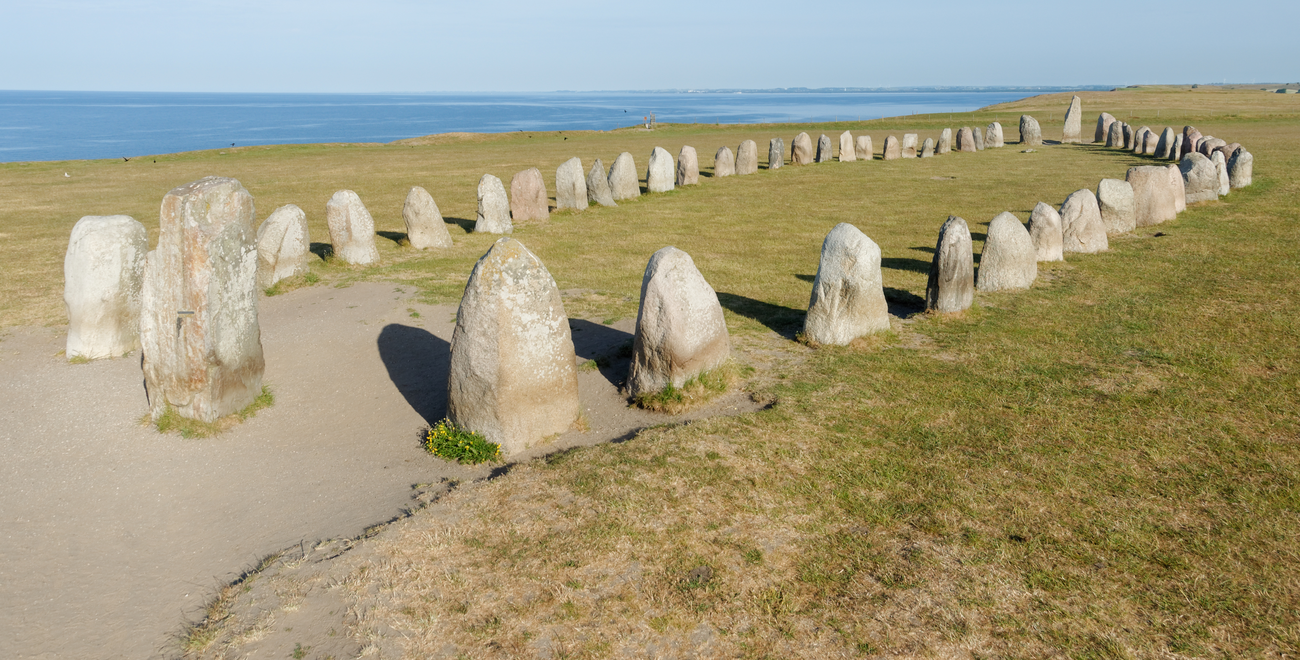
In southern Sweden, Ale’s Stones takes the megalith in another direction. The monument forms a 67-meter stone ship made of 59 large stones on a cliff above the Baltic. Its dating has long been argued over, but heritage authorities and radiocarbon evidence generally place its construction in the late Iron Age, around 600 CE, not in deep prehistory. That does not make it less arresting. It makes it sharper. Ale’s Stones belongs to a world where stone still carried funerary and ceremonial force, but the language of that force had shifted into the shape of a vessel, a journey, a body turned toward sea and horizon.

Sardinia’s Giants’ Tombs work on a different emotional register. These collective burial monuments, built by Nuragic communities during the Bronze Age, are spread across the island in large numbers and marked by long burial chambers fronted by broad semicircular forecourts. They are not built to isolate a single dead ruler. They gather the dead together. The architecture has a public face, almost an assembly front, which suggests that burial here involved repeated return, ceremony, and shared memory rather than sealed-off prestige. In that sense they rival Stonehenge by revealing a different social use of megalithic form, less about skyline drama, more about continuity between community and tomb.

The Ring of Brodgar in Orkney brings those themes together in a setting that still feels stark enough to hold them. The main ring was probably built between 2600 and 2400 BC. It originally had 60 stones, 36 of which survive, and sits inside a rock-cut ditch on a narrow strip of land between two lochs, with burial mounds nearby. Brodgar is not larger than Avebury, and it is not older than Göbekli Tepe. Its force comes from placement. Few stone circles sit so cleanly inside a broader ritual landscape, where water, mound, horizon, and ring are all locked into the same field of vision.
Precision at altitude
Puma Punku, part of the Tiwanaku monumental complex in Bolivia, is where the conversation turns from placement and antiquity to workmanship. Most of Tiwanaku’s ancient city was built in adobe and later overlaid by settlement, but the ceremonial core preserves monumental stone architecture on the high Altiplano at 3,850 meters above sea level.

Work on Pumapunku appears to have concentrated in the AD 600s, and the ruined platform is famous for finely cut andesite and sandstone elements, carefully fitted blocks, and fragments of gateways that hint at a far more complete structure than what now survives. People often overstate the mystery by treating the masonry as impossible. The real point is better than that. It is skilled, exact, and technically ambitious enough that even in ruin it still resets expectations about what highland Andean builders were doing with stone.
Taken together, these ten sites do not dethrone Stonehenge so much as place it back inside the full range of ancient monument building. Carnac overwhelms by number. Avebury by scale. Göbekli Tepe by age. Nan Madol by urban strangeness. Rujm el-Hiri by unresolved function. Brodgar by setting. Sardinia’s Giants’ Tombs by funerary repetition. Ale’s Stones by form. Guadalperal by its broken returns from the water. Puma Punku by the confidence of its stonework. Stonehenge remains extraordinary, but it no longer looks solitary. It looks like part of a global human habit, the urge to move impossible weight into meaningful order and leave it there for millennia