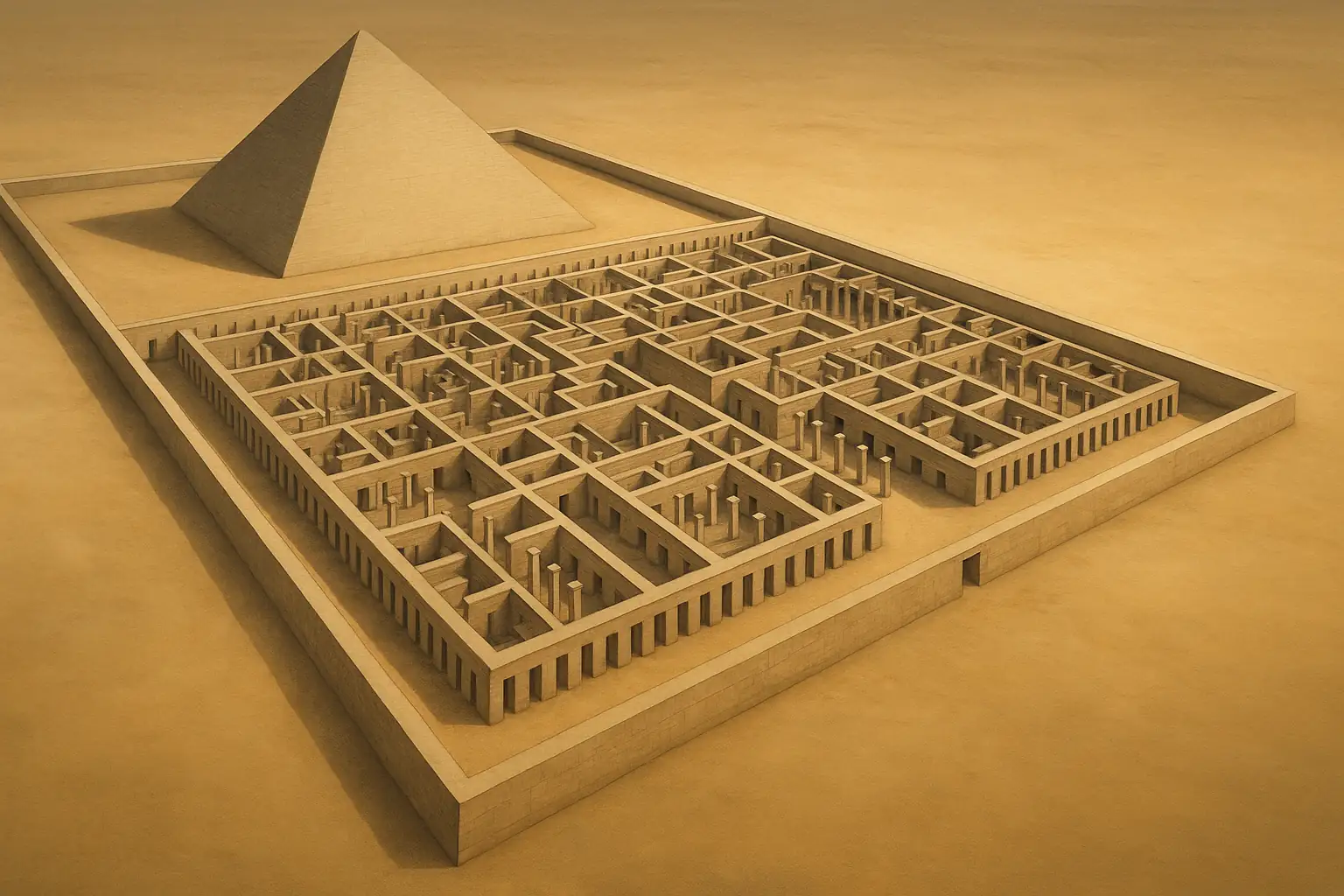

Near Egypt’s Faiyum, ancient visitors described a monument of courts, columns, and countless chambers beside the pyramid of Amenemhat III. Most of it is gone, but not the case for its existence.
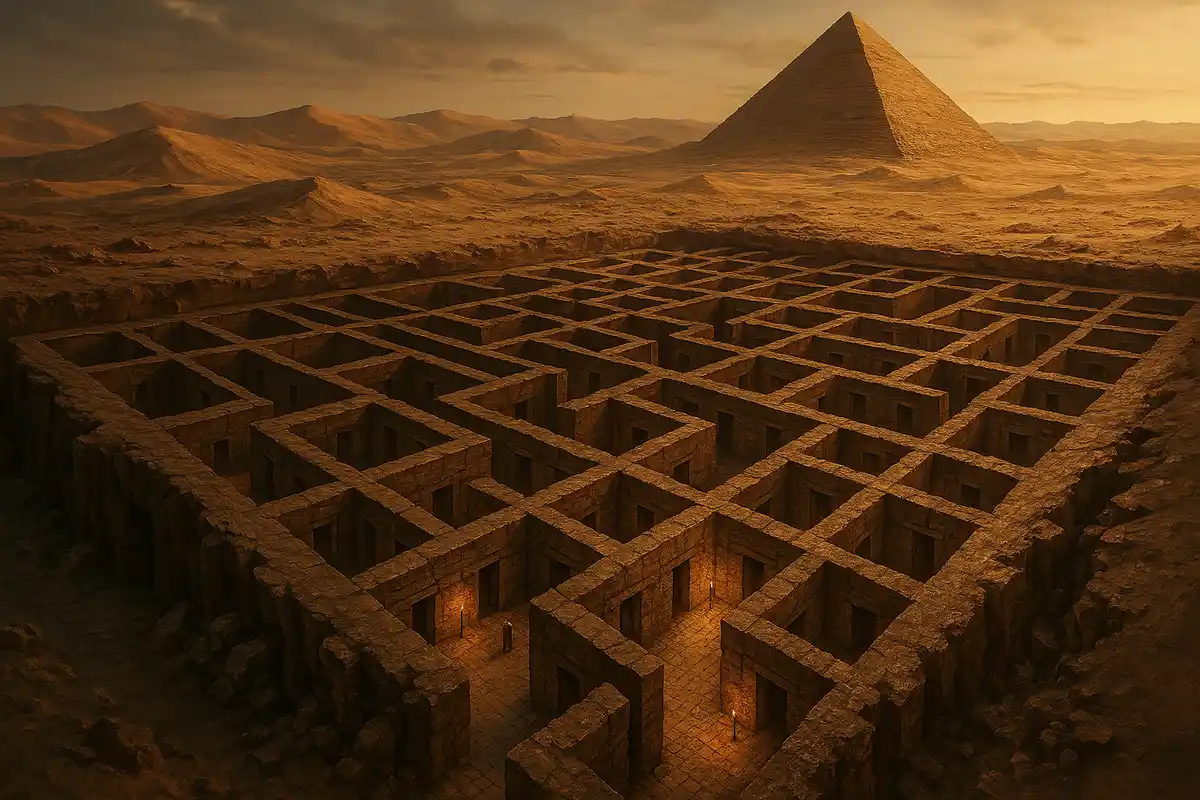
When Herodotus reached Egypt in the fifth century BCE, the pyramids were already ancient. Yet the monument that seems to have stunned him most was not at Giza. Near Lake Moeris, opposite the City of Crocodiles, he said he saw a labyrinth so large and so elaborate that it surpassed even the pyramids. He did not describe it as a rumor, a local legend, or a half-seen ruin. He wrote that he had seen it himself, then tried to convey its scale through courts, chambers, colonnades, and a layout so complex it defeated ordinary comparison. Even in a civilization remembered above all for its pyramids, this was the monument he singled out as greater than words could easily carry.
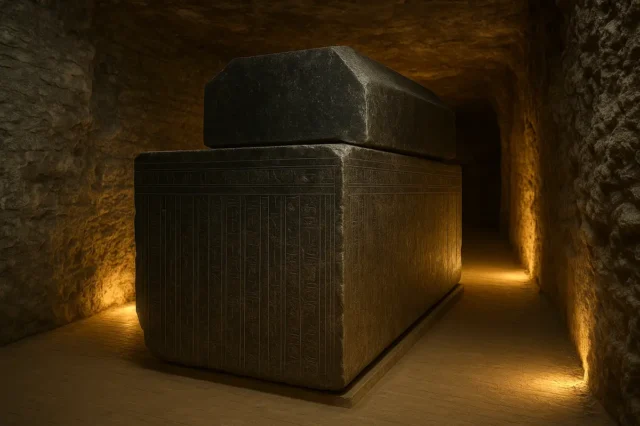
His account is striking because it is both grand and careful. Herodotus wrote of twelve covered courts and three thousand chambers, fifteen hundred above ground and fifteen hundred below. He said he personally walked through the upper chambers, but he made a point of separating that from what he had only been told. The Egyptian custodians would not show him the lower level, he said, because those chambers held the tombs of the kings who first built the labyrinth, along with sacred crocodiles. That admission matters. It means the most famous underground part of the story entered the record as local testimony, not direct observation. The upper half, with its passages, courts, and colonnades, was the part he claimed to know at first hand.
Ancient visitors kept the story alive
Herodotus was not the only writer to leave the labyrinth standing in memory. Centuries later, Strabo also placed it in the Faiyum and described a monumental complex of courts and colonnades, with long winding passageways so confusing that no stranger could move through them without a guide. He was especially struck by the construction, noting roofs of single stone slabs and walls built from equally massive blocks. At the end of the building, he said, stood a pyramid-tomb. That does not reproduce Herodotus word for word, but it does something more useful. It shows that the monument still had a recognizable identity centuries later and that later visitors still regarded it as one of Egypt’s great architectural spectacles.
By the Roman period, the labyrinth had already begun to move from physical monument into literary memory. Strabo still wrote like a visitor describing a place. Pliny, by contrast, preserved a later and longer account without having seen it himself. UCL’s Hawara research notes that Pliny was probably blending earlier descriptions with his own idea of what a labyrinth ought to be. That distinction matters because it helps sort the tradition into layers. Herodotus and Strabo bring us closest to the monument as experience. Later authors kept the wonder alive, but they also helped turn it into something larger, stranger, and easier to mythologize than the archaeology can fully support.
Why Hawara remains the strongest match
The strongest identification places Herodotus’s labyrinth at Hawara, beside the pyramid complex of Amenemhat III in the southeastern Faiyum. The British Museum identifies the Temple of Amenemhat III at Hawara as the structure often referred to by classical authors as the Egyptian Labyrinth, and UCL’s reconstruction work describes it as a large cult complex, roughly 120 by 300 meters, built to the south of the king’s pyramid. In the broader history of Egyptian royal building, from Egypt’s oldest pyramid to the later monumentality of Giza, Hawara belongs to a mature tradition in which the pyramid was only one part of a much larger ceremonial and funerary landscape.
That point is easy to miss if the labyrinth is imagined only as a giant maze. The better reading is a royal complex with several roles at once. UCL notes that Amenemhat III’s southern complex was a cult center in which the king was worshipped as a god, and that it came to be known in classical antiquity as the Labyrinth. Strabo adds something important here. He says the number of courts may have reflected the nomes of Egypt, which assembled there with priests and priestesses for sacrifices, offerings, and the administration of justice. That does not turn the labyrinth into a town hall in the modern sense, but it does suggest a place where kingship, ritual, administration, and funerary meaning met inside one enormous architectural scheme.
What archaeology found, and what it did not
The reason the labyrinth feels half real and half missing is not that the ancient writers were necessarily inventing it. It is that the monument was dismantled with extraordinary thoroughness. UCL’s history of the site says the complex was used as a quarry from Ptolemaic times onward, especially under Roman rule, and that most of it disappeared long before modern archaeology arrived. When Flinders Petrie excavated Hawara in 1888 and again in 1911, he could not recover an intact labyrinth. His own reconstructions depended heavily on the classical descriptions because the surviving evidence on the ground was so limited. In other words, archaeology did not disprove the labyrinth. It ran headfirst into the fact that the building had already been stripped to a stubborn minimum.
Modern survey work has kept the case alive without turning it into fantasy. A 2010 VLF-EM study treated the area south of the pyramid as the labyrinth mortuary temple complex at Hawara and reported subsurface anomalies consistent with buried archaeological remains. That is not the same thing as uncovering Herodotus’s full three-thousand-room wonder. But it does matter, because it suggests the site still holds architectural traces below the surface. The same body of work around Hawara has also stressed how difficult the site has become to read cleanly, thanks to later disturbance, modern encroachment, and water-related damage in the broader pyramid precinct. Hawara is not a blank patch of sand. It is a complicated archaeological landscape that has been damaged, reused, flooded, and only partly understood.
That also helps cut away some of the weaker claims that keep attaching themselves to the labyrinth. Nothing in the published archaeology from Hawara confirms dramatic tunnels stretching north to Memphis, secret archives from predynastic Egypt, or a pristine underground maze waiting untouched beneath the desert. Herodotus himself was careful enough to say that the lower chambers were reported to him, not shown to him. Modern work supports a monumental complex at Hawara, not a license to import every later legend into the same space. The real site is more disciplined than that, but it is no less interesting. A vast cult and mortuary complex tied to Amenemhat III is already remarkable enough.
A damaged wonder is still a wonder
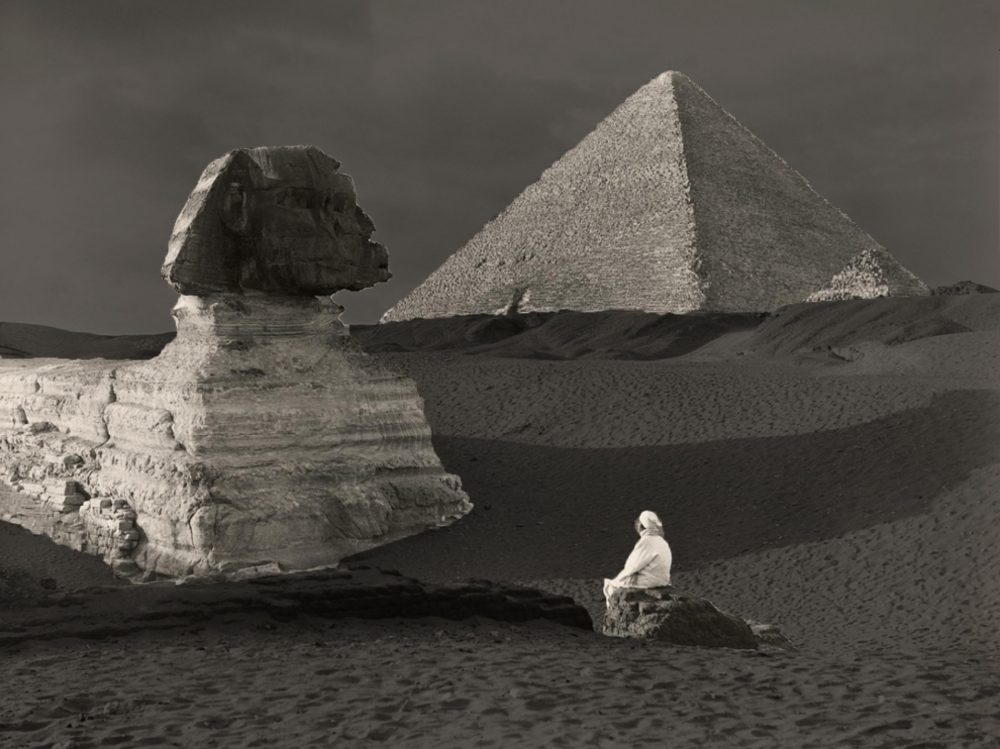
Part of the labyrinth’s grip comes from the kind of absence it leaves behind. The Great Pyramid overwhelms because it is still there, massive, legible, and impossible to ignore. Hawara works differently. Its power comes from the gap between what ancient visitors described and what now survives. That gap invites exaggeration, but it also tells a more grounded story about how monuments disappear. They are not always swallowed whole by desert or myth. Sometimes they are taken apart block by block, reused, weathered, cut through, flooded, and left as foundations, fragments, and arguments. The labyrinth belongs to that harsher history of survival.
So was Herodotus exaggerating? Probably at times, yes. Ancient travel writing often pushed scale to the edge of the imaginable. But exaggeration is not invention. The strongest reading today is not that the Egyptian labyrinth was a fantasy, nor that it remains fully hidden underground exactly as described. It is that a major monument once stood at Hawara beside the pyramid of Amenemhat III, that ancient visitors found it extraordinary, and that later destruction reduced it so completely that texts now preserve more of its shape than stone does. That is why the labyrinth still matters. It is not merely a lost wonder. It is one of those rare cases where the written record, the archaeological setting, and the surviving traces all still point toward the same missing thing.