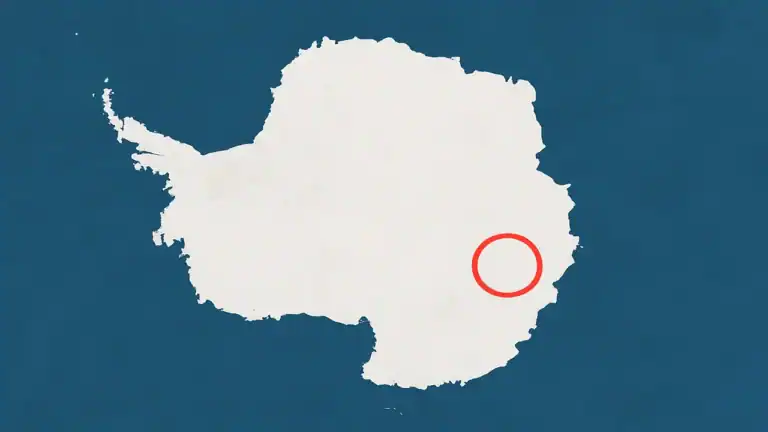
A satellite screenshot shared online has been described as a giant face in Antarctic ice. Dark and light patches suggest eyes, a nose and a mouth, but the feature’s precise location, dimensions and age have not been independently verified.
Why a landscape can look like a face
Face pareidolia is the perception of a face in an object or pattern. In a 2021 University of Sydney study, researchers examined how people judged expressions in real faces and face-like objects. Judgments were influenced by preceding images across both categories, suggesting shared processing of facial expression. A shape can continue to look face-like even when the viewer knows it is an object.

A familiar example from Mars
NASA’s discussion of pareidolia uses the Cydonia mesa known as the Face on Mars as an example. Shadows in a Viking orbiter image suggested facial features; later, higher-resolution views showed the terrain in much greater detail.
Pyramid shapes in a glacial landscape
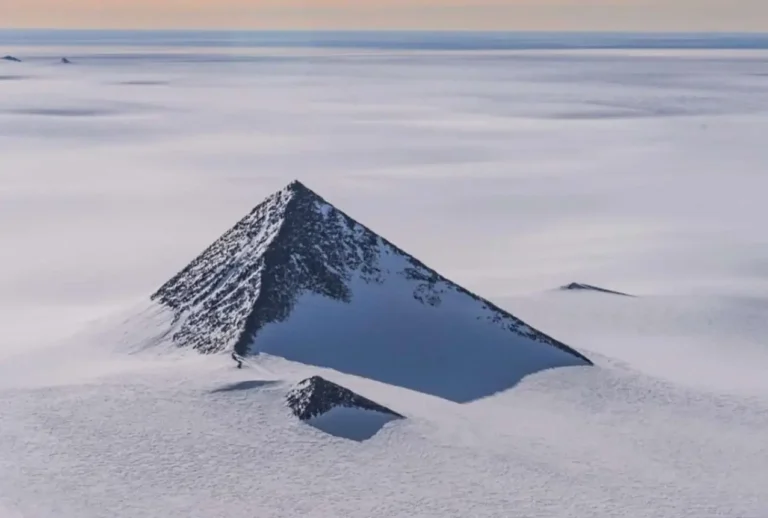
Pyramid-shaped peaks also have a geological explanation. The US Geological Survey’s glacier glossary describes a horn as a pointed peak bounded by three or more cirques, with faces and ridges cut by erosion.
Posts cited with the claim
UFO_Scandinavia and thirdphaseofthemoon were the social-media references associated with the claim in this article. Their original posting sequence and the claim’s first observer have not been independently verified.
https://www.instagram.com/p/B1ZtwtkCFOw/
Related Curiosmos reading: UFO reports.
Join the Curiosmos discussion on Telegram.