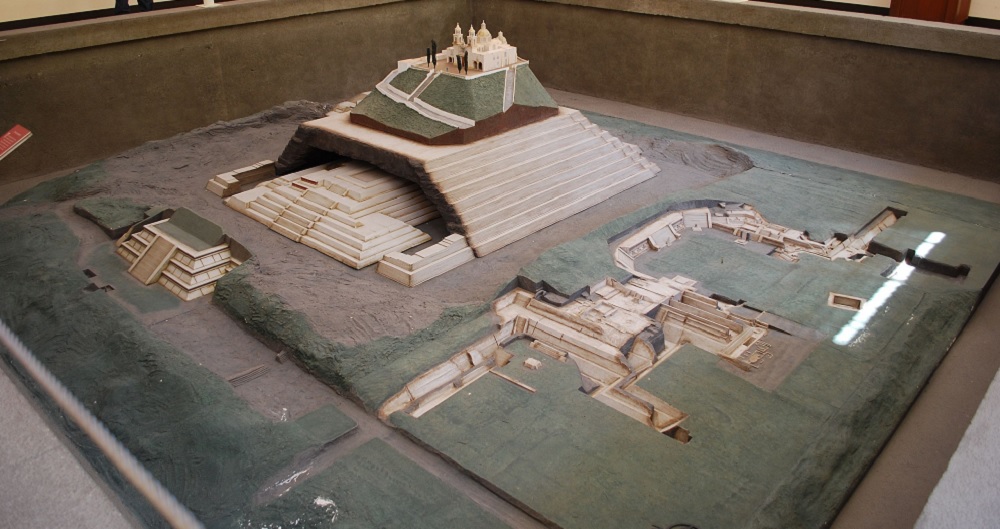

It is the largest pyramid as well as the largest monument ever constructed anywhere in the world.
When people picture the world’s largest pyramid, they usually think of Egypt’s Great Pyramid at Giza. But in central Mexico, a much larger pyramid by total volume sits beneath what looks like an ordinary hill.
The structure is the Great Pyramid of Cholula, or Tlachihualtepetl, a vast earthen-and-adobe monument in the state of Puebla, near the modern city of Cholula.
A record set by size, not height
By height, Cholula does not compete with the Great Pyramid of Giza, part of the Memphis and its Necropolis World Heritage site. What sets Cholula apart is bulk. Guinness World Records lists it as the largest pyramid by volume, estimating about 4.45 million cubic metres, compared with roughly 2.4 million cubic metres for the Pyramid of Khufu at Giza.
Guinness also places Cholula’s height at about 66 metres and its base area at nearly 16 hectares, dimensions that help explain how a pyramid that is not especially tall can still be the biggest by mass.
Its outward appearance complicates the comparison. Cholula does not present as a clean-edged stone pyramid. Soil and vegetation have softened its lines over centuries, making the structure resemble a natural rise in the landscape.
Built in layers over centuries
Cholula’s pyramid was not a single construction project completed under one ruler. It grew across long stretches of pre-Hispanic history, built and expanded in stages through the Preclassic and Classic periods, from roughly the 3rd century BCE to the 9th century CE, according to Guinness World Records.
Archaeological work has identified multiple superimposed building phases, a pattern seen in several Mesoamerican ceremonial centers. In Cholula’s case, later construction often enclosed earlier structures rather than replacing them outright. The result is a complex interior: a large mound containing earlier platforms, walls and architectural elements embedded within.
Mexico’s National Institute of Anthropology and History describes the site as a major challenge for researchers precisely because so much of the ancient city, not just the pyramid, lies beneath the modern surface.
A hill topped by a colonial church
The pyramid’s modern silhouette is defined as much by colonial history as by ancient engineering. In the 16th century, Spanish builders constructed the Iglesia de Nuestra Señora de los Remedios on the summit. The church, begun in 1574 and completed in 1575, still crowns the mound.
That decision helped fix the pyramid’s “hill” identity in the public eye. From ground level, the church reads as a mountaintop landmark. The pyramid beneath it reads as terrain.
Cholula itself became an early flashpoint in the Spanish invasion. In October 1519, Hernán Cortés and his forces carried out what historians generally describe as the Cholula massacre, an event widely reported in accounts that differ on motive and death toll. The key point is stable: violence at Cholula marked a turning moment in the campaign inland toward Mexico-Tenochtitlan.
The pyramid itself was not dismantled in the way many temple structures were. Its form, disguised by accumulated earth and vegetation, made it easier to treat as a usable mound rather than an obvious pagan monument.
Tunnels that revealed what the surface concealed
Modern excavation changed how Cholula was understood. In 1931, Mexican authorities authorized large-scale work that relied heavily on tunnels to probe the mound’s interior. The project was designed by the architect and archaeologist Ignacio Marquina and ultimately created a long network of passages through the pyramid, according to INAH’s site description.
INAH’s own visitor materials say that exploring the pyramid’s construction phases required excavating about eight kilometres of tunnels, following the contours of different building stages, a figure repeated in the Cholula Site Museum guide.
The tunneling allowed archaeologists to map internal layers and identify architectural features and mural fragments without stripping away the entire exterior. INAH notes that the project lasted until 1971 and led to discoveries including “al fresco paintings” and a broad range of materials that helped clarify the site’s development.
Those tunnels remain one of the main ways visitors encounter the pyramid today: not as a façade, but as a cross-section.
What the pyramid was for, and what remains uncertain
Scholars have long associated the Cholula pyramid with religious functions and ceremonial use. It has traditionally been viewed as dedicated to the feathered-serpent deity Quetzalcoatl, though the specifics of dedication and ritual practice are difficult to pin down with the certainty that carved royal inscriptions sometimes provide at Old World sites.
What is clearer is Cholula’s broader role. INAH describes it as a sacred and commercial city of wide regional importance, with evidence of ties to other contemporary centers and an archaeological record spanning from the Late Preclassic into the Postclassic period, as summarized in the Cholula Site Museum guide.
The same guide places key museum materials in time, including Classic and later phases, underscoring that the pyramid and its surrounding complex were not abandoned immediately after their earliest construction.
A giant that does not look like one
Cholula’s pyramid challenges the common mental picture of what a “pyramid” is supposed to look like. It is enormous, but it does not dominate the skyline the way a tall stone pyramid does. It is architecturally complex, but its complexity is mostly internal. It has a clear modern landmark on top, but that landmark is a colonial church, not an exposed ancient temple.
The result is a paradox of visibility. Cholula is one of the largest monuments humans have ever built by sheer volume, a point recognized by Guinness World Records. Yet many visitors who would instantly recognize Giza’s pyramids would not recognize Cholula as a pyramid at all unless they were told what sits beneath the grass.
Even after decades of archaeological work, large portions of the structure remain unexcavated, in part because the pyramid is integrated into a living urban landscape and because the church above it is a protected monument. INAH notes that the tunnel system began as a research technique and later became a tourist feature, but also that it reveals only part of a much larger, buried archaeological setting that extends beyond the mound itself