
The Great Sphinx of Giza has been staring east for roughly 4,500 years, and even now it resists a clean, final explanation. Its size is plain enough, its setting is unmistakable, yet the deeper questions around its age, purpose, damage, repairs, and even identity have never stopped pulling archaeologists, historians, geologists, and dreamers back to the same strip of limestone at Giza.
The world’s most famous stone guardian is far more than a postcard relic, and the closer you look, the less fixed it seems.
The Great Sphinx is usually introduced as a monument of Egypt’s 4th Dynasty, likely tied to the pyramid complex of Khafre. That remains the strongest conventional case. But the Sphinx is not a tidy monument. It is a carved body cut directly from the living bedrock of the Giza Plateau, a damaged face with traces of paint, a monument repaired and reinterpreted across dynasties, and a structure surrounded by just enough silence in the historical record to leave room for argument.
Cut from the plateau itself
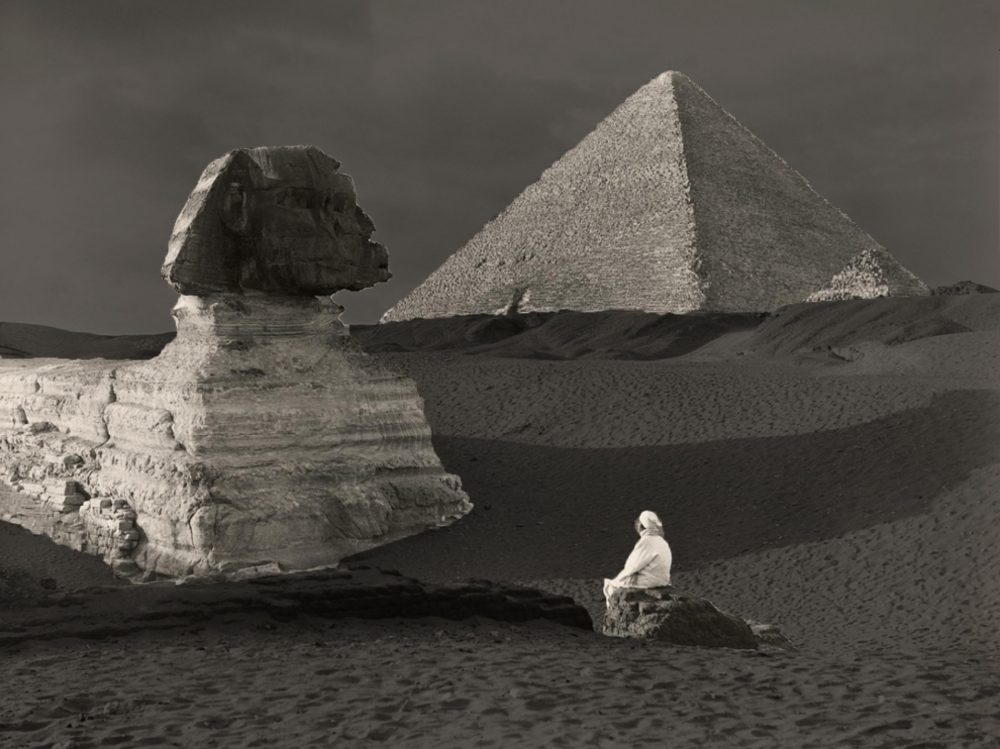
One reason the Sphinx feels different from the pyramids is that it is. The pyramids were built from quarried blocks hauled into place. The Sphinx was carved directly out of the limestone ridge beneath it, with the trench around the body quarried away as the form emerged. In that sense, it is less a statue placed on the landscape than a section of the landscape transformed into a statue. The scale is still hard to absorb. At about 73 meters long and 20 meters high, it remains the largest monumental sculpture to survive from ancient Egypt.
That fact matters because it shapes nearly every argument that follows. Since the Sphinx was hewn from the plateau itself, its body, its enclosure walls, and the stone removed during carving are all part of the same archaeological problem. Those quarried blocks were likely used in the Sphinx Temple just to the east, tying the sculpture to the wider construction logic of Giza. Detailed mapping of the monument and its masonry has only deepened that connection, even as it has shown how complicated the statue’s history became after its first carving. The work published through AERA’s mapping project makes clear that the Sphinx visible today is partly original core and partly a long record of repairs.
That alone gives the monument an unusual biography. It is Old Kingdom sculpture, New Kingdom restoration project, medieval ruin, modern conservation case, and global symbol all at once.
The age fight never really ended
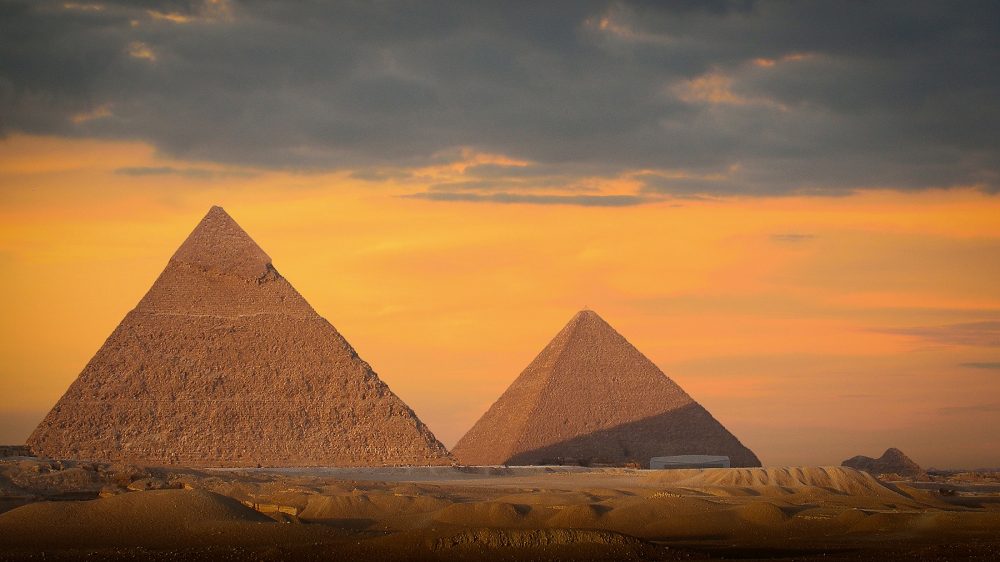
The mainstream date places the Sphinx around 2500 BCE, most often under Khafre, whose pyramid and valley temple sit immediately nearby. The case is circumstantial rather than inscriptional. No surviving text says, in direct and final terms, that Khafre ordered the Sphinx carved. Still, the monument fits the larger plan of the Giza necropolis well enough that many Egyptologists see the attribution as the most likely.
And yet the absence of a decisive inscription has left the door open.
That is where the arguments begin to widen. Some researchers have long held that the weathering on the enclosure walls points to erosion from heavier rainfall than the plateau has known in later historical periods. From there comes the more dramatic claim that the Sphinx could predate the 4th Dynasty by a great margin, perhaps by thousands of years. This is the idea that has given the monument its second life in popular imagination. A monument older than the pyramids. A survivor from some vanished horizon of Egyptian prehistory. A carved lion whose true age was hidden in plain sight.
The problem is not that the idea lacks force. It is that the evidence does not settle it cleanly. Geological arguments over runoff, salt weathering, fissures in the limestone, burial by sand, and phases of exposure have produced more heat than consensus. The conventional dating still holds the stronger archaeological ground, especially when the Sphinx is read as part of Khafre’s landscape. But the older-age argument persists because the monument’s surface does not feel simple, and because the Sphinx has always sat at the border between archaeology and interpretation.
A damaged face, and a face that may have changed
The missing nose is the Sphinx’s most famous wound. The old story blaming Napoleon’s soldiers does not survive contact with the record. Drawings made before Napoleon’s Egyptian campaign already show the nose gone. Later accounts point instead toward deliberate mutilation, likely centuries earlier, part of the long and familiar history of damaged sacred images in Egypt. On Egyptian statues, the nose was a vulnerable and symbolically potent target. Break the face, and you impair the image.
That kind of damage opens a wider question about what the Sphinx originally looked like. The face is heavily weathered and disproportionately small compared with the body, which has encouraged generations of speculation. Some have suggested the head was recarved from an earlier form. Some have argued it was reshaped to resemble Khafre. Others have proposed different royal identities altogether. Even the royal beard is not straightforward. A fragment of the Sphinx’s beard survives in the British Museum collection, and scholars have argued that parts of that beard may belong to a later phase rather than the first carving.
The face also once carried far more visual force than the pale stone suggests today. Traces of red pigment on the face, and hints of yellow and blue elsewhere, show that the Sphinx was not originally the monochrome ruin modern visitors expect. It was painted. The weathered giant that now looks ancient by virtue of its faded stone once had color, surface, and sharper visual control. That lost skin of paint matters because it reminds us that the monument was made to be seen as a living image, not as a romantic ruin.
Beneath the paws
Few ideas around the Sphinx have proved as durable as the thought that something lies beneath it.
This is where archaeology, remote sensing, legend, and modern myth have become tangled. Over the years, geophysical work around the monument has identified anomalies, voids, fissures, and cavities in the limestone. A 1992 geophysical study on the site reported cavities to the sides of the monument and between the paws, findings that helped keep speculation alive about hidden chambers or passages beneath the Sphinx. The paper, published in Geoarchaeology, is often cited because it shows that the subsurface story is not pure fantasy. There are real anomalies in the rock.
That still falls short of a buried archive, a secret chamber, or a hidden library of lost knowledge. The leap from underground irregularities to dramatic revelation is where evidence thins out fast. The Sphinx sits on fissured limestone in a geologically messy setting. Cavities may be natural, cut, reused, or structurally unimportant. Some passages and intrusive holes are known from later periods anyway. The monument has been probed, cleared, patched, buried, exposed, and re-entered for centuries. The ground beneath it is not pristine.
Still, this is one of the reasons the Sphinx never settles down into a museum label. There is enough underfoot to sustain the mystery, and not enough to close it.
A guardian with more than one meaning
The Sphinx is usually described as a guardian, and that is fair as far as it goes. A royal human head on a lion’s body placed before temples and pyramids is a statement of protection, kingship, and divine force. But the monument’s exact function remains less tidy than the usual caption allows.
By the New Kingdom, the Sphinx had become a sacred presence in its own right. The most famous witness to that later life is the Dream Stele of Thutmose IV, set between its paws, where the prince claimed the buried monument promised him kingship if he freed it from the sand. The story, and the later restorations that followed, show that Egyptians themselves encountered the Sphinx as an ancient object already layered with memory. They did not inherit a fully transparent explanation either.
The monument’s orientation has also fed astronomical readings. The Sphinx faces east toward the rising sun, a fact that fits ancient Egyptian solar ideas well enough without strain. More elaborate star theories, especially those tying the monument to the constellation Leo and pushing its date far earlier, remain far more speculative. They survive because the Sphinx invites cosmic language. A colossal lion-bodied figure staring toward the horizon practically demands it. But the firmer ground remains religious and topographical rather than astronomical.
What is easier to state is that the Sphinx has been under repair for a very long time. Ancient restorers patched it. New Kingdom kings repaired and reframed it. Roman-period interventions came later. Modern conservation has continued the same battle against crumbling limestone, salt, moisture, and wind. The monument has endured partly because generations refused to let it collapse.
That long repair history is the clearest way to understand the Sphinx. It is neither a solved monument nor a free-floating enigma. It belongs securely within the Memphis and its Necropolis World Heritage landscape, and the case for a 4th Dynasty origin remains the strongest. But the Sphinx also carries real uncertainties: no definitive builder inscription, a face that may have been altered, subsurface anomalies that resist easy reading, and weathering that still fuels argument. The secret past of the Sphinx is not a single hidden answer waiting under the sand. It is the fact that this monument has had several lives, and we can still see the seams.