
A researcher argues Egypt’s Fourth Dynasty reused the monuments, a view that collides with archaeological and textual evidence tying Giza to Khufu and his successors.
António Ambrósio, an independent researcher who describes himself as trained in Egyptology through Barcelona’s Institut d’Estudis del Pròxim Orient Antic at the Universitat Autònoma de Barcelona, is promoting a claim that the pyramids of Giza were not built for the pharaohs traditionally linked to them. In a short, non–peer-reviewed essay posted online as The Pyramids of Giza: Legacy of an Unknown Civilization, Ambrósio places the complex’s origins roughly 12,000 years ago, long before the start of dynastic Egypt around 3100 B.C.
In this framing, rulers of the Fourth Dynasty did not commission the Great Pyramid and its neighbors. They inherited them and folded them into a royal landscape already standing. “Las pirámides de Guiza no fueron construidas por los faraones de la Cuarta Dinastía, sino que fueron apropiadas por ellos”, he writes.
The core argument: precision first, decline later
Ambrósio’s thesis hinges on what he presents as a reversal of the standard arc of Egyptian monumental building. The pyramids of Giza, he says, show a level of planning and stonework that later pyramids failed to match, so Giza must belong to an earlier, more capable culture.
He points to features often cited in alternative histories: claims of extremely fine granite work in the Great Pyramid’s interior, high-accuracy leveling, and alignments that he treats as evidence of advanced astronomical knowledge. He pairs those claims with a narrative of “technological regression,” arguing that later pyramids’ smaller scale and rougher construction are best explained as imitation attempts by builders who no longer understood the original methods.
The essay also leans on a familiar line in pyramid lore: no royal mummies were found in the three main pyramids. Ambrósio argues that the empty granite sarcophagus in the Great Pyramid is consistent with reuse and symbolic claiming rather than original burial. In his version, later tombs and later pyramids reflect a civilization trying, and failing, to replicate something it did not create.
What mainstream chronology rests on
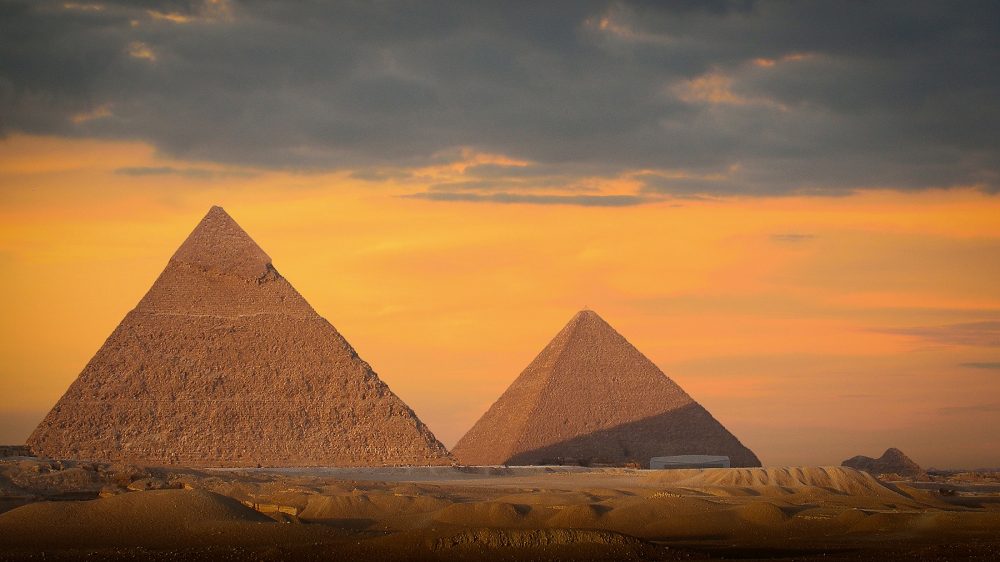
The conventional timeline places the Great Pyramid in the reign of Khufu, with Khafre and Menkaure following, in the mid–third millennium B.C. The case is not built on any single artifact or inscription. It is a mesh of archaeology, texts, landscape planning, and logistics.
A key datapoint is the corpus of Wadi al-Jarf papyri published by the French Egyptologist Pierre Tallet. Among them is the so-called Diary of Merer, a logbook attributed to an official overseeing crews moving limestone by boat from Tura to a place named Akhet-Khufu, widely understood as the Great Pyramid’s ancient name and construction site. The diary does not read like a mythic memory of a vanished superculture. It reads like supply-chain paperwork.
Archaeology on the plateau also points to a large, purpose-built labor and logistics system operating in the Old Kingdom. Excavations by Ancient Egypt Research Associates have documented an extensive Fourth Dynasty settlement south of the Sphinx often described as a workers’ town, with administrative and industrial features consistent with sustained state-directed building.
A parallel strand comes from the monument complex itself: the pyramids at Giza were not built as isolated stone mountains. They were integrated with causeways, temples, and cemeteries laid out in a coherent plan, a pattern that fits the broader development of royal funerary architecture in the Old Kingdom. The Great Pyramid’s broader setting is also treated in standard reference works that place its completion in the early third millennium B.C., including Encyclopaedia Britannica’s entry on the Great Pyramid.
The “missing mummies” point, and what it does and does not show
The absence of royal mummies inside the three main pyramids is real. It is also not, by itself, a timestamp.
Burial theft and disturbance were common across Egyptian history, and pyramids were targeted early. A missing body does not automatically imply the structure never served a king’s funerary program. It can mean the burial was removed, looted, relocated, or destroyed long after construction.
Even within the Giza landscape, there is abundant evidence of royal ritual and commemoration tied to the Fourth Dynasty, including elite cemeteries around the pyramids and material culture associated with royal cults. Museums and scholarly syntheses situate Khufu’s reign squarely in this era, including the Metropolitan Museum’s Old Kingdom overview and related catalog material connected to Khufu’s pyramid complex, such as a mortar specimen linked to the Great Pyramid’s construction context.
The Sphinx, rainfall erosion, and how contested claims get used
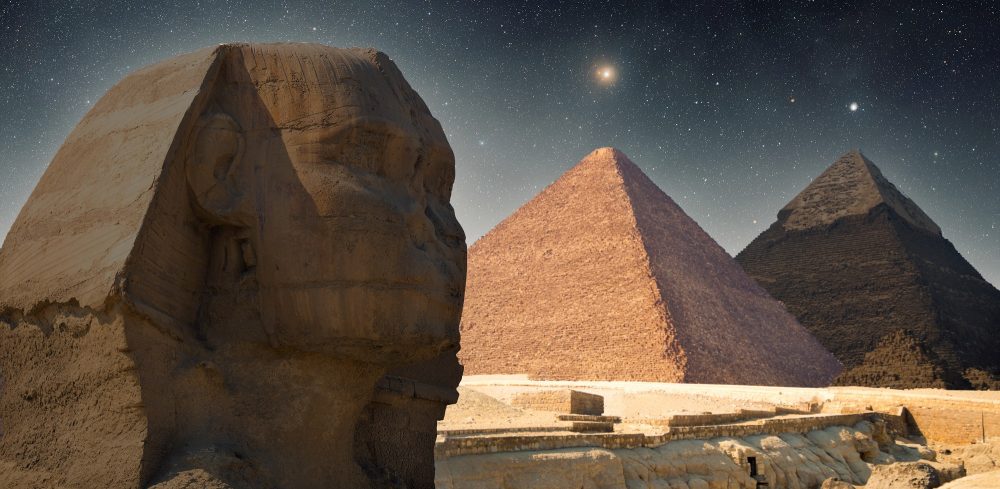
Ambrósio’s essay also borrows heavily from the long-running dispute over the Great Sphinx’s erosion patterns, citing the geologist Robert Schoch, who has argued that rainfall-related weathering implies a far earlier origin than the Fourth Dynasty.
That view has been rejected by many Egyptologists and contested by other specialists who interpret the weathering through different mechanisms, including runoff, local geology, and the monument’s complex conservation history. One often-cited alternative is the engineering geologist Colin Reader, who has argued that water action may matter but does not require a 12,000-year date, and can be framed within a later development sequence at Giza rather than a lost civilization, in work such as his Archaeometry study on Giza’s geomorphology. Documentation of the Sphinx’s long repair history and changing stone “skin” also complicates any simple read of surface wear, as described in institutional summaries of mapping and conservation work like the ARCE Sphinx Mapping Project.
Radar “tunnels” and the modern scanning reality
The Spanish-language summary attached to Ambrósio’s claim also gestures toward radar and satellite scanning reports that circulate online as hints of deep tunnels and chambers under the plateau. Those claims often blur together very different technologies.
There is a legitimate, well-documented modern scanning effort at Giza that has produced results inside the Great Pyramid using muon radiography, including the 2017 discovery of a large void and later work characterizing a corridor-like structure behind chevron blocks, published in Nature Communications. That is about internal spaces within known stone structures.
By contrast, sensational claims of vast deep underground “cities” detected by satellite radar run into basic physics limits. Technical discussions of synthetic aperture radar note severe constraints on penetration into dense materials, and reporting on the viral “underground city” narrative has highlighted that mismatch between method and claim, including a detailed critique in National Geographic.
A disciplined boundary between evidence and interpretation
Ambrósio’s paper sits in a crowded genre: alternative chronologies that treat architectural skill as proof of missing technology, and missing bodies as proof of missing builders. That genre thrives because Giza is genuinely difficult to explain in human terms: scale, organization, and endurance.
Mainstream Egyptology does not claim every construction detail is settled. It does claim the evidence ties Giza to the Fourth Dynasty state: texts that describe logistics, archaeology that shows a labor system, and an integrated landscape of monuments and cemeteries consistent with Old Kingdom royal building.
A horizon exists here too, but it is not a cosmic one. Physics can define what a method can and cannot detect underground; archaeology can define what a text, a settlement layer, or a quarry record can responsibly support. Theology and myth can supply meaning, but they do not supply dates