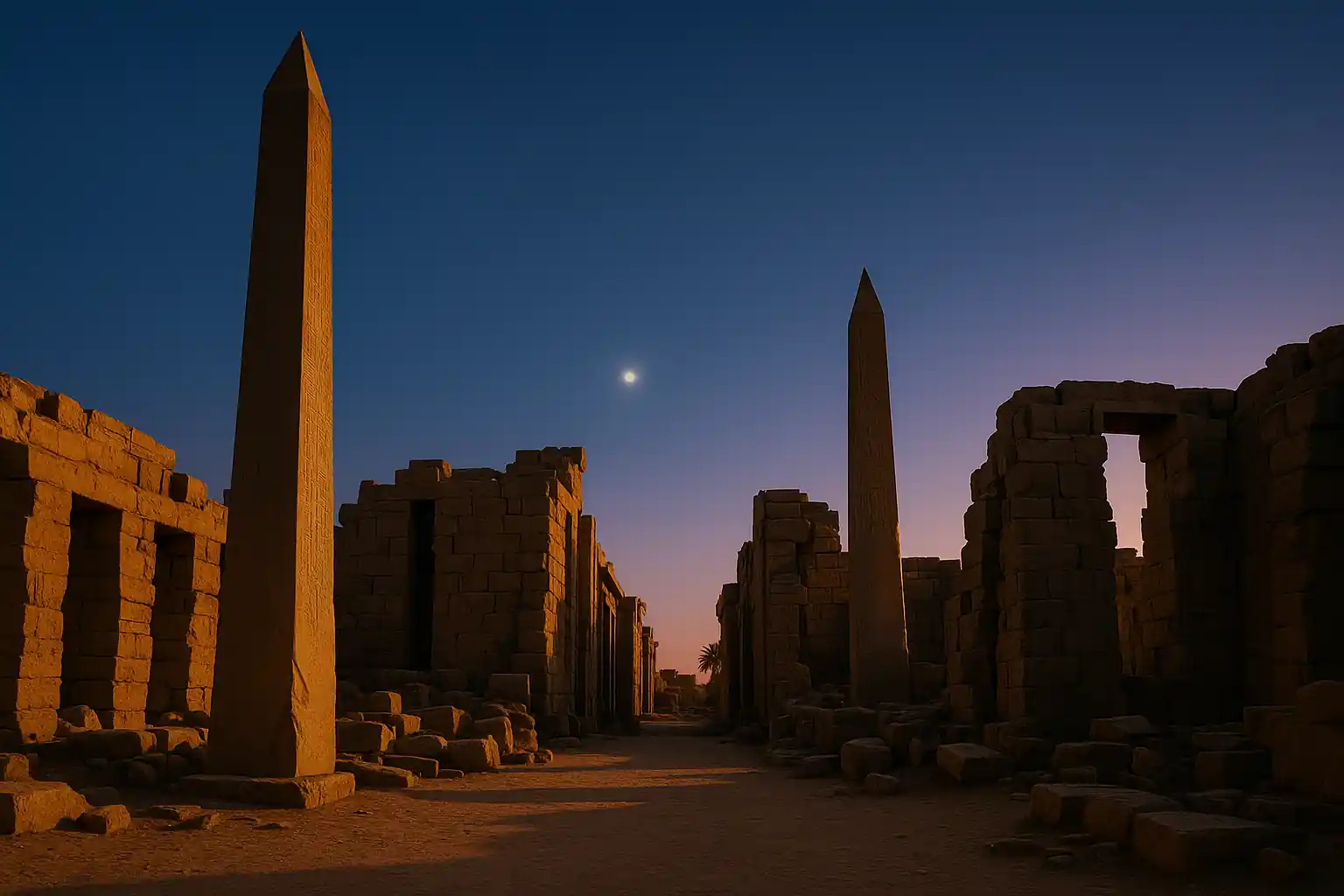
People began measuring time long before they had clocks in any modern sense. They did it with moving shadows, dripping water, returning stars, and repeating lunar phases, and the result was far more exact than the word “primitive” allows.
The surprise is not that ancient societies watched the sky. It is that they turned those observations into working systems that could regulate planting, ritual, navigation, legal speech, and the beginning of a new year.
When a shadow became an instrument
The earliest timekeeper may have been nothing more than a vertical stick. A gnomon, literally a simple upright marker, turned the Sun into a measuring device. As daylight moved, the shadow moved with it, and that motion could be read, compared, and eventually predicted.
In ancient Egypt, this basic idea developed into real instruments. By the New Kingdom, Egyptians were using shadow clocks and sundials to divide daylight into hours, and even monumental forms could read the Sun across open space. A surviving shadow clock in the Metropolitan Museum shows how deliberate the geometry became. This was no idle curiosity. The position of the device mattered, the scale mattered, and the reading changed with the season because daylight itself changed with the season.
Ancient timekeeping did not begin with abstract units floating free of the world. It began with repeated observation of a world that shifted in lawful ways. In Egypt, a noon shadow could help define the season. In China, shadow measurement became part of calendar science and state astronomy. A moving line on the ground became a way to organize labor, ceremony, and the year itself.
There was a limit. A shadow only works when the Sun is there to cast it. Once light failed, another medium had to take over.
When water carried the hours
That medium was water. The clepsydra, or water clock, appears in several ancient traditions, and by the Babylonian world it had already entered the practical business of astronomical timekeeping. In the classic Babylonian evidence, time intervals could be reckoned by the measured flow of water, especially at night when a shadow could say nothing.
The elegance of the device lies in its simplicity. Water escapes or accumulates at a controlled rate. Marks inside a vessel translate that changing level into elapsed time. Yet behind that plain design sat a technical problem. Flow is never perfectly uniform. Pressure changes as the vessel empties. Seasonal hours matter. Ancient makers had to compensate in ways that were practical rather than theoretical, and some Egyptian examples were calibrated month by month because winter nights and summer nights did not last the same length.
Water clocks changed what a society could do after sunset. Temple rituals no longer had to end when daylight disappeared. Night observations of stars could be structured. Later Mediterranean courts even used water clocks to limit speaking time. The device did not create the modern minute, but it did create something just as important for the ancient world, a repeatable interval that could be trusted.
The star that reset the year
Some of the most powerful ancient clocks were not devices at all. They were celestial events with consequences on the ground.
In Egypt, the heliacal rising of Sopdet, or Sirius, its first visible appearance before dawn after a period of invisibility, became one of the great markers of the year. It returned at roughly the same seasonal moment as the Nile flood, the event on which Egyptian agriculture depended. That connection gave a bright star practical force. It also gave it religious and administrative force, because the return of Sirius became tied to New Year reckoning and to the wider ordering of the calendar.
This was not fortune-telling. It was cumulative observation on a civilizational scale. To use a star as a seasonal signal, observers had to know when it vanished, when it returned, where on the horizon it should appear, and how that appearance related to local conditions. Priests and astronomer-scribes were building a durable link between a heavenly pattern and a terrestrial schedule.
The sophistication here is easy to underestimate because the method looks so exposed. There are no gears, no springs, no face, no hands. But the act of recognizing a reliable annual signal in the sky, then tying it to farming and ritual, required long records and disciplined attention.
The Moon as a working calendar
The Moon offered something different. Unlike the Sun, which traces a broad daily arc, the Moon changes shape in ways that almost anyone can follow. New, waxing, full, waning. That cycle made it one of humanity’s most widespread clocks.
Lunar calendars appeared in many cultures because the Moon gave early communities a visible rhythm that could be counted without special instruments. For people who depended on migration, fishing, seasonal travel, or planting windows, that rhythm was useful in immediate ways.
In some traditions, the months or moon phases carried names that tied time directly to work, climate, and scarcity. A “Planting Moon.” A “Fishing Moon.” A “Bone Moon,” when resources ran low. Those names were not decorative. They encoded memory. They linked a cycle in the sky to a cycle on the ground, and they survived because they helped people act at the right time rather than at an abstract hour.
This is where ancient timekeeping begins to feel very different from modern life. Today, a clock gives identical minutes in every setting. Earlier systems often measured something else, the relation between recurring natural signals and the human tasks that depended on them. Time was not only duration. It was timing.
Time cut into earth and stone
Some of the strangest evidence for early timekeeping does not come from clocks at all. It comes from pits, carvings, and marks whose meaning has to be reconstructed long after the people who made them disappeared.
The site at Warren Field, in Scotland, is among the clearest examples. There, a series of pits dating back roughly 10,000 years has been interpreted as a lunar tracking system, with an alignment that also catches the midwinter sunrise and could have reset the count against the solar year. If that reading is right, the site preserves a very old attempt to keep the Moon and the seasons in step.
Elsewhere, the evidence grows more difficult. At Lascaux in France, some researchers have read clusters of dots near animal figures as lunar notation or seasonal tallying, though specific interpretations remain disputed. The famous Cochno Stone, with its dense spirals and rings, is undeniably real and ancient, but translating its carvings into a calendar is another matter. In the Americas, carved spirals, horizon alignments, and solstitial markers show that rock and landscape could be used to hold time in place, even when no writing system was present.
This is where the mystery tightens. Modern archaeology can date a site, map an alignment, and test whether a solar or lunar event fits the layout. What it cannot always recover is the full rulebook in the makers’ heads.
Precision without seconds
That does not reduce these systems to guesswork. It places their precision in the right category. Ancient timekeepers were often less concerned with chopping the day into uniform, context-free units than with catching the correct recurrence, the right dawn, the proper season, the expected star, the safe departure window.
That way of thinking survived far beyond prehistory. Across the Pacific, expert navigators memorized the star compass as a living framework of rising and setting stars, directions, and night movement. Navigation and time were not separate problems. The sky was both map and schedule.
So the baffling part is not that ancient people somehow possessed impossible science. It is that they built dependable systems from observation alone, often across centuries, and sometimes in forms we can no longer fully decode. Their methods were adaptive, local, and exact in the way their world required. Modern clocks measure uniform seconds with extraordinary power. Ancient methods often measured the right moment with extraordinary care