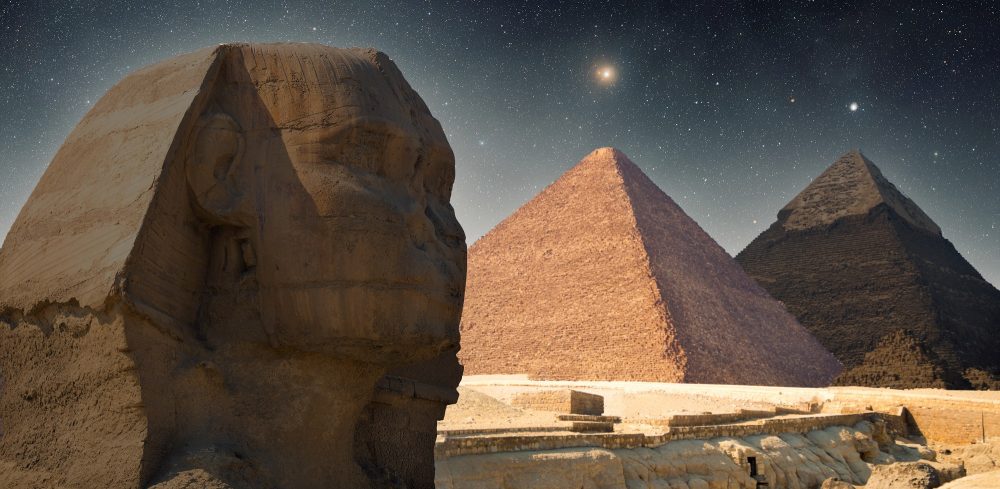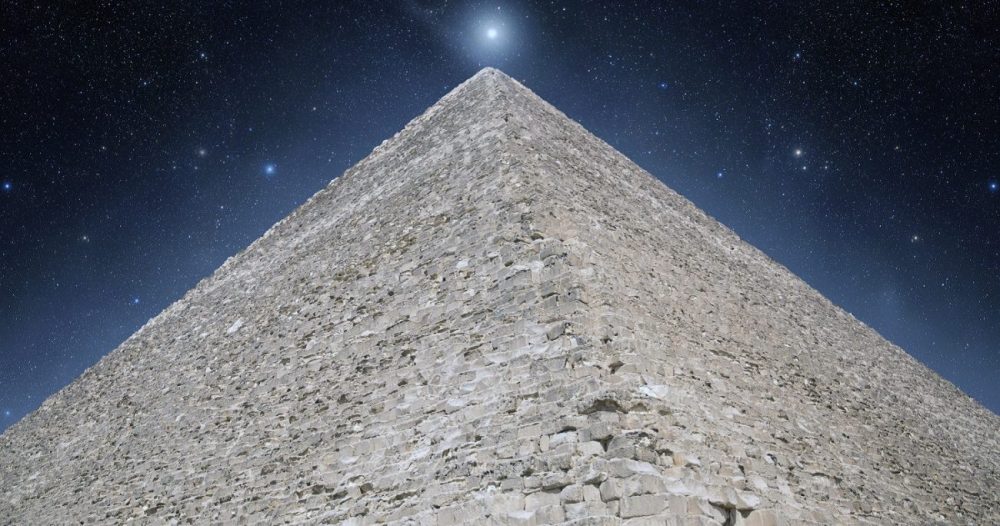

From its scale and finishing to its internal stonework, the Great pyramid remains the clearest case of ancient engineering at national scale.
The Great Pyramid of Giza, beleived to have been built in Egypt’s Fourth Dynasty, is widely identified as the tomb complex of King Khufu among mainstream archaeologists. It is the last surviving monument from the ancient “Seven Wonders” tradition and sits within UNESCO’s listed Memphis and its Necropolis. More than 4,500 years after it rose on the plateau, the pyramid is still the cleanest case study for what ancient Egyptian engineering could do at national scale.
The basics are not in dispute. The debate starts when people try to turn those basics into a single tidy explanation. The structure’s size, its orientation, its internal stonework, and the quality of its original finish add up to an accomplishment that is easy to admire and still hard to reduce to one method.
A building that only works if everything stays under control
The Great Pyramid’s original height is commonly given at about 146.5 meters, and it remained the tallest human-made structure for roughly 3,800 years, according to Egypt’s official heritage portal on the Great Pyramid. Academic summaries of Giza’s main pyramids treat the same order of dimensions, including a base length around 230.3 meters and the original height around 146.6 meters in Harvard-hosted research such as Giulio Magli’s Giza archaeoastronomy paper.
Those numbers matter because they are not just “big.” They are big in a way that punishes error. A square base hundreds of meters across does not tolerate sloppy leveling. A pyramid that rises to that height does not tolerate drifting angles. A monument built in courses cannot “average out” mistakes without showing them as bends, bulges, and cumulative misfit.
Using those measured dimensions, the pyramid’s volume comes out to roughly 2.6 million cubic meters of stone. At that mass, construction is not a single clever trick. It is supply lines, staging, labor discipline, and repeatable checks, sustained year after year.
Millions of blocks, and the reality of hauling stone
Modern estimates commonly cite about 2.3 million stone blocks for the monument. The better sources do not pretend they are counting each one. They converge on the same order of magnitude because the visible masonry, the known dimensions, and the pyramid’s overall mass force that conclusion. A widely read overview from National Geographic describes the structure as composed of an estimated 2.3 million blocks, with typical block weights spanning a broad range.
That range is the point. Online summaries often lock onto one “average” weight. Real construction does not. Most blocks are in the few-ton class, while selected pieces are far heavier, especially where granite was used for critical interior elements.
Granite is not a Giza material. It is associated with Upper Egypt, and the Great Pyramid contains granite in the King’s Chamber system. That alone implies transport planning, heavy handling, and placement accuracy under conditions where a mistake would be expensive and obvious. A peer-reviewed paper in Nature Scientific Reports discusses block numbers and weight ranges in the course of a technical study, reflecting the same basic reality: the pyramid was built from stones of different sizes and masses, deployed deliberately across layers and functions.
Cardinal alignment that still reads as extreme
One of the most stubborn facts about the Great Pyramid is how closely it tracks the cardinal directions. It is not “roughly north.” It is north with a small, measurable deviation that has remained a focus of serious work.
Modern discussions of how Egyptian builders could have established true north often cite arcminute-level deviations and testable surveying procedures. A detailed technical treatment by Glen Dash, including Dorner’s measurements and the arcminute-scale offset for the Great Pyramid, is laid out in a PDF on pyramid true north methods. The important point is not one preferred technique. It is that the final monument preserves evidence of careful astronomical or solar-based surveying, executed with consistency.
This is one reason the pyramid keeps resisting casual explanations. Any workable build method still has to fit the alignment that is there.
The finish that disappeared, but not the evidence
The Great Pyramid today looks rough because its exterior finish is largely gone. In its completed state, it was clad in fine white limestone casing that created smooth faces and a different visual impact. Physical evidence survives. The National Museum of Scotland displays a casing stone attributed to the Great Pyramid, and it is a simple reminder of what the outer surface once looked like: carefully worked stone meant to read as a continuous plane.
This matters for two reasons. First, it adds a finishing phase to any serious construction account. Second, it ties the monument to the administrative reality of quarrying and transport beyond the plateau.
Inside, the engineering gets harder, not easier
The Great Pyramid is not a solid pile with a hollowed-out room. It contains a descending passage, an ascending passage, the Grand Gallery, and chamber systems that sit within a massive stone body. Any interior plan of that complexity adds constraints. Loads have to be managed around voids. Long passages have to meet chamber positions cleanly. Roof systems have to deal with weight in a way that does not fracture.
Granite in the King’s Chamber is the headline feature, but the deeper point is structural intention. The pyramid’s interior makes sense only if the builders were thinking in volumes and forces, not only in stacking.
The oldest papyri, and what they show clearly
Among the few surviving documentary windows into the period are the Wadi al-Jarf papyri, including the Diary of Merer. These texts are widely treated as the oldest known papyri with substantial writing, and they describe organized work and transport, including limestone deliveries from Tura by boat in the later years of Khufu’s reign. A straightforward reference overview is in the entry for the Diary of Merer, and a high-quality narrative treatment is available through National Geographic.
These documents are not a step-by-step construction manual. They do not tell readers which ramp was used, or how blocks were raised course by course. What they do show is that large-scale stone movement was administered, logged, and tied to the Khufu project in language close to the operation itself. That is not “proof of the method.” It is proof of the kind of organized logistics the monument requires.
A modern physics result that the pyramid’s shape makes possible
In recent years, the Great Pyramid has also shown up in a very different type of research: electromagnetic modeling. A 2018 study in the Journal of Applied Physics reported that, under resonance conditions in simulations, the pyramid’s geometry can concentrate electromagnetic energy in specific internal regions and near the base.
This does not establish ancient intent. It establishes something more basic and still striking: the geometry is not trivial. The pyramid’s form can produce measurable effects in modern modeling, simply because waves and shapes interact in predictable ways.
Astronomical targets, shafts, and the limits of certainty
The Great Pyramid’s narrow shafts have long been linked to astronomical interpretations, including claims about Orion-associated stars and ancient pole stars. Scholarly work exists in this area, but it is a field where conclusions depend on angles, epoch calculations, and assumptions about intent. Magli’s Harvard-hosted paper on Giza alignments reflects the kind of interdisciplinary effort that keeps the subject alive: architecture, landscape, and sky brought into one argument.
What can be said safely is that the pyramid’s builders achieved an alignment standard that makes astronomical methods plausible, and the monument retains enough geometric discipline that such claims can be tested rather than merely asserted.
Egypt’s own heritage summary of the Great Pyramid puts the central point plainly: it remains uncertain exactly how the building was done. That uncertainty is not a weakness in the record. It is a reflection of what survives.
The Great Pyramid’s “advanced” reputation does not depend on one sensational hook. It rests on the convergence of hard facts: a structure of exceptional size built with controlled geometry, finished with high-quality casing, oriented with unusual accuracy, and executed with logistics that look like an early form of state-scale project management. The monument has been measured for generations. It still leaves room for argument about the precise steps of its construction, because the finish and the precision are visible, and the full method is not.