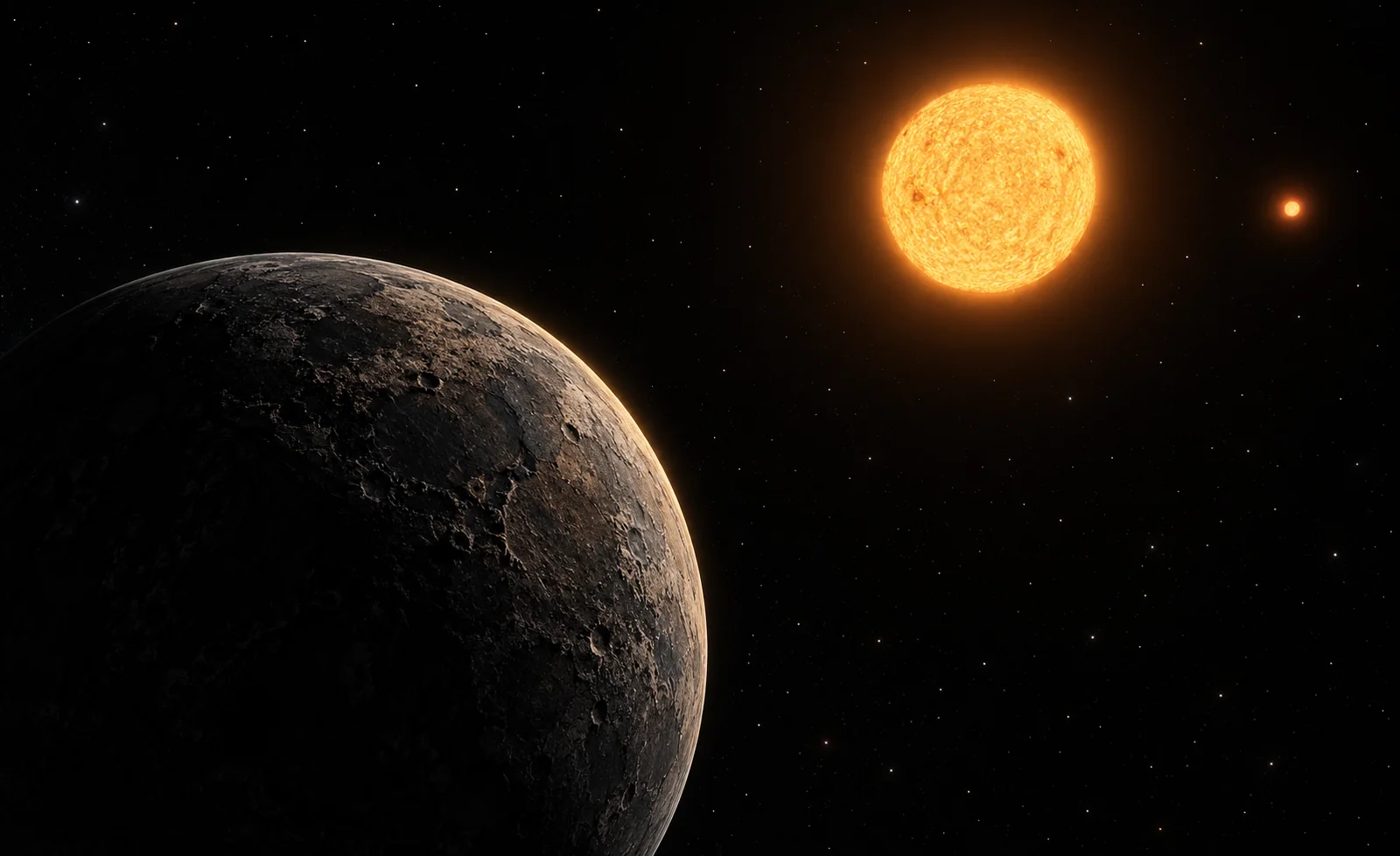
A second sun need not make a planetary neighbourhood impossible. Around 70 Ophiuchi, a binary system roughly 16.6 light-years away, astronomers have identified orbits where an Earth-mass planet could remain stable within the larger star’s habitable zone.
No planet has been confirmed there. The result identifies somewhere worth searching: a region where a small world could survive the gravitational pull of both stars while receiving an amount of starlight compatible with liquid surface water under suitable conditions.
The study combines measurements of the stars’ motion with computer simulations. UC Riverside’s September 29 account describes doctoral researcher Skylar D’Angiolillo placing an Earth-mass test planet at different distances from the primary star and following its orbit. Some locations allow the planet to stay; others can send it into an increasingly elongated orbit or out of the system.
A planet would orbit one of the two stars
The proposed arrangement is different from a planet circling both suns together. Here, the planet would travel around 70 Ophiuchi A, with the other star acting as a more distant gravitational influence.
Imagine tracing a loop around one lamp while a second lamp moves elsewhere in the room. The second star contributes gravity and light, but it does not have to sit inside the planet’s orbit. Whether that arrangement lasts depends on the distances, orbital shapes and orientations involved.
Both stars are smaller and cooler than the Sun. Their measured masses are about 88 and 73 percent of the Sun’s mass. That makes the system a useful nearby test of a question with wider reach: how many apparently complicated stellar neighbourhoods still leave room for smaller planets?
The observations found no convincing planetary signal
In the paper led by Yiting Li, published in The Astrophysical Journal, researchers added 499 measurements of the primary and 334 of the secondary from the Planet Finder Spectrograph in Chile to older observations. They refined the binary orbit and examined whether additional motion might reveal a companion.
They found no coherent planetary signal. The remaining velocity variations were consistent with stellar activity. The observations also restrict what could have escaped detection: under the paper’s assumption that a planet shares the binary’s orbital plane, Jupiter-mass planets inside five astronomical units of the primary are excluded. An astronomical unit is the Earth–Sun distance.
The gravitational modelling places the primary’s stable region out to roughly 2.5 astronomical units, encompassing its habitable zone. Smaller planets remain possible. The absence of a large wobble is therefore compatible with a small world, but it supplies no evidence that such a world formed.
Tilting an orbit changes its prospects
A separate August preprint led by Alyssa Jankowski explored long-term habitability in 70 Ophiuchi, 36 Ophiuchi and Gamma Leonis. Its simulations found promising regions in the two Ophiuchus systems, while the eccentric binary orbit in Gamma Leonis disrupted the modelled habitable zones.
The comparison also shows why an orbital diagram cannot answer everything. Test planets tilted 45 degrees relative to the binary’s plane underwent larger changes in orbital eccentricity than those aligned with it. As a planet’s orbit stretches, the amount of light it receives changes through the year. Surviving gravitationally and maintaining a suitable climate are related questions, but each needs its own calculation.
A search target rather than another Earth
NASA defines the habitable zone through the possibility of liquid water on a planet’s surface. A world in that region still needs appropriate physical conditions. Its atmosphere, composition and climate cannot be read from its orbital distance alone.
The practical contribution of the 70 Ophiuchi work is to narrow the search. A future observation that hints at a planet can be compared with the regions where an orbit is expected to last. Researchers can also judge which nearby stars deserve time on instruments built to find faint companions. Our coverage of the search for Betelgeuse’s companion explores the challenge of separating a faint object’s light from a bright star.
There may be no planet waiting there. But the second sun, by itself, is no reason to leave this neighbourhood unexplored.