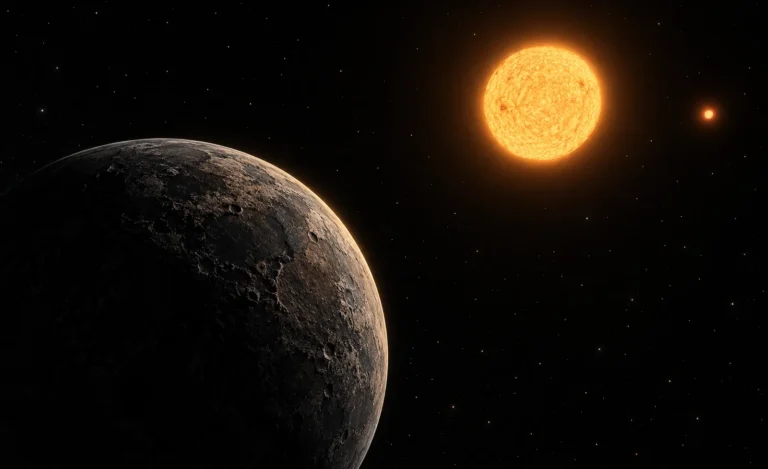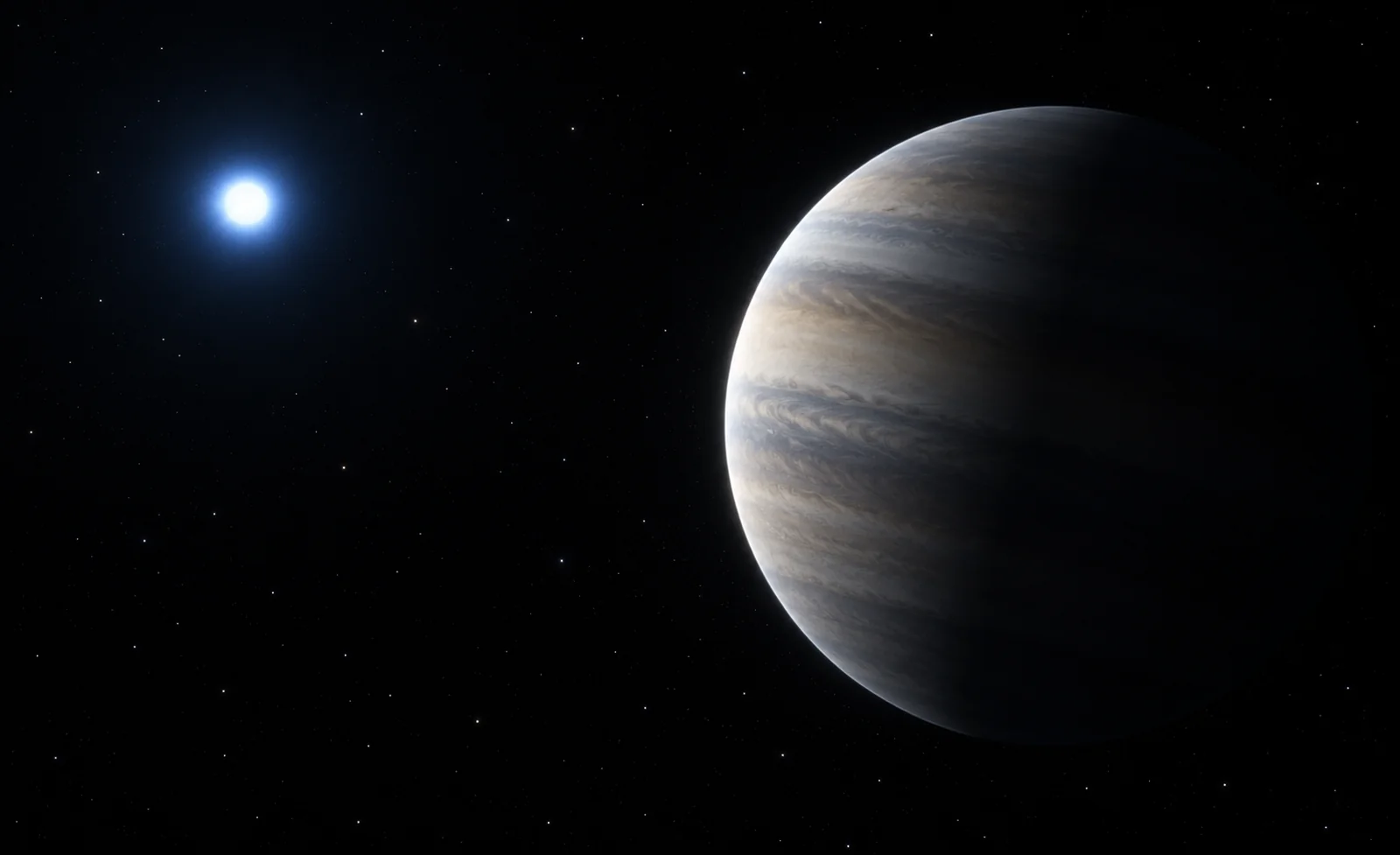
The arrival times of a star’s pulsations may be pointing to an unseen giant planet. Around HD 156295, researchers have identified a tentative signal consistent with a companion roughly 6.3 times Jupiter’s mass, travelling around the star once every 2,200 days.
The result is intriguing because it comes from a kind of star that makes conventional planet hunting difficult. It is also unusually uncertain. The American Astronomical Society’s September 25 summary reports that the authors put the probability of the planetary signal being real at just over 50 percent.
The study, led by Logan Wilson of the Center for Astrophysics | Harvard & Smithsonian, examined 16,440 pulsating Delta Scuti stars observed by NASA’s TESS spacecraft. It selected nine possible substellar companions: eight more consistent with brown dwarfs and the potential planet around HD 156295. The paper appeared in The Astrophysical Journal.
A moving star changes the light’s travel time
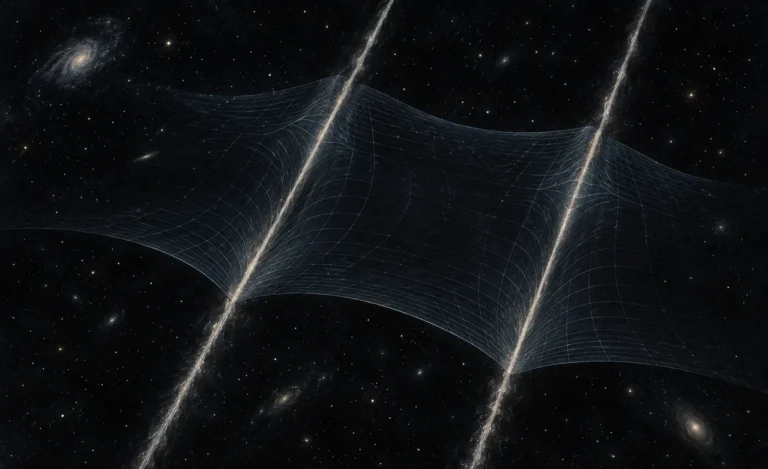
A planet’s gravity moves its star around their shared centre of mass. As the star shifts towards and away from Earth, its light travels a slightly different distance. Regular pulsations can arrive earlier or later as a result.
Picture a clock whose ticks are transmitted to you from a moving platform. The clock may keep a steady rhythm, while the time taken for its signal to reach you changes. In astronomy, the signal travels at the speed of light. Enough precisely measured arrival times can reveal a repeating pattern consistent with an orbit.
This approach has an established history. A 2014 study by Simon Murphy and colleagues used pulsations in Kepler observations to identify stellar binaries. It measured frequencies over long light curves, then followed changes in pulsation phase through shorter intervals. The resulting delay curves carried information about companion orbits.
Several pulsation modes offer a useful comparison. If orbital motion changes the distance to the whole star, different reliable modes should show compatible travel-time delays. A change confined to one mode raises a different question about the star’s own behaviour. That makes comparison across modes part of checking an orbital interpretation.
The star’s changing brightness becomes an instrument
Delta Scuti stars have multiple pulsation patterns. Waves travelling through their interiors make parts of the stars expand and contract, producing brightness variations. Their rapid rotation can complicate those patterns.
NASA described a breakthrough in decoding some of these stars in 2020, when researchers identified a subset with clear pulsation patterns. That work concerned stellar structure. The new companion search puts precisely tracked variability to another use.
The distinction is easy to miss. A dimming caused by a planet crossing a star measures an interruption of the light. Pulsation timing instead measures when an existing brightness pattern arrives. It can therefore investigate companions without requiring them to pass directly between their star and us.
The habitable-zone label describes an orbit
For HD 156295, the proposed companion lies about 3.9 astronomical units from its star, near the outer edge of the calculated habitable zone. That is almost four times the Earth–Sun distance. A hotter star can place this zone farther out than the Sun does.
The habitable zone describes where suitable planets might retain liquid surface water. It is not a statement that every object within it has an ocean, a breathable atmosphere or life.
A companion of the proposed mass would be a giant planet, rather than a second Earth. NASA’s description of gas giants explains why a familiar solid surface cannot simply be assumed. Moons might be an interesting subject for a later investigation, but this study has not detected any around the candidate.
The next observations have a prediction to test
A 2,200-day orbit lasts about six years. If the delay comes from orbital motion, later pulsations should continue a consistent pattern. Longer monitoring could test the proposed period and improve the companion’s estimated properties. Agreement with an independent measurement would strengthen the interpretation further. Direct imaging, such as the observations discussed in our report on Betelgeuse’s companion, follows a different route by seeking the companion’s own light.
For now, HD 156295 is a candidate to follow. The broader promise is the method: variability that once made a star troublesome to observe can, in suitable cases, supply the clock needed to investigate a hidden companion.