Imagine following a route through space and returning to an event that happened before you set off. Your own watch keeps ticking forward throughout the journey. Yet the route brings you into your past.
In 1991, physicist J. Richard Gott III described a spacetime in which that could happen. His paper in Physical Review Letters used two cosmic strings moving past one another at extraordinary speeds. Under the right mathematical conditions, paths around them could form closed timelike curves: journeys that loop back through time.
Cosmic strings remain hypothetical. That makes this a proposal about what gravity might permit, rather than a discovery of a working time machine. Still, the idea raises a wonderful question. If Einstein’s equations can describe such a journey, what might stop nature from making it possible?
What is a cosmic string?
These strings would be narrow concentrations of energy left by changes in the early universe. They are often described as defects in fields, somewhat like boundaries or flaws that remain when a material changes state. Their possible formation depends on the physics of that early transition.
Despite the shared name, they should not be confused with the tiny fundamental strings of string theory. Here the imagined object stretches through space and carries energy along its length.
The LIGO Scientific Collaboration explains that strings could form loops, which would lose energy by emitting gravitational waves. Sharp features on those loops, called cusps and kinks, could produce distinctive bursts.
Before anyone can ask how to navigate around such an object, there is a more basic task: find evidence that the objects exist.
The route Gott found
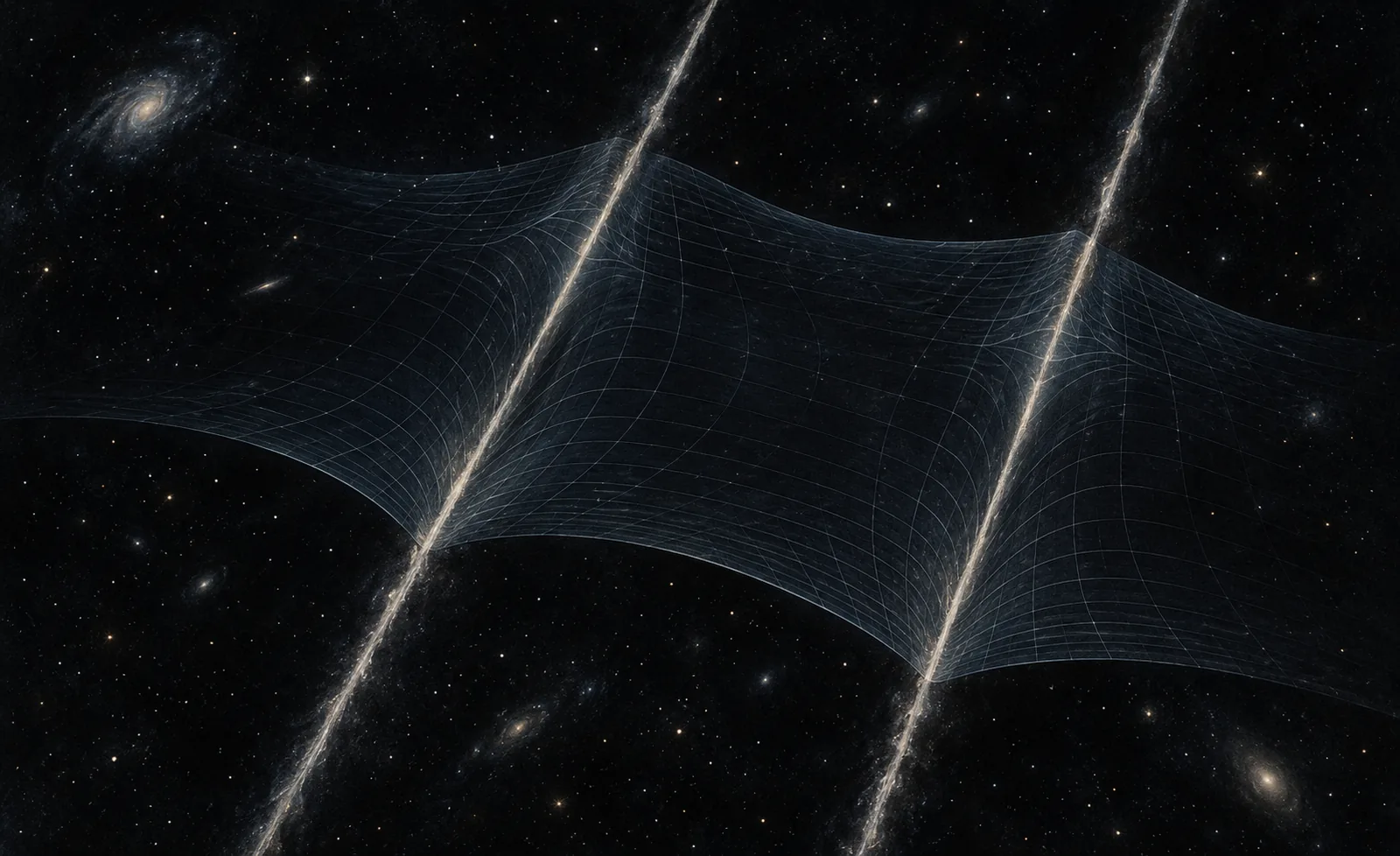
Gott solved Einstein’s field equations for moving straight strings that did not intersect. In the parallel case, the strings passed in opposite directions. Above a speed threshold determined by their energy, the solution contained paths circling the pair that could return an observer to their own past.
A closed timelike curve is a description of a path through spacetime. Along it, a traveler still moves toward their local future. The peculiar result comes from how that path fits into the wider geometry.
The unsettling part is the geometry. A spacecraft’s engines and clock could work normally throughout a journey, while the arrangement of spacetime brings it back to an earlier event.
The calculation also does not tell us that any two strings we might discover would do the job. Their motion and the surrounding universe matter.
Can that arrangement actually be made?
Sean Carroll, Edward Farhi and Alan Guth examined a major obstacle in a 1992 paper. In the equivalent model with two spatial dimensions and time, they found that an open universe with the specified, physically ordinary total momentum could not contain the Gott time machine. Starting with stationary particles and letting them decay would not supply a way to build it.
The restriction concerns the wider spacetime and its energy and momentum. A mathematically described region cannot be treated as something we may insert into any universe we choose.
Gott also discussed whether finite string loops might collapse into black holes before producing the time loops. His original result therefore already carried questions about replacing its idealized strings with physical objects.
The search begins with gravitational waves
A LIGO–Virgo analysis published in 2021 searched data from the third observing run, collected between April 2019 and March 2020. It found no cosmic-string signal. The researchers used the absence to constrain several models of string loops and their gravitational-wave emission.
Those limits depend on assumptions about the loop population and its features. They do not amount to checking every imaginable string and finding none. This was a particular search of a particular dataset, not the final word on the subject.
Our explainer on Planck time and length explores another place where familiar descriptions of space and time reach difficult territory.
For cosmic strings, there are three separate questions to follow: do they exist, can their gravity create the proposed geometry, and can that geometry occur in a physically possible universe? A discovery answering the first would be extraordinary. The route into yesterday would still need answers to the other two.