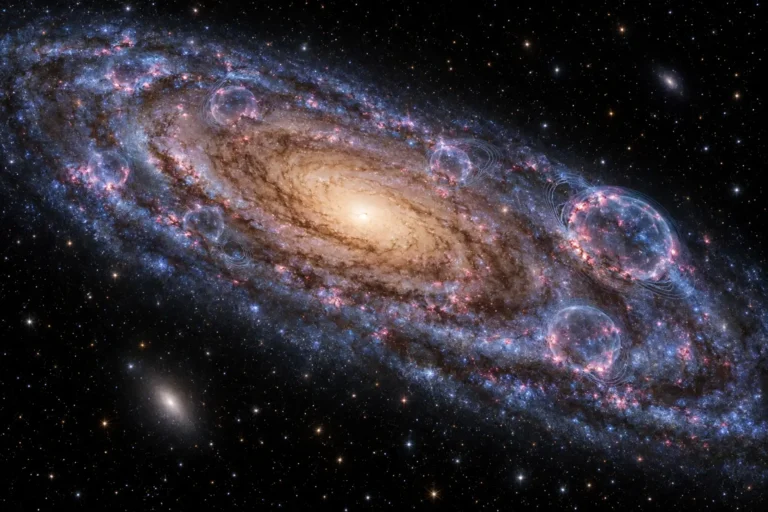
A galaxy can look full of stars and still be running out of a future
The Milky Way is not finished. New stars are still forming inside clouds of cold gas, and the same basic process has shaped galaxies across cosmic time. Yet many galaxies appear quiet: their old stars remain visible, while the supply of new stellar birth has slowed to a trickle.
Astronomers call this transition quenching. The word sounds like a switch, but a galaxy does not always shut down in one dramatic moment. It may lose its cold gas, heat the gas so it can no longer collapse, or stop receiving fresh material from its surroundings. Different galaxies can reach the same quiet state by different routes.
The fuel is cold gas
Stars form when dense pockets of gas collapse under gravity. The gas must cool enough for gravity to win against pressure. A galaxy needs more than a large supply of material; that material must remain in the right physical state.
Observations of distant galaxies have shown that some quenching galaxies still contain substantial gas reservoirs. That result changed the question. If the fuel is present, why are new stars not appearing at the expected rate?
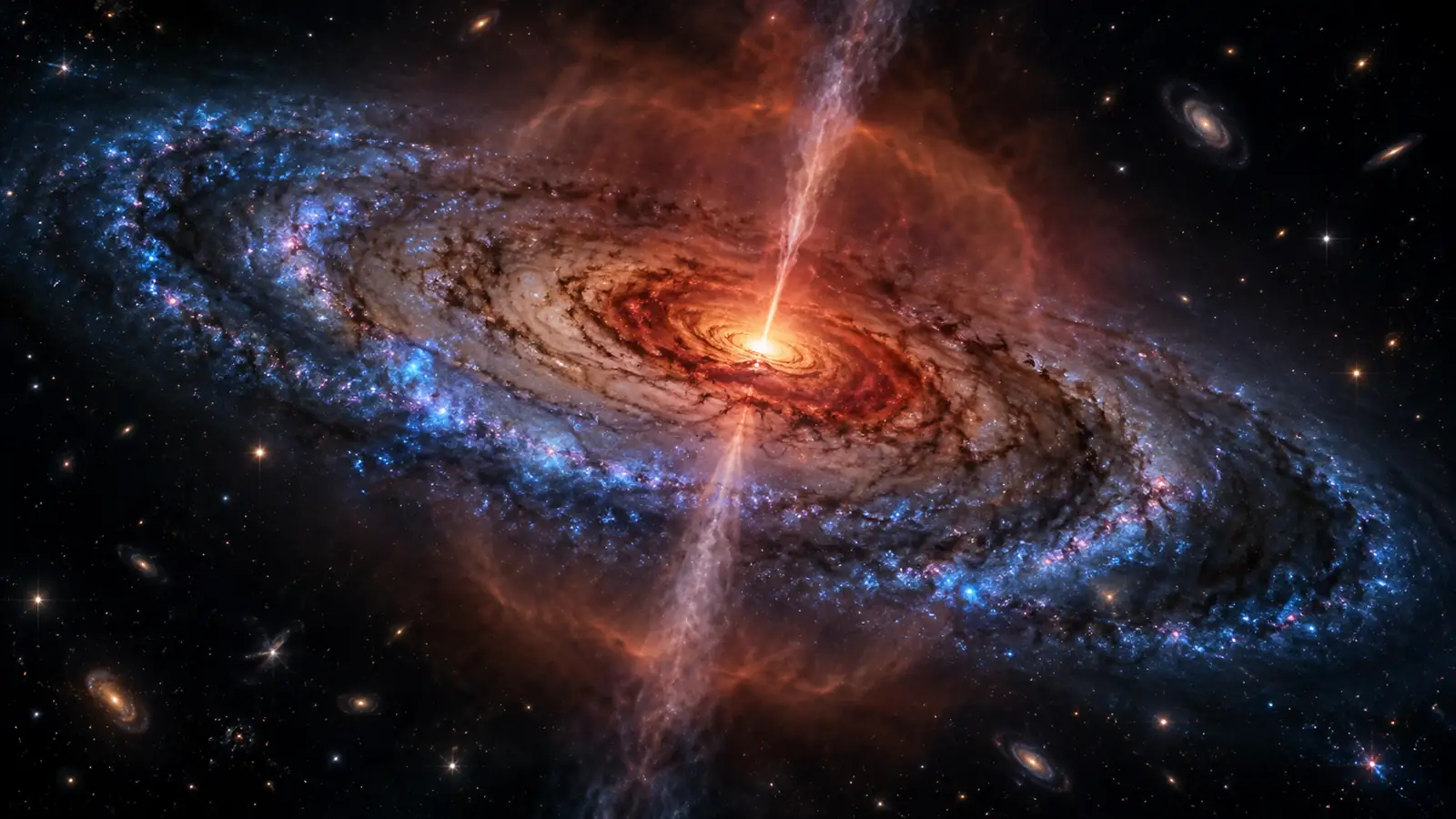
One possibility is that the gas has been heated or stirred. A hot halo around a massive galaxy can prevent cooler material from settling into the star-forming disk. Another is feedback from the galaxy’s central black hole. When matter falls toward a black hole, the surrounding region can release enormous energy through radiation and jets. That energy may heat or expel gas, making it harder for the galaxy to build another generation of stars.
Black holes can influence a galaxy far beyond their scale
The black hole at a galaxy’s centre is tiny compared with the galaxy itself, but its outbursts can reach far into the surrounding gas. NASA’s Chandra observations of galaxy clusters have shown how jets from central black holes can disturb the hot atmosphere around them. In some environments, that activity appears to interrupt the cooling that would otherwise feed star formation.
This does not mean every quiet galaxy is controlled by a black hole. The environment matters. A galaxy moving through a dense cluster can lose gas through pressure from the surrounding medium, like a swimmer feeling water push against an open bag. Smaller galaxies can also be affected by their neighbours, while an isolated galaxy may quench through a slower change in its own gas supply.
A galaxy can stop growing without losing everything
The phrase “dead galaxy” is memorable, but it can hide the physics. A quenched galaxy still contains stars, planets and often some gas. Its history continues in the light of those older stars. The change is that the balance has shifted: the galaxy is no longer adding young stars quickly enough to keep its population blue and bright.
Astronomers measure this change through spectra, colours, gas lines and the distribution of stars. Young, massive stars live briefly and produce distinctive light. When those stars stop forming, their signal fades while older, redder populations remain. The galaxy has not vanished. It has become a record of an earlier era of activity.
Related reading: Start with our guide to what a galaxy is, then see how the same supply problem connects with black-hole jets.
Can a galaxy restart?
Some galaxies do appear to resume star formation after a quiet period. A merger can bring in fresh gas, or a close encounter can compress material in a disk. For the orbital side of that story, see our explainer on why galaxies still collide. That makes quenching less like a one-way death sentence and more like a change in a galaxy’s supply system.
The difficult part is connecting a snapshot to a history. Telescopes see galaxies at different distances and therefore at different moments in cosmic time. A single image cannot show whether a galaxy is entering a quiet phase, leaving one or has been stable for billions of years. Astronomers compare large samples and use simulations to reconstruct the sequence.
The deeper question is why a galaxy stops making stars. It is how the galaxy’s black hole, gas, surroundings and past collisions share responsibility. The answer may differ from one system to the next—which is precisely why a quiet galaxy can be as informative as a spectacular starburst.