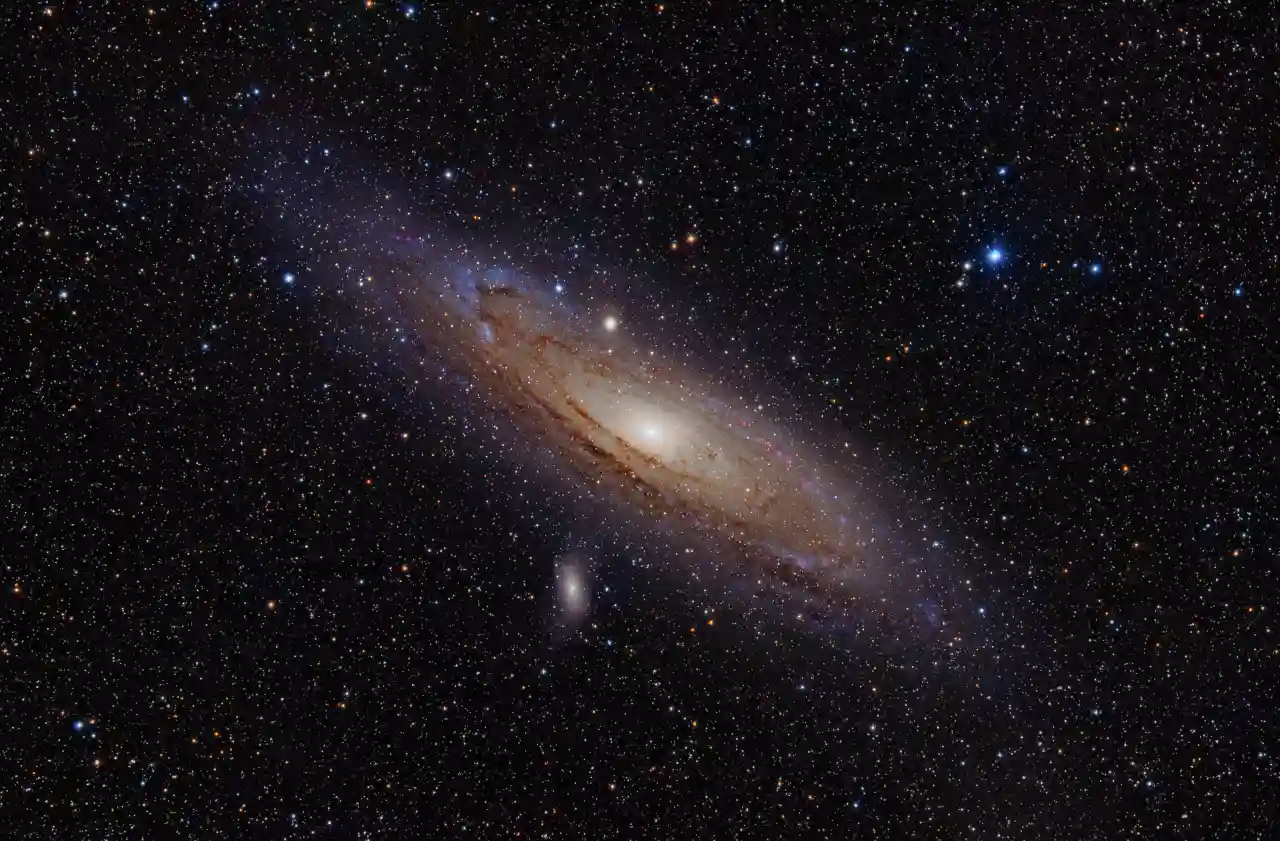
When people picture a galaxy, they often imagine a bright spiral like the Milky Way or Andromeda. The shape is memorable, but it is only the visible part of the story. A galaxy is a vast gravitational system made of stars, gas, dust, stellar remnants, and a much larger component that does not shine: dark matter.
Gravity holds all of those ingredients together. It also shapes the paths of stars, feeds central black holes, and influences whether a galaxy grows quietly or changes after a collision with another galaxy.
What a galaxy contains
Stars provide most of the visible light. Between them lie clouds of gas and dust, the raw material from which new stars can form. Some galaxies are rich in cold gas and still produce stars. Others have used or lost much of their fuel and are dominated by older, redder stars.
At the center of many large galaxies sits a supermassive black hole. The black hole does not pull every star directly into it. At the distances involved, its gravity is part of the wider gravitational field produced by the whole galaxy. When gas falls toward the black hole, however, it can become hot enough to outshine the surrounding stars.
Why dark matter matters
Stars at the outer edges of spiral galaxies orbit faster than the visible matter alone seems able to explain. The leading interpretation is that each galaxy sits inside a broad halo of dark matter. We cannot see the halo directly, but its gravity affects stars, gas, gravitational lensing, and the way galaxies gather in groups and clusters.
Dark matter is not the same thing as dark energy. Dark matter helps pull structures together. Dark energy is the name given to the unknown cause associated with the universe’s accelerated expansion. Keeping those two ideas separate prevents a great deal of confusion.
The main galaxy shapes
Spiral galaxies have rotating disks, winding arms, and often a central bulge. Elliptical galaxies are rounder or more elongated and usually contain older stars with less cold gas. Irregular galaxies lack a neat overall shape, often because gravity from a nearby galaxy has disturbed them.
These categories are useful descriptions, not permanent boxes. A galaxy can change after a close encounter or merger. A collision does not mean that stars crash into one another like cars; the distances between stars are so enormous that direct impacts are rare. The encounter can still rearrange orbits, compress gas, and trigger new bursts of star formation.
Where the Milky Way fits
The Milky Way is a barred spiral galaxy. Our Solar System lies in a minor arm, well away from the central bulge, and takes roughly 230 million years to complete one orbit around the galactic center. That orbit is one reason the night sky changes slowly on human timescales even though the galaxy is constantly in motion.
The Milky Way also belongs to a larger environment of galaxies. Curiosmos has examined the large-scale motion of our galaxy through surrounding structure, and explored the wider cosmic neighborhood in its coverage of the local supercluster.
Galaxies are the universe’s long-term record
When astronomers observe a galaxy, they are reading several histories at once: the ages of its stars, the chemistry of its gas, the path of its dark-matter halo, and the record of earlier encounters. The farther away the galaxy is, the earlier in that history we see it.
That is what makes galaxies so useful. They are not simply destinations in deep space. They are living archives of how matter assembled after the early universe and how gravity continues to shape the cosmos.