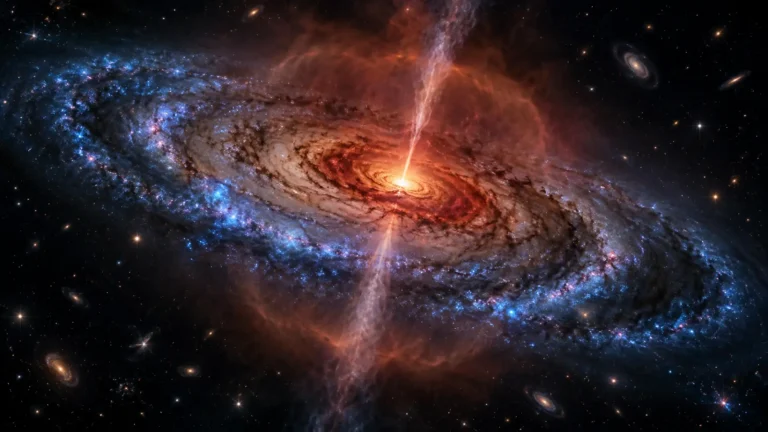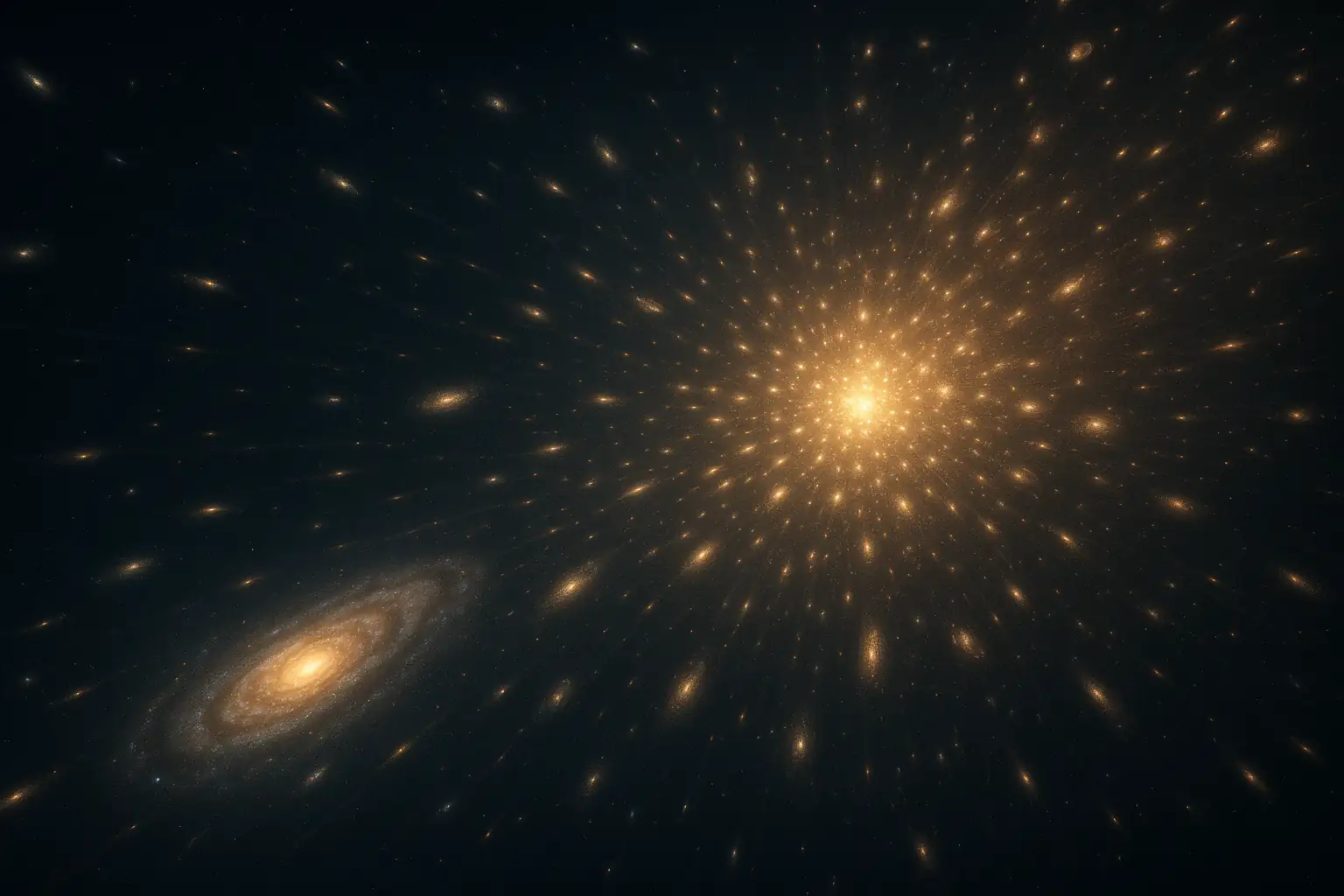
The Milky Way is expanding away from distant galaxies with the rest of the universe, yet it also has a local motion of its own. Our galaxy, together with the Local Group, is moving through space at roughly 600 kilometres per second relative to the cosmic microwave background. For decades, astronomers have traced part of that motion toward a densely populated and partly hidden region of the nearby universe called the Great Attractor.
The name sounds like a single immense object waiting in the dark. It is more interesting than that. The Great Attractor is a region where the gravity of many galaxies, galaxy groups, clusters and dark matter shapes the motion of surrounding galaxies. It is a feature of the cosmic web, not a lone black hole or a mysterious machine at the centre of space.
How astronomers noticed it
Space is expanding, so on the largest scales distant galaxies recede from one another. Astronomers can calculate an expected recession speed from a galaxy’s distance. When a galaxy moves faster, slower or in a different direction than that broad expansion predicts, the difference is called its peculiar velocity.
During the twentieth century, measurements of those peculiar velocities showed that many nearby galaxies appeared to be streaming toward the same broad direction in the sky. The pattern pointed through the plane of the Milky Way, where dust, gas and countless foreground stars hide part of the universe from optical telescopes. That blind strip is called the Zone of Avoidance, and it made the source of the flow unusually hard to map.
By the late 1980s, surveys had identified a major concentration of galaxies in the region of the constellations Norma and Triangulum Australe. The Norma Cluster, also known as Abell 3627, became a central piece of the picture. NASA describes the broader mass concentration in that direction as the Great Attractor, at a distance of roughly 250 million light-years.
Why “attractor” is the right word—and the wrong mental picture
Gravity is doing the work, but the word can encourage a misleading image of everything plunging toward a single target. Galaxies are not being vacuumed into a hole. They sit in an expanding universe while also responding to the uneven distribution of matter around them. Dense regions pull; comparatively empty regions contribute less pull. The observed motion is the sum of many such influences across enormous distances.
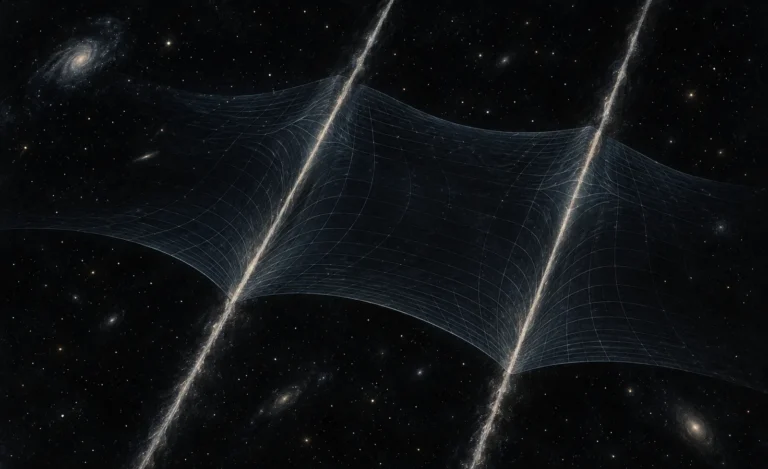
That is why astronomers talk about flows. Picture a landscape after rain: water moves along valleys and around ridges, following the overall shape of the terrain rather than heading toward one visible drain. In the nearby universe, galaxy motions trace a three-dimensional gravitational landscape. The Great Attractor marks a deep and influential part of that landscape.
It is also not an imminent destination. The Milky Way will not collide with the Norma Cluster in any human, planetary or even ordinary galactic timescale. The phrase “pulling the Milky Way” describes a component of our present velocity relative to the general expansion, not a countdown to a cosmic fall.
Seeing through the Milky Way’s blind spot
Mapping the Great Attractor has been difficult because its direction lies close to the crowded, dusty band of our own galaxy. Visible light from remote galaxies is absorbed and scattered by the Milky Way’s dust. Astronomers work around that barrier with infrared observations, radio surveys of neutral hydrogen and measurements of galaxy distances and motions.
Each method fills in a different part of the map. Infrared light penetrates dust better than visible light. Radio telescopes can detect hydrogen in galaxies whose starlight is heavily obscured. Distance measurements let researchers turn a redshift catalogue into a velocity field, separating simple cosmic expansion from the local motion driven by structure.
The result is an evolving map rather than a finished portrait. As surveys improve, astronomers can identify clusters and filaments that had been missing from the Zone of Avoidance and revise how much each structure contributes to the flow.
The Great Attractor inside Laniakea
In 2014, a team led by R. Brent Tully used galaxy velocity data to define Laniakea, the supercluster region that contains the Milky Way. The name comes from Hawaiian and means “immense heaven.” The study described Laniakea as a basin of attraction: a volume whose internal galaxy flows converge toward a common region.
That work placed the Great Attractor in a clearer setting. Laniakea includes the Virgo Cluster, the Norma, Hydra and Centaurus clusters, the Pavo-Indus filament and neighbouring voids. The Great Attractor is therefore best understood as a local convergence area inside a larger web of structures, not as an isolated object with a neatly defined edge.
The Laniakea map made a familiar idea visual. Galaxies do not form a random spray. They inhabit filaments and clusters separated by emptier regions, and their motions preserve the memory of how those structures grew. The Milky Way is a tiny participant in that flow, not an observer standing outside it.
Why Shapley and the voids matter too
The Great Attractor is influential, but it is not the whole story. Farther away lies the Shapley Concentration, a remarkably massive collection of galaxy clusters. Studies of cosmic flows have argued that Shapley contributes strongly to the motion seen in our region. A 2017 analysis also showed that an underdense region—a “dipole repeller”—can matter almost as much as an attractor in shaping the direction of the local flow.
That language can sound strange because voids do not repel through a new force. A void has less matter than its surroundings, so there is less gravitational pull from that direction. In a map of relative motions, the effect can look like galaxies are being pushed away, even though ordinary gravity remains the only force in the calculation.
This is why a simple answer such as “the Great Attractor pulls everything” no longer captures the full picture. The local universe is governed by overlapping structures: nearby clusters, the Great Attractor region, Shapley and the broad distribution of matter between them. The map has become richer, not less mysterious.
What remains hidden
The Zone of Avoidance still limits what we can see directly, even with modern surveys. New radio and infrared data continue to reveal galaxies and clusters behind the Milky Way’s disk. Better distance catalogues will also refine the velocity field and test where the major basins of attraction begin and end.
That is part of the Great Attractor’s lasting appeal. It began as a discrepancy in galaxy motions and became a lesson in how science maps an unseen universe: not by one spectacular photograph, but by combining distance estimates, redshifts, cluster catalogues and the subtle drift of thousands of galaxies.
The Great Attractor is real in the sense that the gravitational flow is real. Its exact role is more nuanced than the name suggests. It is a nearby crossroads in the cosmic web, partly hidden behind our own galaxy, and it helped show that the Milky Way’s motion is written into a much larger map.
Sources
NASA Hubble: the Norma Cluster and Great Attractor region
Tully et al., “The Laniakea supercluster,” Nature (2014)
Hoffman et al., “The dipole repeller,” Nature Astronomy (2017)