Expansion does not push every galaxy away
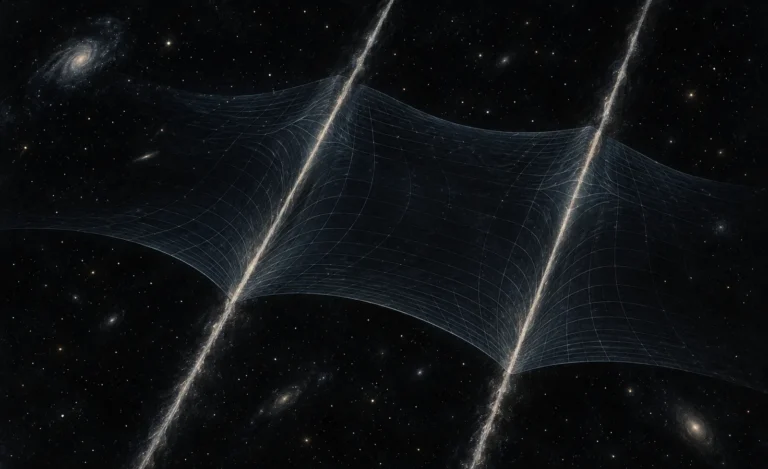
The phrase “the universe is expanding” can sound as though every galaxy must move away from every other galaxy. That is not how the process works on smaller scales. Cosmic expansion becomes the dominant effect across enormous distances, while gravity can keep nearby galaxies bound together.
The Milky Way and Andromeda are a familiar example. Both galaxies are part of the Local Group, a collection of galaxies held together by gravity. Their local motion matters more than the general expansion of space between faraway, unbound systems, so Andromeda is moving toward us.
The same balance appears elsewhere. A pair of galaxies can drift closer because of their mutual gravity even while the space between much more distant groups continues to expand. There is no contradiction: the two statements describe different scales and different kinds of motion.
What actually happens in a galactic collision
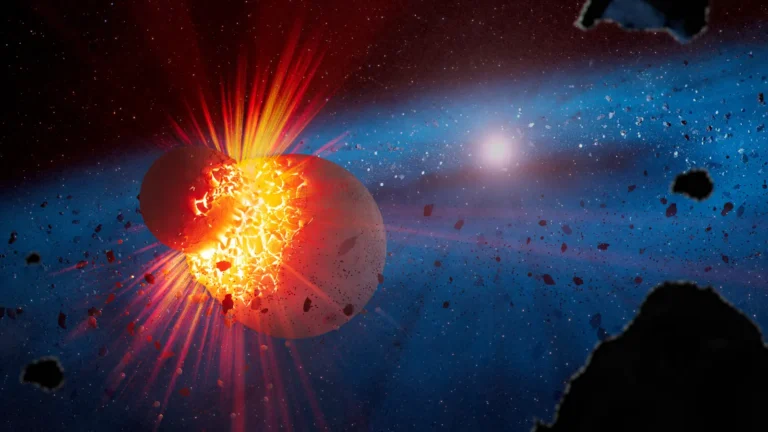
A galaxy is mostly empty space. Its stars are separated by enormous distances, so a merger is unlikely to involve stars smashing into one another like cars in a road accident. The gravitational fields of the two galaxies begin reshaping them long before the centres meet.
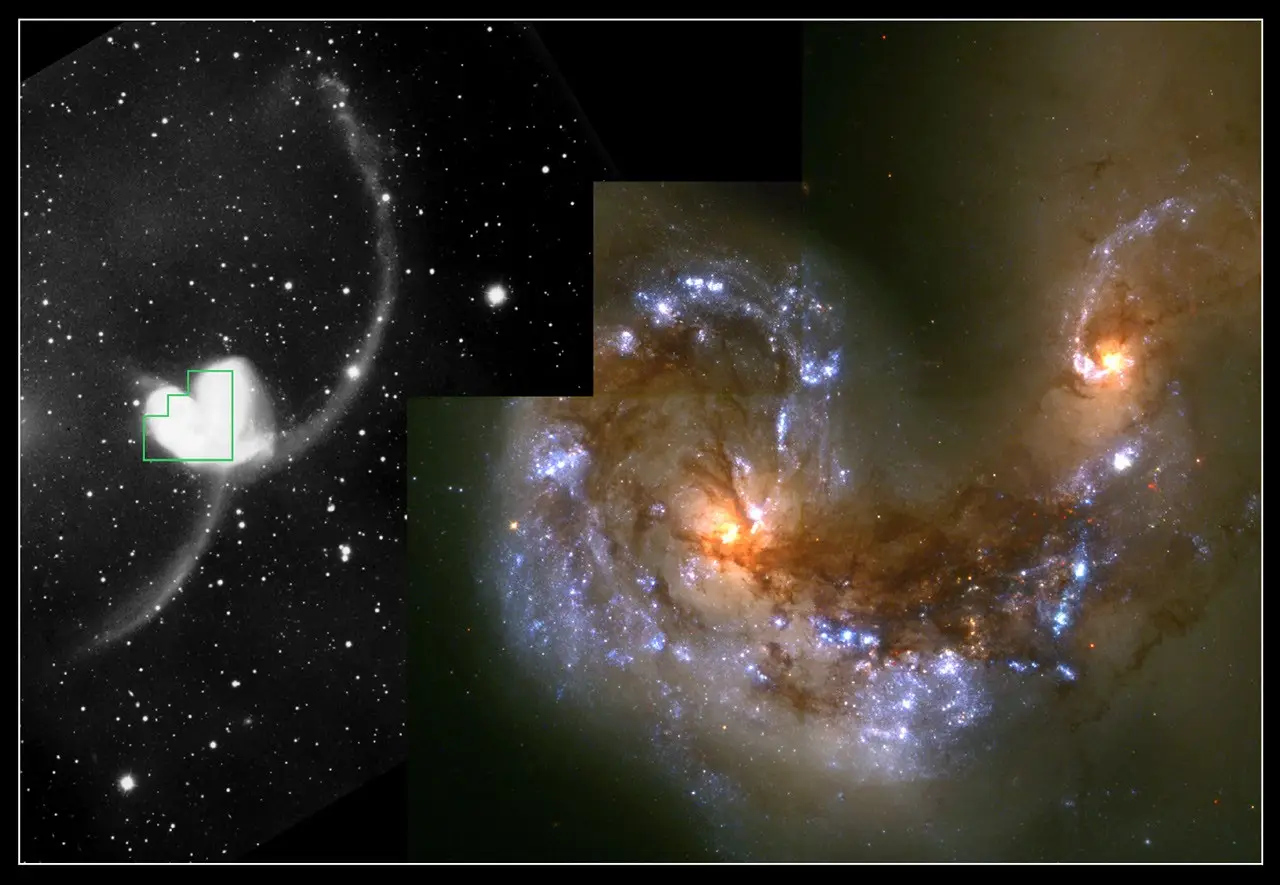
As the galaxies pass close to one another, their spiral arms can stretch into long tidal tails. Gas clouds are compressed, and that pressure can trigger new waves of star formation. Dust lanes buckle, stellar orbits change, and the galaxies may lose the clean shapes they had before the encounter.
The first pass may not finish the interaction. If the galaxies do not have enough speed to escape each other, gravity pulls them back for another encounter. Over hundreds of millions or billions of years, the pair can settle into one larger system.
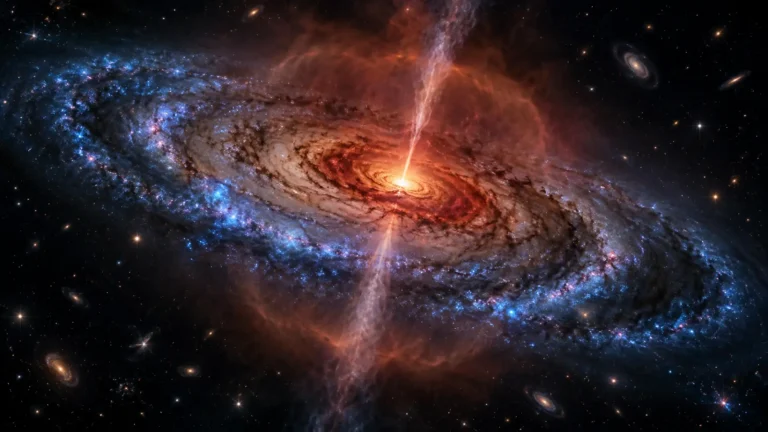
The final object may look very different from either parent. A merger between spiral galaxies can produce a disturbed remnant, while repeated interactions can help build a larger elliptical galaxy. Material driven toward the centre may also feed a supermassive black hole and make the core unusually bright.
Why the expansion of space does not stop local mergers
Cosmic expansion describes how distances between very distant, unbound regions change over time. A gravitationally bound system does not expand in the same simple way. The Milky Way, the Solar System, and even the atoms in your body are held together by forces that overwhelm the tiny effect of cosmic expansion at their scale.
The Local Group is larger and more complicated, but the principle is similar. Its members share a gravitational environment. Their individual velocities, dark-matter halos, and past encounters determine what happens inside the group. The expansion of the universe becomes important outside the group, where gravity is not strong enough to keep every structure together.
That is why astronomers can observe distant galaxies receding faster with distance while also seeing nearby galaxies with blue-shifted light. Blue shift means the local motion toward us is strong enough to outweigh the redshift expected from expansion in that particular neighbourhood.
Why collisions help galaxies grow
Galaxies are not finished objects that simply sit in space. They grow by collecting gas, forming stars, and merging with smaller systems. Interactions can move gas into central regions, stir up star formation, and redistribute stars over much larger orbits.
The process also leaves clues. Astronomers look for tidal tails, shells, warped disks, double nuclei, streams of stars, and unusually young clusters. Computer simulations can then test whether a particular pattern is consistent with two galaxies passing close together or merging.
Hubble images of interacting systems show that collisions unfold slowly. A single photograph captures one stage of an event that may last hundreds of millions of years. Across a large survey, however, astronomers can compare many systems at different stages and reconstruct the sequence.
The long future of the Milky Way
Andromeda’s approach does not guarantee a merger. A 2025 analysis reported by NASA, using Hubble and Gaia measurements, estimated roughly a 50% chance of a collision within the next 10 billion years. Uncertainties in the galaxies’ motions and the gravitational influence of neighbouring galaxies allow different futures. If a close encounter happens, it can rearrange stellar orbits even though individual stars are very unlikely to strike one another.
The important distinction is scale. The universe can expand overall while gravity continues to build structure locally. Galaxies collide because they belong to bound neighbourhoods where gravity still has the stronger hand; distant unbound galaxies recede because the space between them is expanding.
Continue reading on Curiosmos
- The Great Attractor: What Is Pulling the Milky Way Through Space?
- What Does the Universe Expand Into?
- How Can the Universe Be 93 Billion Light-Years Across?